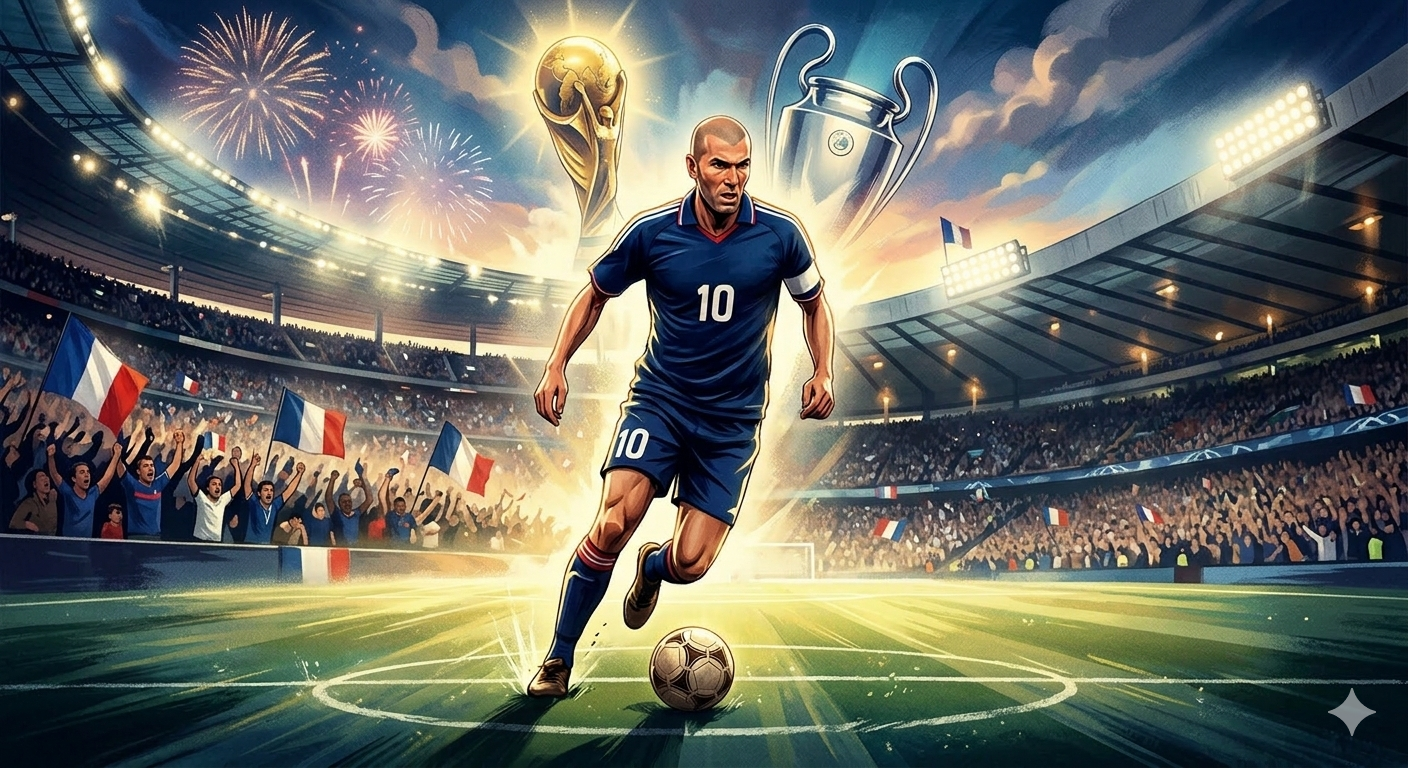
There are four moments that define Zinedine Zidane's career, and they span the full spectrum of human experience: two headers in a World Cup final that made him a national hero; a volley in a Champions League final that France Football later voted the greatest goal ever scored in the competition's history; and a headbutt in the last minutes of his final professional match that brought everything to an end in the most theatrical way imaginable. Between those four moments sits one of the most complete careers the sport has ever produced. Zinedine Yazid Zidane won the FIFA World Player of the Year award three times, the Ballon d'Or once, the World Cup, UEFA Euro 2000, the Champions League and La Liga — and was named the Golden Ball winner at the 2006 World Cup despite being sent off in the final. No career in football history has ended in quite the same way, and very few have contained quite as much.
Chapter I: La Castellane — A Child of the Banlieue
Zinedine Yazid Zidane was born on June 23, 1972, in Marseille, in the south of France. His parents, Smaïl and Malika, had emigrated from the Kabyle Berber region of Algeria in 1953 — a decade before Algerian independence — and settled in the working-class neighbourhood of La Castellane, one of the most deprived housing estates in France. Zidane grew up the fourth of five children. The family apartment faced a concrete courtyard; the courtyard had a surface that passed for a football pitch; the football pitch was where he spent every available hour.
He joined AS Cannes at age fourteen, making his professional debut on May 20, 1989, at just sixteen years old — coming on as a substitute and scoring twice in a 4–0 win against Nantes. It was, by any measure, an introduction. He spent three seasons at Cannes before Girondins de Bordeaux signed him in 1992 for approximately €3.5 million. At Bordeaux, under coach Rolland Courbis, he scored 39 goals in 139 appearances over four seasons and reached the UEFA Cup final in 1996 — losing to Bayern Munich on away goals. That spring, France hosted UEFA Euro 1996 qualifying; Zidane won his first senior cap for the national team in August 1994. By the summer of 1996, Juventus had seen enough.
Chapter II: Juventus — Five Seasons, Two Titles, Three Finals
Juventus signed Zidane in the summer of 1996 for €3.5 million — a fee that would seem almost comically modest five years later. Under coach Marcello Lippi, he was given the freedom to operate as a deep-lying playmaker behind the strikers, receiving the ball in space, turning at pace and dictating the rhythm of the game. Italian football, then the most tactically sophisticated in the world, gave him the environment to refine everything he already possessed.
He won two Serie A titles at Juventus — in 1996–97 and 1997–98 — and reached the Champions League final in both 1997 and 1998, losing narrowly to Borussia Dortmund and Real Madrid respectively. A third consecutive final appearance in 2003 would come after his departure, but the template for the run was largely his work. In five seasons at Juventus he scored 31 goals and provided a volume of assists that the statistics of the era did not fully capture. He was named the Serie A Foreign Footballer of the Year twice — in 1997 and 2001 — and the FIFA World Player of the Year in 1998. The world record transfer that followed was, in the context of what he had done, entirely logical.
Career Statistics by Club
| Club | Country | Years | Apps | Goals | Notable |
|---|---|---|---|---|---|
| AS Cannes | France | 1988–1992 | 61 | 6 | Professional debut at 16; sold to Bordeaux for €3.5m |
| Girondins de Bordeaux | France | 1992–1996 | 139 | 39 | UEFA Cup final 1996; first senior France cap (1994) |
| Juventus | Italy | 1996–2001 | 212 | 31 | 2× Serie A; 2× UCL final (lost); 2× FIFA World Player of the Year; Ballon d'Or 1998 |
| Real Madrid | Spain | 2001–2006 | 227 | 49 | 1× La Liga; 1× Champions League; 1× FIFA Club World Cup; world-record transfer €77.5m |
All competitions included. Career club total: 639 appearances, 125 goals. International record: 31 goals in 108 caps for France. Zidane's €77.5 million move to Real Madrid in 2001 remained the world-record transfer fee for eight years.
Chapter III: Real Madrid — The World Record and the Volley
In the summer of 2001, Real Madrid paid Juventus a world-record €77.5 million for Zidane — a fee that eclipsed the previous record and remained the most expensive transfer in history for the next eight years. Real Madrid's official profile of Zidane describes him as a player who "won everything that could possibly be won" with the club — a record that was sealed in his very first season with the Champions League title in Glasgow. The goal he scored in that final became the image by which his entire career would be remembered.
On May 15, 2002, at Hampden Park in Glasgow, Real Madrid faced Bayer Leverkusen in the Champions League final. The match was level at 1–1 when Roberto Carlos collected the ball on the left flank and sent a cross into the penalty area. The ball was rising, dropping, spinning — almost impossible to control. Zidane had drifted to the edge of the box. He watched it onto his left foot — his supposedly weaker foot — and in one pivoting motion struck a volley that rose into the top corner before the goalkeeper could react. Zidane himself described it as a "once in a lifetime" goal — adding that winning the Champions League trophy that night was one of his greatest memories alongside lifting the FIFA World Cup. France Football later selected it as the greatest goal ever scored in a Champions League final.
The minute in which Zidane's volley was struck at Hampden Park — from a Roberto Carlos cross that the assist provider himself later claimed was "terrible." Leverkusen goalkeeper Jörg Butt never moved. France Football subsequently voted it the greatest goal ever scored in a Champions League final. "To score in such a way in the Champions League — if it has to happen once in a lifetime, well it happened that night in the final." — Zinedine Zidane
Chapter IV: The Numbers Behind the Dominance
Zidane's output across his career was not defined by volume — he was never a prolific scorer in the conventional sense — but by the quality and timing of his contributions. His peak at Real Madrid and Juventus produced statistics that, in their context, remain exceptional for a player whose primary function was creation rather than finishing. Across 506 top-five league appearances for Cannes, Bordeaux, Juventus and Real Madrid, Zidane scored 95 league goals — a return that, for a central playmaker who dropped deep to receive and distribute, places him among the most productive of his position in the modern game.
| Season | Club | League Goals | UCL Goals | All Comps Goals | Award |
|---|---|---|---|---|---|
| 1996–97 | Juventus | 5 | 2 | 7 | Serie A title · UCL final (lost to Dortmund) |
| 1997–98 | Juventus | 7 | 1 | 9 | Serie A title · Ballon d'Or · FIFA World Player of the Year · UCL final (lost to Real Madrid) |
| 1998–99 | Juventus | 2 | 1 | 5 | Banned for headbutt vs Hamburg; UCL group-stage exit |
| 2000–01 | Juventus | 6 | 3 | 10 | FIFA World Player of the Year · Serie A Foreign Footballer of the Year |
| 2001–02 | Real Madrid | 7 | 4 | 12 | Champions League winner · UCL final volley vs Leverkusen · La Liga |
| 2002–03 | Real Madrid | 9 | 3 | 13 | FIFA World Player of the Year · FIFA Club World Cup |
| 2003–04 | Real Madrid | 5 | 2 | 8 | Injury-disrupted season; 17 games missed |
| 2004–05 | Real Madrid | 6 | 2 | 9 | Retirement announced; returned for 2005–06 |
| 2005–06 | Real Madrid | 9 | 3 | 12 | Golden Ball 2006 WC · retired after World Cup final |
All competitions. Zidane won the FIFA World Player of the Year award in 1998, 2000 and 2003 — one of only four players to win it three or more times. His Ballon d'Or came in 1998, the same year France won the World Cup on home soil.
Five Goals That Defined a Career
| Date | Match | Club | Description |
|---|---|---|---|
| Jul 1998 | France vs Brazil (WC Final) | France | Two headed goals from corners in a World Cup final — a player not renowned for heading, scoring the two most important headers of his life in the biggest game of his generation. France won 3–0. His image was projected onto the Arc de Triomphe. |
| Jun 2000 | France vs Portugal (Euro 2000 SF) | France | A penalty in the 117th minute for a golden goal that sent France to the final — converted with a chip, the calmest penalty imaginable under the most extreme pressure. Zidane later said Euro 2000 was the tournament where he was at his peak. |
| May 2002 | Real Madrid vs Leverkusen (UCL Final) | Real Madrid | The volley at Hampden Park — left-footed, from a dropping Roberto Carlos cross, struck on the turn into the top corner. France Football voted it the greatest goal ever scored in a Champions League final. Zidane called it once in a lifetime. |
| Jun 2004 | France vs England (Euro 2004 GS) | France | Two goals in injury time to overturn a 1–0 deficit — a free-kick into the top corner in the 91st minute, then a penalty in the 93rd. France had been heading out of their own tournament. Zidane dragged them back in. |
| Jun 2006 | France vs Italy (WC Final) | France | A Panenka penalty to open the scoring in the World Cup final — the most audacious method of penalty in football, attempted in the biggest match of his career, at 33, in what would be the last goal he ever scored. The chip clipped the underside of the bar on the way in. |
Chapter V: France — From La Castellane to the Arc de Triomphe
Zidane's international career with France spanned 108 caps and 31 goals from 1994 to 2006, and contained two of the most celebrated tournament campaigns in the history of the sport. The first came in 1998, when France hosted the World Cup and Zidane delivered the performance that made him a national icon. In the 1998 World Cup final against Brazil — the holders and overwhelming favourites — Zidane scored twice with headers from corners, becoming the unlikely match-winner in a 3–0 victory that delivered France's first World Cup title. France coach Aimé Jacquet said afterwards that heading was "not his forte" but that Zidane had been "determined to get to those corners — and he did". That night, his face was projected onto the Arc de Triomphe in Paris. He was twenty-five years old.
Two years later came the chapter that Zidane himself considered his finest. At UEFA Euro 2000, Zidane was named Player of the Tournament as France became the first reigning World Cup holders to win the European Championship — with UEFA's technical director Andy Roxburgh commenting that Zidane had "made in heaven" printed on his head. France defeated Italy 2–1 in the final with a golden goal from David Trezeguet, but it was Zidane who had driven them there — scoring the golden goal penalty against Portugal in the semi-final, and providing the pass from which Wiltord levelled in the final.
Chapter VI: Roberto Carlos's Cross and the Goal of a Lifetime
The 2002 Champions League final volley is among the most analysed goals in football history, partly because of its quality and partly because of what Roberto Carlos — who provided the assist — has said about it in the years since. Roberto Carlos has maintained that his cross was "terrible" — too high, too central, too difficult to do anything useful with — and that only the presence of the best player in the world at exactly the right moment turned it into an assist. France Football, in their retrospective assessment, agreed: the goal was later named the greatest ever scored in a Champions League final.
The technical details are worth stating plainly. The ball was dropping from a height that made a first-time finish almost impossible without miscuing. Zidane adjusted his body as it fell, rotating his hips, and struck it with the outside of his left foot — his weaker foot — with such timing that it cleared the goalkeeper and dipped under the bar. The sequence lasted less than two seconds. The goalkeeper, Jörg Butt, described it afterwards as a goal he had never seen before and could not have saved under any circumstances.
The Trophy Cabinet
| Trophy | Times | Details |
|---|---|---|
| FIFA World Cup | ×1 | France 1998 — two goals in the final against Brazil; national hero |
| UEFA European Championship | ×1 | France 2000 — Player of the Tournament; first nation to hold World Cup and EURO simultaneously |
| UEFA Champions League | ×1 | Real Madrid 2001–02 — scored the final volley at Hampden Park |
| La Liga | ×1 | Real Madrid 2002–03 |
| Serie A | ×2 | Juventus 1996–97, 1997–98 |
| FIFA Club World Cup | ×1 | Real Madrid 2002 |
| UEFA Super Cup | ×1 | Real Madrid 2002 |
| Intercontinental Cup | ×1 | Real Madrid 2002 |
| Supercoppa Italiana | ×1 | Juventus 1997 |
| Ballon d'Or | ×1 | 1998 — voted France Football Player of the Year simultaneously |
| FIFA World Player of the Year | ×3 | 1998, 2000, 2003 — one of only four players to win three or more times |
| UEFA Euro Player of the Tournament | ×1 | Euro 2000 — Roxburgh: "made in heaven" |
| FIFA World Cup Golden Ball | ×1 | 2006 — awarded despite red card in the final; the only player to win it as a substitute exit |
| Serie A Foreign Footballer of the Year | ×2 | Juventus 1997, 2001 |
| FIFA 100 | ×1 | Named by Pelé as one of the 125 greatest living footballers (2004) |
Chapter VII: 2006 — The Panenka, the Headbutt and the Golden Ball
Zidane had announced his retirement before the 2006 World Cup began. The tournament in Germany was to be the final chapter — an orderly conclusion to a career that had given everything. What followed was neither orderly nor conclusive, but it was entirely in keeping with a career that had never been predictable.
France arrived in Germany ranked outside the top ten favourites. Zidane, now 33 and carrying a knee injury, was playing on borrowed time in every sense. He was magnificent throughout — driving France past Spain and Brazil in the knockout rounds, scoring and assisting at a rate that recalled his peak years. In the final against Italy, with the score 0–0, he converted a penalty for France's opener with a Panenka — a chip straight down the middle — that clipped the underside of the bar on the way in. It was the most audacious penalty imaginable, taken with absolute composure in a World Cup final. It was the last goal of his career.
Then, in the 110th minute of extra time, with the score still 1–1 and the game heading toward penalties, Zidane headbutted Italy's Marco Materazzi in the chest, was shown a red card by referee Horacio Elizondo, and walked off the pitch past the World Cup trophy — which he touched briefly — and into retirement. His idol Enzo Francescoli, watching from Miami, described it as "madness" while insisting Zidane had been the best player in the tournament and that France would almost certainly have won the trophy with him on the pitch. Without him, France lost on penalties. Italy became world champions. Zidane was awarded the Golden Ball as the tournament's best player.
The minute of Zidane's headbutt in the 2006 World Cup final — the last competitive act of his career. He was shown a red card, walked past the World Cup trophy, and retired. He was then voted the tournament's best player and awarded the Golden Ball. No career in football history has ended in quite the same way. "I ask for forgiveness from the kids who saw it." — Zinedine Zidane, on the headbutt
Chapter VIII: The Legacy — Grace, Power and the Unavoidable Exit
Zidane retired in July 2006 as one of the three FIFA World Players of the Year in history alongside Ronaldo and Messi to have won the award three times. He had scored 125 goals in 639 appearances across his club career and 31 in 108 for France. He had won a World Cup, a European Championship, a Champions League and two Serie A titles. He had scored what France Football considered the greatest Champions League final goal in history. He had been sent off in his final professional match and awarded the tournament's best player prize on the same evening.
His legacy as a player is inseparable from his identity: a child of Algerian immigrants from the most deprived neighbourhood of Marseille, who became the most decorated player of his generation and a symbol of what multicultural France could produce and represent. When France won the 1998 World Cup, his face on the Arc de Triomphe was not just a celebration — it was a statement about who the country was and wanted to be.
After retirement he moved into management, winning three consecutive Champions League titles with Real Madrid between 2016 and 2018 — a feat that had not been achieved by any manager in the competition's history. The player who made football look like art became the manager who made winning look inevitable. Both versions of Zidane operated from the same principle: do the thing properly, do it completely, and let the results follow. For the most part, across a career of seventeen years as a player and beyond, they did.