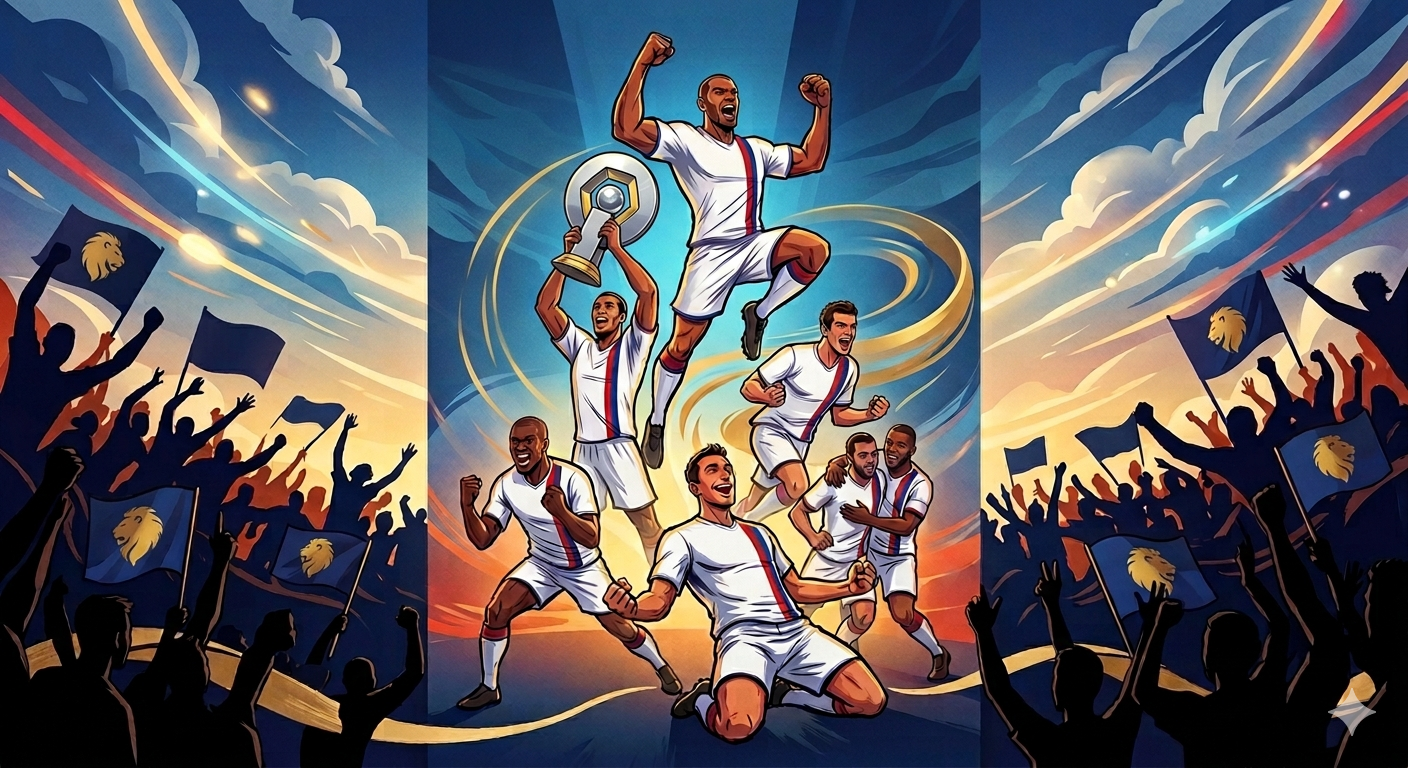
On the final day of the 2001–02 Ligue 1 season, Olympique Lyonnais hosted Lens at the Stade de Gerland needing a win to claim their first ever French league title. The north stand unfurled a tifo that read: "The more enemies, the sweeter the victory." Lyon won. Lens finished second. And what followed over the next six seasons was something French football — or any of Europe's major leagues — had never seen before. Between 2002 and 2008, Olympique Lyonnais won seven consecutive Ligue 1 titles — a national record that has never been matched — becoming the first club in any of Europe's traditional top-five leagues to win six consecutive championships in the 21st century, and the only club ever to win seven in a row in France. They did it under four different head coaches. They did it by selling their best players every summer and replacing them. And they did it starting from a position that makes everything that followed even more remarkable: they had never won the league title once before that final-day victory over Lens.
The Foundation: Aulas, a Second-Division Club and a Promise
The dynasty did not begin in 2002. It began in 1987, when a 38-year-old software entrepreneur named Jean-Michel Aulas bought a financially distressed Olympique Lyonnais from the second division of French football. Aulas promised to qualify the club for European competition within four years — a target that struck most observers as unrealistic for a side playing in Ligue 2. He met it by 1991, cleared the club's debts, restructured its management, and began the patient construction of a club that would eventually end the era of rotating champions in French football. His method was unusual: he ran Lyon not as a football club but as a business, floating the club on the Paris stock exchange in 2007 and treating player contracts as assets to be developed, sold and reinvested. The word "selling" had a different meaning at Lyon than at most clubs. It was not failure. It was the model.
By the late 1990s, Lyon had become regular Champions League participants and genuine Ligue 1 contenders — finishing second in 1995, then consistently placing in the top four. Aulas assembled a squad of technical players, brought in coaches with clear tactical identities, and added the final piece in the summer of 2001: a Brazilian midfielder from Vasco da Gama who had been quietly establishing himself as the finest free-kick taker on the planet. His name was Juninho Pernambucano. His arrival, almost unnoticed, changed everything.
Title I — 2001–02: The First, Against All Odds
Lyon's first Ligue 1 title was not won comfortably. They lost their opening game of the season to Lens 2–0 and found themselves eight points adrift of the leaders after the winter break, requiring wins at Auxerre and Bordeaux in the final weeks of the season before trailing Lens by a single point going into the last day. The title was decided at the Gerland, where Lyon needed — and claimed — all three points. The head coach was Jacques Santini, who had been given the brief to win the league and did exactly that before immediately departing to manage the French national team. What he left behind was a group of players who had discovered, in that final day, what winning felt like. They would not forget it for seven years.
The Seven Titles: Season by Season
| Season | Coach | Pts | Runner-Up | Gap | Key Addition | Key Departure |
|---|---|---|---|---|---|---|
| 2001–02 | Santini | 66 | Lens | +1 | Juninho | Sonny Anderson |
| 2002–03 | Le Guen | 69 | Monaco | +3 | Luyindula | — |
| 2003–04 | Le Guen | 79 | PSG | +12 | Diarra, Malouda | — |
| 2004–05 | Le Guen | 79 | Lille | +15 | Wiltord, Tiago | — |
| 2005–06 | Houllier | 84 | Bordeaux | +15 | Carew, Ben Arfa | Luyindula |
| 2006–07 | Perrin | 81 | Bordeaux | +4 | Benzema (promoted) | Wiltord, Tiago |
| 2007–08 | Perrin | 81 | Bordeaux | +3 | — | Malouda, Abidal, Diarra |
Ligue 1 standings. Points reflect the 38-game format (introduced 2002–03); the 2001–02 season was 34 games. Gap = points ahead of runner-up. Lyon used four head coaches across seven titles — a detail that distinguishes their dominance from almost every comparable dynasty in European football history.
The Architect: Jean-Michel Aulas and the Sell-to-Win Model
The most striking feature of Lyon's dynasty is not the seven titles but the manner in which they were won: by selling key players every single summer and still winning the league. Between 2002 and 2008, Lyon sold Sonny Anderson, Michael Essien, Florent Malouda, Éric Abidal, Alou Diarra and eventually Karim Benzema — all to clubs competing with Lyon at the top of European football. Each summer, a significant player left. Each summer, the title was retained. The replacement policy was meticulous: Aulas and his sporting staff identified players earlier than rivals, signed them at lower cost, developed them for two or three seasons, sold them at a premium, and recycled the proceeds into the next cycle. It was not luck. It was a system.
The most consequential sale of the dynasty came in 2005, when Michael Essien — who had been one of the best midfielders in Ligue 1 for two title-winning seasons — was sold to Chelsea for €38 million, then a world record for a defensive midfielder. Lyon immediately reinvested in new players, won the title that season by 15 points, and then won it again the following year by 15 points. The Essien sale did not weaken the squad. It funded the next two seasons of dominance. That is the model, expressed in its most complete form.
The Core: Players Who Stayed Through the Era
| Player | Pos | Years at Lyon | Titles Won | Note |
|---|---|---|---|---|
| Juninho Pernambucano | CM | 2001–2009 | 7 | 44 direct free-kick goals for Lyon; 100 goals in 350 appearances; Andrea Pirlo dedicated a chapter of his autobiography to analysing his technique |
| Grégory Coupet | GK | 1997–2008 | 7 | Lyon all-time appearance record (518 matches); only player alongside Govou to win all four domestic trophies in the era |
| Sidney Govou | FW | 1999–2010 | 7 | Consistent contributor across all seven seasons; named in the 2006 World Cup squad; one of only two players to appear in all seven title campaigns |
| Cris | CB | 2004–2012 | 4 | Brazilian centre-back; became club captain; redefined Lyon's defensive stability from 2004 onward |
| Karim Benzema | ST | 2005–2009 | 4 | 66 goals in 148 appearances; Ligue 1 top scorer and Player of the Year in 2007–08; sold to Real Madrid for €35m |
| Rémi Garde | CM | 1999–2007 | 6 | Club captain for much of the dynasty; leadership presence throughout the first six titles |
Juninho: The Free-Kick That Defined a Dynasty
No discussion of Lyon's seven titles is complete without confronting the singular contribution of Juninho Pernambucano. He arrived in 2001 from Vasco da Gama with a reputation known only to the most attentive observers of Brazilian football. Within two seasons, he had changed how European players and coaches thought about free-kicks. Juninho scored 44 direct free-kick goals for Lyon across eight seasons — and 100 goals in total across 350 appearances — with Andrea Pirlo writing in his autobiography that he had dedicated an "obsessive" search to uncovering the technical secret behind the knuckleball technique Juninho had brought to European football. The search eventually led Pirlo to the conclusion that the secret was in the contact point — three toes only, not the full instep — and that no goalkeeper, regardless of experience, could reliably predict where the ball would go. Juninho scored two free-kicks in a single game on three separate occasions. He scored them against Oliver Kahn. He scored them from 45 yards. He simply, as Pirlo concluded, never went wrong.
Direct free-kick goals scored by Juninho Pernambucano for Lyon across eight seasons — the most by any player for a single club in Ligue 1 history. He was the only player present in all seven title campaigns alongside Grégory Coupet and Sidney Govou. "That man made the ball do some quite extraordinary things. He never went wrong. Never." — Andrea Pirlo, on Juninho Pernambucano
Karim Benzema: The Homegrown Heir
The seventh and final title of Lyon's dynasty was, in many ways, the one that introduced their greatest-ever product to the world. Karim Benzema had grown up in the Lyon suburb of Bron, joined the academy at nine years old, and made his first-team debut in January 2005 — the same season Lyon were winning their fourth consecutive title. In 2007–08, Benzema scored 20 goals in 32 starts to finish as Ligue 1's top scorer — the first Lyon player to win the award — and was named Ligue 1 Player of the Year as the club completed their seventh consecutive championship and their first ever league and cup double. Bernard Lacombe, Lyon's sporting advisor, later recalled spotting Benzema at fifteen and telling Aulas there was "a phenomenon coming through here." Aulas sold him to Real Madrid in 2009 for €35 million. The dynasty had already ended by then, but the model — develop the talent, win with it, sell it, reinvest — had produced one last, extraordinary result.
The Coaches: Four Men, Seven Titles
The most underappreciated dimension of Lyon's dynasty is the head coaching instability that ran through all seven years. Four different coaches won the title — Jacques Santini (2001–02), Paul Le Guen (2002–03, 2003–04, 2004–05), Gérard Houllier (2005–06) and Alain Perrin (2006–07, 2007–08). Santini left for the French national team. Le Guen left for Rangers after delivering three consecutive titles, reportedly frustrated by Aulas's relentless ambition for Champions League success. Houllier was brought in specifically to crack Europe — and won the league, but not the Champions League. Perrin inherited the project and steered it to its conclusion.
The fact that the titles continued regardless of who was in the dugout suggests that Lyon's dominance was structural rather than dependent on a single tactical genius. The system Aulas had built — the recruitment pipeline, the financial model, the squad depth — was robust enough to survive repeated changes at the top. In this sense, Lyon's dynasty most resembles a corporation rather than a football club: the brand continued regardless of the individual in charge.
The Numbers Behind Seven Titles
| Stat | Figure | Context |
|---|---|---|
| Consecutive titles | 7 | French record — never matched before or since by any club in Ligue 1 |
| Coaches used | 4 | Santini, Le Guen, Houllier, Perrin — title survived each departure |
| Previous league titles before 2002 | 0 | Lyon had never won Ligue 1 before their first title in 2002 |
| Largest winning margin | +15 pts | Achieved twice — 2003–04 over PSG and 2004–05 over Lille |
| Closest winning margin | +1 pt | 2001–02 — decided on the final day against Lens |
| Champions League quarter-finals | 3× | 2004–05, 2005–06, 2006–07 — the glass ceiling they could not break |
| Michael Essien transfer fee | €38m | World record for a defensive midfielder in 2005 — proceeds funded two more consecutive titles |
| Juninho free-kick goals | 44 | For Lyon alone; 100 goals in 350 appearances total |
| Benzema Lyon goals | 66 | 148 appearances; sold for €35m in 2009 after the dynasty ended |
| Dynasty ended by | Bordeaux 2008–09 | The first Ligue 1 season since 2001 with a different champion |
| First European title | Never | Lyon's greatest failure: seven domestic titles, zero UCL semi-finals during the run |
The Glass Ceiling: Champions League and the Limits of Domestic Dominance
The one dimension of Lyon's dynasty that consistently fell short was Europe. During seven consecutive Ligue 1 titles, Lyon reached the Champions League quarter-finals three times — in 2004–05, 2005–06 and 2006–07 — without progressing further. They beat Real Madrid in the round of sixteen in 2005. They eliminated AC Milan in 2006. They were consistently one of the best eight clubs in Europe. But the semi-final, and the final, remained out of reach. The gap between Lyon's domestic trophy haul — seven Ligue 1 titles, six Trophées des Champions, one Coupe de la Ligue and one Coupe de France across the period — and their European ceiling defined the era's central contradiction. It was this frustration that led Aulas to dismiss Le Guen despite three consecutive titles, and to bring in Houllier as a specifically European-focused appointment. Houllier won the league. He did not crack Europe either.
Title VII — 2007–08: The End and the Double
The seventh title was the hardest and, in some ways, the most telling. By the 2007–08 season, the financial and squad advantages that had sustained Lyon through the first six titles were eroding. Lyon had sold Florent Malouda, Alou Diarra, Éric Abidal and Sylvain Wiltord before the season began — an exodus that left them visibly thinner in depth than in any previous campaign. They led by as little as a single point at the midway stage and were pressed all the way to the final weeks by Bordeaux and Marseille. Benzema's 20-goal season rescued them. The title was confirmed with a Coupe de France win over PSG — Sidney Govou scoring the only goal in extra time — giving Lyon their first ever domestic double and the perfect ending to an era that had defined French football for nearly a decade. The following season, Bordeaux won the title. It was the first time in eight years that the Meisterschale equivalent — the Ligue 1 trophy — had left Lyon.
Consecutive Ligue 1 titles won by Olympique Lyonnais between 2002 and 2008 — a French record that has never been equalled. Achieved under four different head coaches, through the annual sale of key players, and from a starting point of zero previous league titles in the club's history. "Les Gones brought a fleeting end to the petty to-ing and fro-ing of control between Monaco, Lens, Bordeaux and Nantes — for seven years, Lyon remained untouchable." — These Football Times
The Legacy: What Lyon's Dynasty Actually Changed
Lyon's seven consecutive titles changed French football in ways that are still visible today. Before 2002, the Ligue 1 title had been shared between Monaco, Bordeaux, Lens, Nantes and Marseille across the preceding decade — genuine competition, genuine variety. After 2008, the league moved from one era of dominance directly into another: PSG, backed by Qatari investment from 2011, won every title but one between 2012 and 2022. Lyon's decade was the pivot point between those two eras of consolidated power.
More broadly, Lyon became a model for how a club could compete at the highest level without the resources of the very largest clubs. The sell-to-win approach — recruiting early, developing talent, selling at a premium and reinvesting — was studied by clubs across Europe. Their academy produced Benzema, Hatem Ben Arfa, and later Alexandre Lacazette and Nabil Fekir. Their financial model kept them competitive in a market they could not afford to dominate.
The dynasty ended in 2009. Aulas remained as president. The players were sold. The coaches moved on. But the seven trophies — the seven consecutive, uninterrupted, entirely dominant Ligue 1 titles — remain the most sustained period of domestic dominance any French club has ever produced, and the longest consecutive run in any of Europe's traditional top-five leagues in the first decade of the 21st century. Jean-Michel Aulas built it from a second-division club with debt. He sold the players every summer. He still won every year.