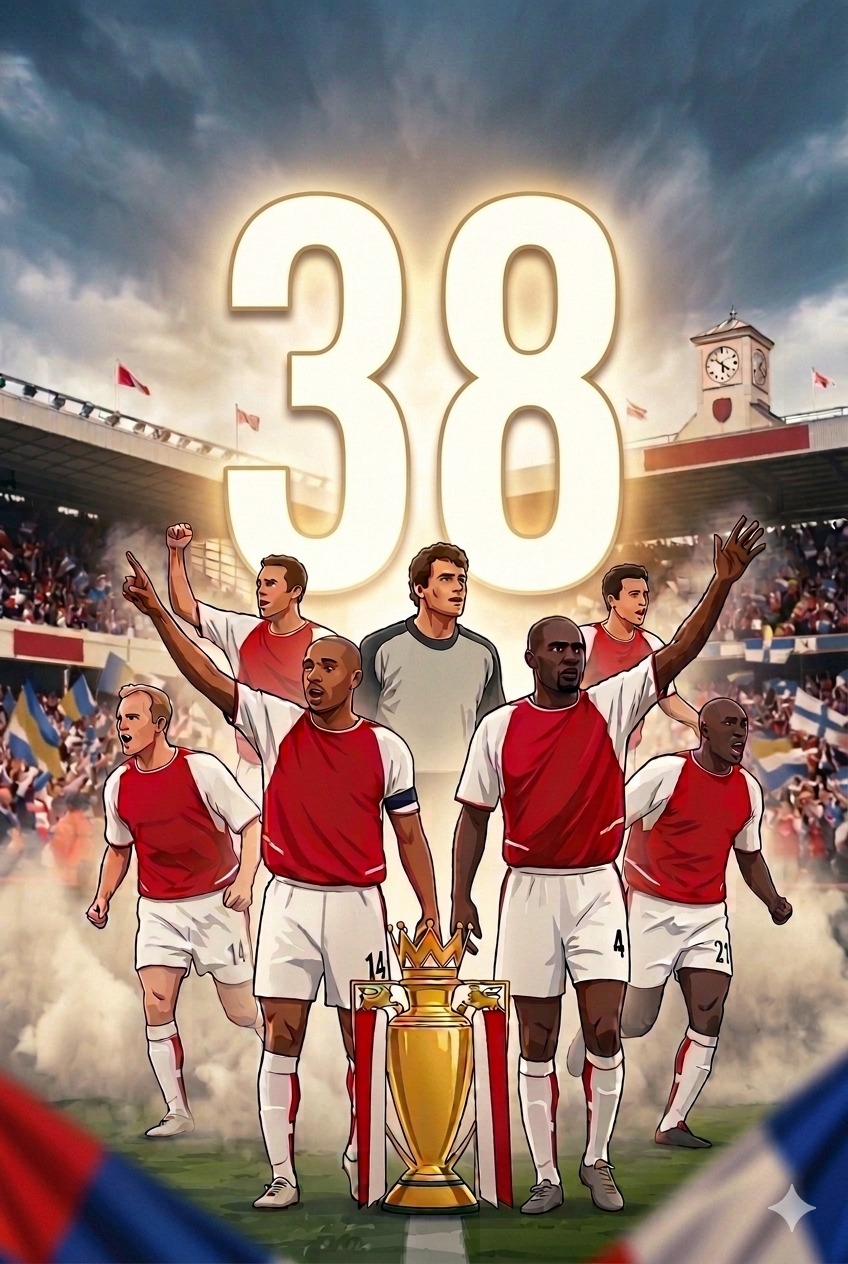
During the 2003–04 Premier League season, Arsenal achieved what no other club has managed before or since in the modern era of English football: they completed an entire 38-match campaign without a single defeat. 26 wins. 12 draws. 90 points. 73 goals scored. 26 conceded. The title was won by 11 points, with Thierry Henry scoring 30 league goals — the highest tally in the division that season. The team earned the nickname The Invincibles, received a special gold Premier League trophy, and set a record for the longest unbeaten top-flight league run in English football history that still stands today.
The Context: Chelsea's Billions and United's Shadow
To appreciate what Arsenal achieved, it helps to understand what they were up against. The summer of 2003 had transformed English football when Roman Abramovich purchased Chelsea for £140 million and immediately invested over £110 million in new players — among them Hernán Crespo, Claude Makélélé, Damien Duff and Joe Cole. Chelsea's vice-chairman David Dein memorably described Abramovich as having "parked his Russian tanks on our lawn and firing £50 notes at us." Abramovich reportedly placed an immediate bid for Thierry Henry, which Arsenal rejected without hesitation.
At the same time, Manchester United — managed by Sir Alex Ferguson and still the dominant force in English football — were unveiling an 18-year-old Cristiano Ronaldo, who had been given the No. 7 shirt vacated by David Beckham and announced himself with a dazzling debut against Bolton. Arsenal, by contrast, made only modest additions: German goalkeeper Jens Lehmannreplaced the retired David Seaman, teenager Cesc Fàbregasarrived from Barcelona's academy, and young left-back Gaël Clichy was signed as cover. This was not a squad assembled at vast expense — it was a group of players Wenger had built, developed, and refined over several years.
Wenger's System and Philosophy
The tactical foundation of the Invincibles was a 4–4–2with wide midfielders — a shape that appeared conventional but masked a level of positional intelligence and collective understanding that was anything but. Wenger's system required defenders to step into midfield, midfielders to arrive late into the box, and forwards to press from the front. The transitions between defensive and attacking phases were rapid and precisely choreographed.
What set this Arsenal apart from previous Wenger sides was the balance between the physical and the technical. Patrick Vieira— six feet four inches, dominant in the air, capable of carrying the ball from deep and arriving in the opposition penalty area — provided the steel at the heart of midfield. Around him, Gilberto Silvascreened the defence with such reliability that he was nicknamed "the Invisible Wall." Further forward, Robert Pirèsand Freddie Ljungberg created relentless threat from wide areas, while Dennis Bergkamp — the non-flying Dutchman who missed European away matches but was a constant menace at home — linked play between midfield and attack with a precision that bordered on telepathic. And at the top, Henry.
The Squad
| Player | Apps | Goals | Assists | Role |
|---|---|---|---|---|
| Jens Lehmann | 38 | 0 | 0 | GK — played every minute, 15 clean sheets |
| Lauren | 32 | 1 | 1 | RB — consistent, underrated |
| Sol Campbell | 35 | 1 | 0 | CB — commanding, rarely beaten |
| Kolo Touré | 38 | 1 | 0 | CB — most appearances of any player (55 all competitions) |
| Ashley Cole | 32 | 0 | 3 | LB — best in England at the position |
| Patrick Vieira | 29 | 3 | 3 | CM — captain, physical authority |
| Gilberto Silva | 24 | 1 | 0 | CM — the Invisible Wall |
| Robert Pirès | 36 | 14 | 7 | LM — 14 goals from midfield |
| Freddie Ljungberg | 30 | 4 | 3 | RM — tireless, clinical |
| Dennis Bergkamp | 28 | 4 | 7 | SS — creative connector, 0 red cards |
| Thierry Henry ★ | 37 | 30 | 6 | ST — Golden Boot, 41% of all league goals |
Premier League appearances and contributions only. ★ Henry's 30 goals were 9 more than runner-up Andrew Johnson of Crystal Palace (21). 20 players earned Premier League winner's medals. Total squad goals across all competitions: 114.
Thierry Henry: The Season That Defined a Career
No account of the Invincibles can avoid centring on Henry. He scored 30 Premier League goals in 37 appearances — 41 per cent of Arsenal's entire league tally — while claiming the Golden Boot with a margin of nine goals over the next highest scorer in the division. He became the first player in PFA history to win the Players' Player of the Year award in consecutive seasons and added the FWA Footballer of the Year to complete a clean sweep of the major individual honours. In all competitions across the season he scored 39 goals in 51 games for club and country combined. His total for Arsenal across all competitions that calendar year reached 44.
The defining individual moment came on April 9, 2004, when Arsenal faced Liverpool at Highbury in a match they could not afford to lose. With the score at 2–1 to Liverpool, Henry produced a solo run from the halfway line — dribbling past the entirety of Liverpool's midfield and defence before finishing — to give Arsenal a 3–2 lead. He completed a hat-trick. Arsenal won 4–2. The unbeaten run survived. That goal, which also took Henry past 100 Premier League goals for the club, remains the most celebrated moment of the entire season.
26 wins. 12 draws. 0 defeats. 90 points. 73 goals. 26 conceded.The only team in Premier League history to complete a full 38-game season unbeaten. Arsenal never trailed in the final 20 minutes of any of the 49 matches in their unbeaten run. "Not once defeated."
Key Matches That Defined the Season
| Date | Match | Score | Significance |
|---|---|---|---|
| Sep 2003 | Man United vs Arsenal | 0–0 | Van Nistelrooy misses last-minute penalty — Vieira era at its peak |
| Feb 2004 | Chelsea vs Arsenal | 1–2 | Statement win at Stamford Bridge in the title run-in |
| Apr 9, 2004 | Arsenal vs Liverpool | 4–2 | Henry hat-trick, including solo goal of the season — unbeaten run survives |
| Apr 25, 2004 | Tottenham vs Arsenal | 2–2 | Title secured at White Hart Lane — maximum significance |
| May 15, 2004 | Arsenal vs Leicester | 2–1 | Final day, season completed unbeaten — guard of honour from Leicester |
Final Premier League Table — 2003–04
| Pos | Club | P | W | D | L | GF | GA | GD | Pts |
|---|---|---|---|---|---|---|---|---|---|
| 1 🏆 | Arsenal | 38 | 26 | 12 | 0 | 73 | 26 | +47 | 90 |
| 2 | Chelsea | 38 | 24 | 7 | 7 | 67 | 30 | +37 | 79 |
| 3 | Manchester United | 38 | 23 | 6 | 9 | 64 | 35 | +29 | 75 |
| 4 | Liverpool | 38 | 16 | 12 | 10 | 55 | 37 | +18 | 60 |
| 5 | Newcastle United | 38 | 13 | 17 | 8 | 52 | 40 | +12 | 56 |
Arsenal won the title by 11 points — the largest winning margin in the Premier League that season. They scored more and conceded fewer goals than any other side in the division.
The Record That Nobody Has Broken
In the more than two decades since, the Premier League has been won by clubs with far greater financial resources. Chelsea lost only one match in 2004–05 but still fell short of the unbeaten record. Liverpool in 2019–20 lost only once before the season was suspended — and that one defeat ended their own unbeaten run at 27 matches. Manchester City set a points record of 100 in 2017–18 — the highest total in the division's history — but still lost five matches. The unbeaten record has never been seriously threatened.
Arsenal's extended unbeaten run did not end with the season itself. They carried their form into 2004–05, extending the sequence to 49 consecutive league matches without defeat — a record in English football that broke Nottingham Forest's previous mark of 42 set between 1977 and 1978. It ended with a 2–0 defeat at Manchester United in October 2004, in a match that included a tunnel confrontation between the clubs and became one of the most heated encounters of the Ferguson era.
In 2012, Arsenal's 2003–04 side won the "Best Team" category at the Premier League's 20 Seasons Awards — selected by a panel of judges ahead of every other squad in the competition's first two decades. The club was presented with a unique gold version of the Premier League trophy, commissioned by the league to mark an achievement it considered unrepeatable. It sits permanently at the Emirates Stadium.
For the generation of supporters who watched it, the Invincibles season represents something that statistics alone cannot fully capture: the sensation of watching a football team reach a state of collective near-perfection across nine months of competition, and doing so in a way that was simultaneously dominant and thrilling. More than twenty years later, no team has come close to repeating it.