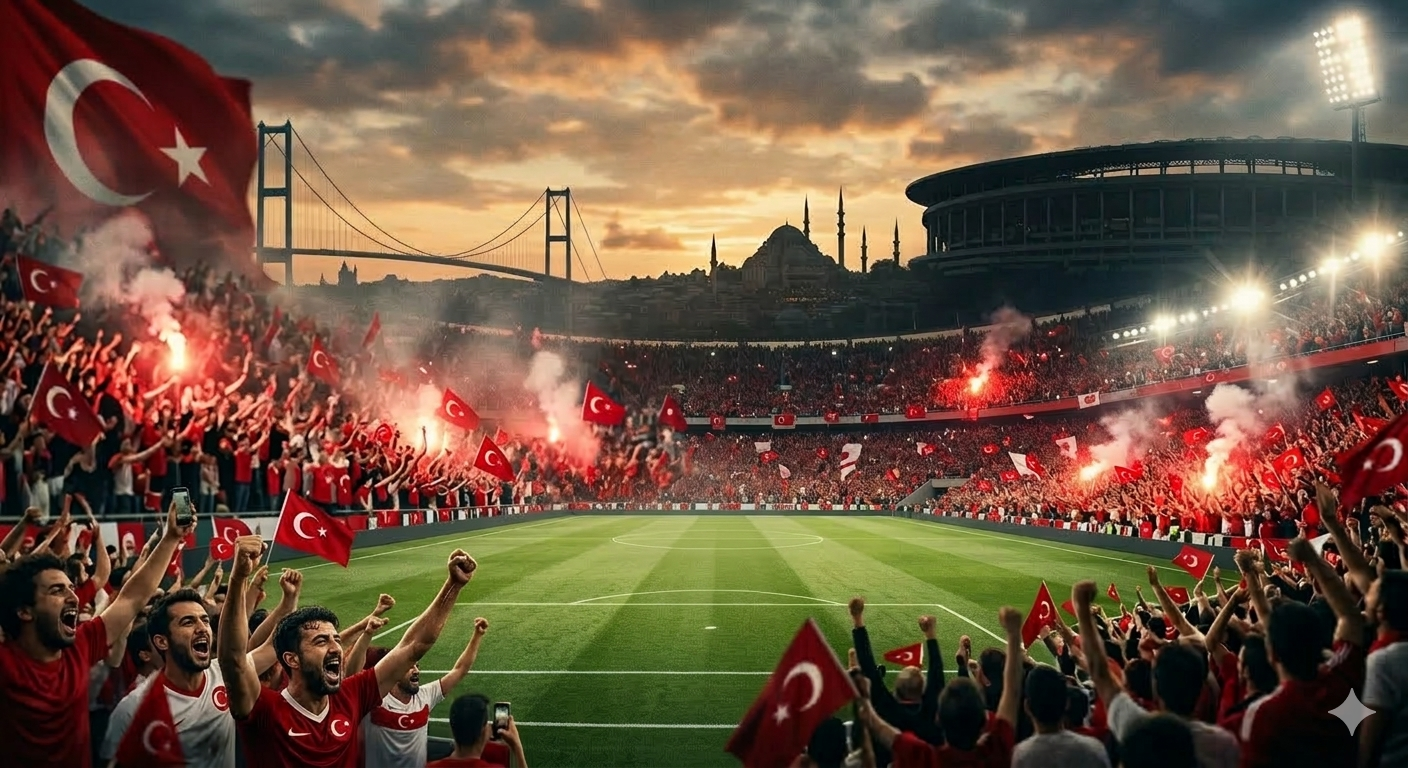
When football historians discuss the great national football stories of the modern era, Turkey's golden decade rarely receives the attention it deserves. Between 1996 and 2008, Turkish football underwent a transformation that was both sudden and extraordinary. A country that had spent decades on the margins of European competition — qualifying for a major tournament only once between 1954 and 1996 — suddenly found itself at the centre of the continent's biggest moments. Galatasaray won Europe's second-most prestigious club competition and defeated Real Madrid to claim the UEFA Super Cup. The national team finished third at the 2002 FIFA World Cup — still the best result ever achieved by a nation making only its second World Cup appearance. And in Euro 2008, a squad of fighters and late-goal specialists reached the semi-finals with a series of dramatic comebacks that the continent had never seen before. This is the story of Turkish football's greatest chapter.
Before the Golden Era: Decades on the Margins
To understand how remarkable Turkey's rise was, it is necessary to understand where they started. Turkey had participated in only one FIFA World Cup before 2002 — the 1954 tournament in Switzerland — and had spent much of the following five decades failing to qualify for major tournaments. Between 1954 and 1996, Turkey did not appear at a single World Cup or European Championship. The domestic game was dominated by the same three Istanbul clubs —Galatasaray, Fenerbahçe and Beşiktaş — but their European campaigns rarely extended beyond the early rounds. The national team was largely an afterthought in UEFA qualifying groups.
The foundations of the golden era were laid quietly throughout the late 1980s and early 1990s. Fatih Terim — who would become the most important figure in Turkish football history — took charge of Galatasaray in 1994 and began constructing a squad that combined Turkish technical talent with a ferocious collective identity. The club had reached the European Cup semi-final in 1989 under Mustafa Denizli — still the deepest any Turkish club has gone in the Champions League — but consistency had remained elusive. Under Terim, Galatasaray won four consecutive Süper Lig titles between 1997 and 2000. What came next changed everything.
Turkish Clubs in European Competition: All-Time Record
| Club | UEFA Cup / UEL | UCL Best Result | UEFA Super Cup | Notable Season |
|---|---|---|---|---|
| Galatasaray | 🏆 Winner (2000) | Semi-final (1988–89) | 🏆 Winner (2000) | 1999–2000: Süper Lig + Turkish Cup + UEFA Cup + UEFA Super Cup |
| Fenerbahçe | Semi-final (2013, UEL) | Quarter-final (2007–08) | — | 2007–08: Beat Sevilla in R16, lost to Chelsea in QF — best UCL run by a Turkish club after Galatasaray |
| Beşiktaş | Round of 16 (UEL ×2) | Round of 16 (2017–18) | — | 2017–18: UCL group stage with 14 pts — highest points tally by a Turkish club in UCL group stage |
| Trabzonspor | Quarter-final (1976–77) | Group stage (×1) | — | 1976–77: Deepest European run before Galatasaray |
| Başakşehir | Group stage | Group stage (2020–21) | — | 2020–21: First Başakşehir Champions League campaign |
Galatasaray remains the only Turkish club to have won a major UEFA competition. Their 1999–2000 season — Süper Lig, Turkish Cup, UEFA Cup and UEFA Super Cup — is the only quadruple in Turkish football history.
2000: Galatasaray Win the UEFA Cup — A Night That Changed Everything
On May 17, 2000, at the Parken Stadium in Copenhagen, Galatasaray faced Arsenal in the UEFA Cup final — the first time a Turkish club had ever reached a major European final. Arsenal were managed by Arsène Wenger and featured Patrick Vieira, Thierry Henry and Robert Pires. The match ended 0–0 after extra time. In the penalty shootout, Galatasaray goalkeeper Cláudio Taffarel saved from Davor Šuker, and Patrick Vieira also missed. Galatasaray won 4–1 on penalties.
It was the first major UEFA trophy ever won by a Turkish club, and it remains the only one. But the summer was not finished. Three months later, in Monaco, Galatasaray faced Real Madrid — the Champions League holders — in the UEFA Super Cup. Real Madrid were overwhelming favourites. Galatasaray won 2–1 after extra time. Mário Jardel scored a golden goal in the 103rd minute to win it. In the space of one summer, a Turkish club had beaten the best England and Spain had to offer and returned home with two European trophies. Turkish football would never be the same again.
Galatasaray's extraordinary summer: UEFA Cup winners over Arsenal on penalties in Copenhagen, then UEFA Super Cup winners over Real Madrid in Monaco via Jardel's golden goal. The only Turkish club ever to win a major UEFA competition. "We beat the best clubs in England and Spain. Now the whole world knows Turkish football." — Hasan Şaş
2002: A Nation Reaches the World Cup Semi-Final
If Galatasaray's European triumph was the club story of Turkey's golden era, the 2002 FIFA World Cup was the national story. Turkey had qualified for the tournament — co-hosted by South Korea and Japan — after finishing second in their qualifying group and defeating Austria 6–0 on aggregate in the play-offs. Their squad featured an extraordinary generation of players: Rüştü Reçber in goal, Alpay Özalan and Bülent Korkmaz in defence, Yıldıray Baştürk and Tugay Kerimoğlu in midfield, and Hakan Şükür and Hasan Şaşin attack.
Turkey were drawn in a group with Brazil, Costa Rica and China. They lost their opening match to Brazil 2–1, then recovered with wins over China and a draw with Costa Rica to advance as group runners-up. In the round of sixteen, they defeated co-hosts Japan 1–0. In the quarter-final, they beat Senegal 1–0 with a golden goal from İlhan Mansız. They were in the World Cup semi-final. It was only Turkey's second World Cup appearance.
The semi-final against Brazil ended 1–0 to the eventual champions. In the third-place play-off against co-hosts South Korea, Hakan Şükür scored after just 10.8 seconds — the fastest goal in FIFA World Cup history, a Guinness World Record that still stands. Turkey won 3–2. Three Turkish players — Rüştü Reçber, Alpay Özalan and Hasan Şaş — were named in the Tournament All-Star Team. Şenol Güneş was voted Best Manager of the Tournament. Turkey returned home with a bronze medal and a nation transformed.
Turkey's 2002 World Cup: Match by Match
| Round | Opponent | Result | Scorers |
|---|---|---|---|
| Group Stage | Brazil | L 1–2 | Alpay 45+1′ |
| Group Stage | Costa Rica | D 1–1 | Şükür 57′ |
| Group Stage | China | W 3–0 | Şükür 6′, Davala 9′, Şaş 85′ |
| Round of 16 | Japan | W 1–0 | Davala 12′ |
| Quarter-final | Senegal | W 1–0 (aet) | İlhan 94′ (golden goal) |
| Semi-final | Brazil | L 0–1 | — |
| 3rd Place | South Korea | W 3–2 | Şükür 11″, İlhan 13′, İlhan 75′ |
Hakan Şükür's 10.8-second goal against South Korea in the third-place play-off remains the fastest goal in FIFA World Cup history. Turkey finished the tournament with 5 wins, 1 draw and 1 defeat.
Euro 2008: The Art of the Comeback
Six years after the World Cup bronze medal, Turkey produced a European Championship campaign that, in terms of sheer drama, may be unmatched in the tournament's history. Euro 2008 will be remembered in Turkey as the tournament of impossible comebacks — Turkey were trailing in the final minutes of each of their three knockout games and still advanced.
Turkey were placed in Group A alongside Portugal, the Czech Republic and co-hosts Switzerland. They lost their opening game to Portugal 2–0. Against Switzerland, Turkey were level at 1–1 deep into injury time before Arda Turanscored the winner in the 92nd minute. Against the Czech Republic, Turkey were losing 2–0 with fifteen minutes remaining. They scored three goals to win 3–2 and advance.
In the quarter-final against Croatia, Turkey trailed 1–0 going into injury time of extra time — effectively moments from elimination — before Semih Şentürk scored an equaliser in the 119th minute. Turkey won the penalty shootout 3–1. In the semi-final against Germany, Turkey trailed 2–1 before equalising in the 86th minute. A German goal in the 90th minute ended the run. The final score was 3–2. Turkey had been eliminated by a goal scored in the last minute of the semi-final of a European Championship, having already staged three of the most extraordinary comebacks the tournament had ever seen.
The minute Semih Şentürk equalised against Croatia in the Euro 2008 quarter-final — moments before the final whistle of extra time, forcing a shootout Turkey would win. Turkey scored five goals in the final ten minutes across their three knockout games. "I have never seen a team refuse to lose like this." — UEFA commentators, Euro 2008
The Golden Generation: Players Who Defined an Era
The performances of 2000–2008 were not accidental. They were built on a generation of Turkish players — many of them developed at Galatasaray, Fenerbahçe and Beşiktaş, several of them forged at major European clubs — who represented the highest concentration of talent Turkish football had ever produced simultaneously.
| Player | Position | European Clubs | Legacy |
|---|---|---|---|
| Hakan Şükür | ST | Inter Milan, Parma, Galatasaray | 51 goals — all-time Turkey top scorer; fastest WC goal in history (10.8 sec) |
| Rüştü Reçber | GK | Fenerbahçe, Barcelona, Beşiktaş | 120 caps — all-time Turkey appearance record; WC 2002 All-Star team |
| Tugay Kerimoğlu | CM | Galatasaray, Rangers, Blackburn Rovers | 94 caps; key link between club and national golden eras |
| Yıldıray Baştürk | CM | Bayer Leverkusen, Hertha BSC | UCL finalist 2002 with Leverkusen; playmaker of WC 2002 run |
| Hasan Şaş | RW | Galatasaray | WC 2002 All-Star team; key figure in Galatasaray UEFA Cup win |
| Arda Turan | AM | Atlético Madrid, Barcelona | Euro 2008 hero; later won La Liga with Atlético Madrid |
| Tuncay Şanlı | ST | Fenerbahçe, Middlesbrough, Stoke City | Silver Ball & Silver Shoe at 2003 Confederations Cup |
| Alpay Özalan | CB | Aston Villa, Fenerbahçe | WC 2002 All-Star team; captain for much of golden era |
The 2003 Confederations Cup: The Achievement That Was Forgotten
Sandwiched between the World Cup bronze medal and Euro 2008, Turkey achieved a result that rarely appears in discussions of their golden era: a third-place finish at the 2003 FIFA Confederations Cupin France. Playing against Brazil, France, the United States and Cameroon — a group that contained the reigning World Cup holders and the host nation — Turkey drew 2–2 with Brazil in the group stage, knocking the South Americans out in the process, before losing to eventual winners France 3–2 in the semi-final. Tuncay Şanlı won both the Silver Ball (second-best player of the tournament) and the Silver Shoe (second-top scorer) awards. It was an achievement entirely consistent with everything Turkey produced during this remarkable period.
Major Tournament Results: Turkey's Complete Record
| Tournament | Year | Result | Key Moment |
|---|---|---|---|
| FIFA World Cup | 1954 | Group Stage | 7–0 win over South Korea; first World Cup appearance |
| UEFA Euro | 1996 | Group Stage | First European Championship qualification since 1954 — ending a 40-year wait |
| UEFA Euro | 2000 | Quarter-final | Beat host Belgium 2–0 in group stage; lost to Portugal in QF |
| FIFA World Cup | 2002 | 🥉 Third Place | Semi-final vs Brazil; Şükür's 10.8-sec goal; 3 All-Star picks |
| FIFA Confederations Cup | 2003 | 🥉 Third Place | Knocked out Brazil in group stage; Tuncay wins Silver Ball & Silver Shoe |
| UEFA Euro | 2008 | Semi-final | 3 comebacks from behind; 119th-min equaliser vs Croatia; lost to Germany 3–2 |
| UEFA Euro | 2016 | Group Stage | Failed to advance despite 3 points |
| UEFA Euro | 2020 | Group Stage | Three defeats — worst tournament performance of the modern era |
| UEFA Euro | 2024 | Quarter-final | Promising run ended by Netherlands 2–1; promising new generation emerging |
The Süper Lig: A League Finding Its Place in Europe
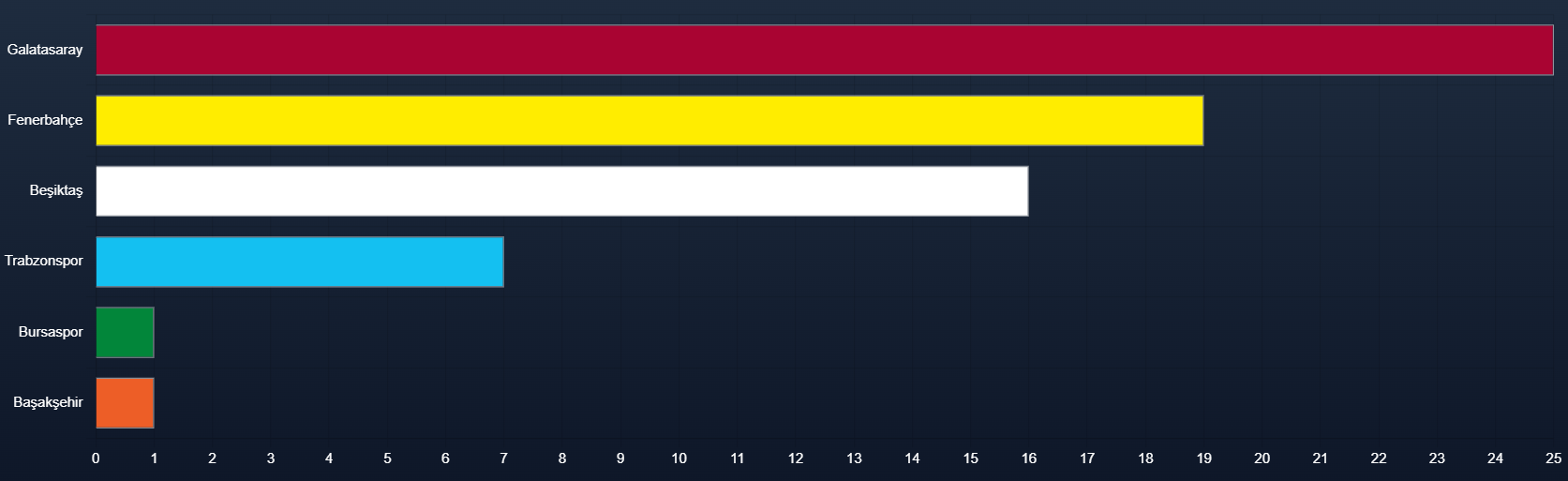
The national team's achievements were mirrored by growing ambition at club level. The Süper Lig — the top division in Turkish football since 1959 — has been dominated by three clubs throughout its history: Galatasaray (25 titles), Fenerbahçe(19 titles) and Beşiktaş (16 titles). Together they have won more than 90% of every Süper Lig title contested. Beyond the big three, only Trabzonspor (7 titles), Bursaspor(1 title) and Başakşehir (1 title) have broken their grip.
In terms of UEFA coefficient — the ranking that determines how many clubs from each country qualify for European competition — the Süper Lig currently sits 9th in Europe. The league's highest-ever UEFA coefficient ranking was 7th in 2001 — a direct reflection of the golden era's European performances. The continued presence of Galatasaray and Fenerbahçe in Champions League group stages has maintained Turkey's coefficient at a level that consistently places it among Europe's top ten footballing nations.
Euro 2032 and the Next Chapter
Turkey's football story is far from finished. In Euro 2024, a new generation — including Arda Güler, one of the most technically gifted young players in European football — showed genuine signs of a revival. Turkey reached the quarter-finals before losing to the Netherlands 2–1. It was the best tournament performance since 2008.
More significantly, Turkey will co-host UEFA Euro 2032 alongside Italy — marking the country's first major hosting role in international football. The tournament will take place in Istanbul, Ankara, Izmir and other major Turkish cities, and represents the largest football event ever staged on Turkish soil. The combination of hosting advantage, a maturing new generation and the enduring passion of a country where football is embedded in daily life makes Turkey one of the most interesting football stories to follow heading into the next decade.
The golden era of 1996–2008 may never be fully replicated — the simultaneous convergence of Galatasaray's European triumph and a national team golden generation was a rare alignment of circumstances. But the foundations it laid, and the ambitions it ignited, continue to shape Turkish football two decades later. A country that spent forty years on the margins of European competition produced, within the space of eight years, a UEFA Cup winner, a World Cup bronze medalist, and one of the most dramatically entertaining national teams the European Championship has ever seen. That story deserves to be told — and remembered.