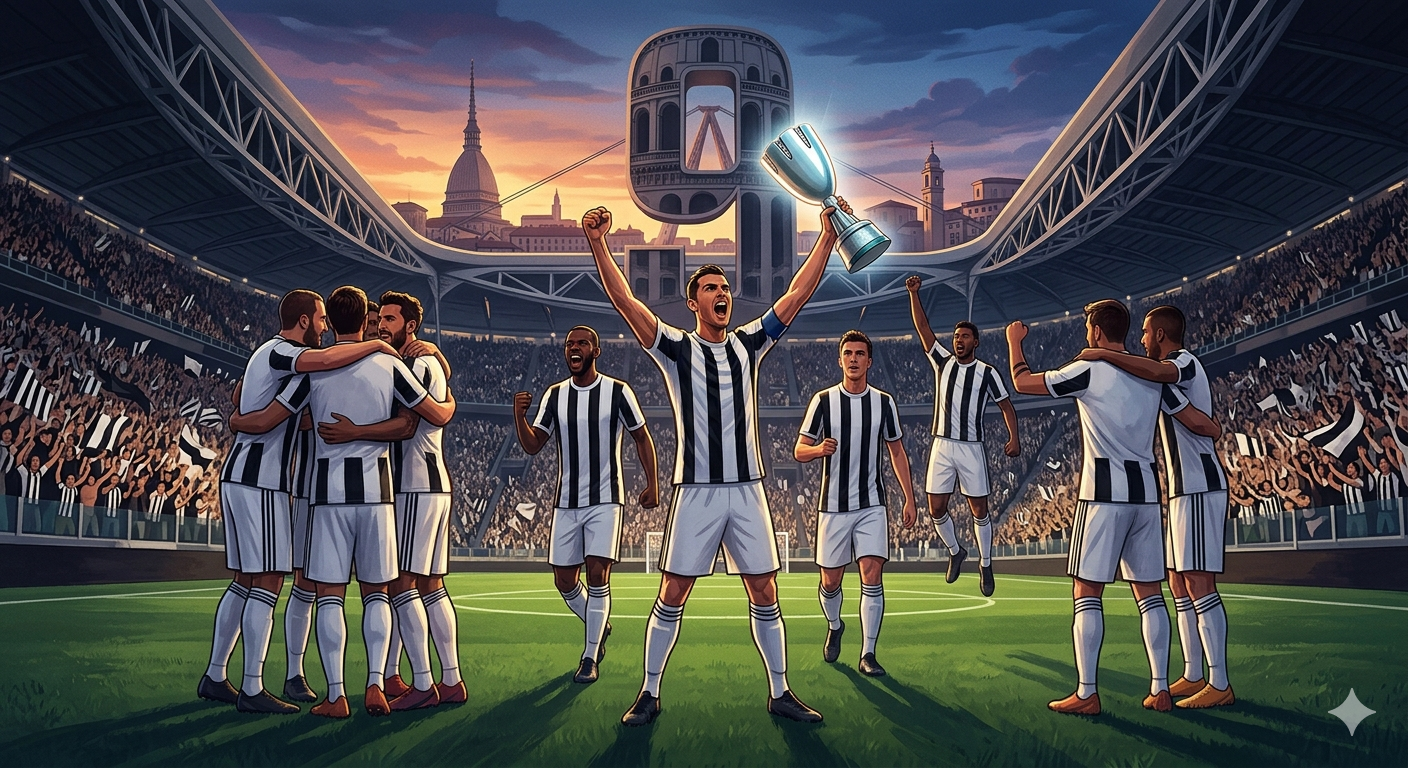
In the summer of 2011, Juventus were a club rebuilding from scandal and mediocrity. They had finished seventh in Serie A in consecutive seasons. Their new coach had never managed a top-flight club. Their most significant summer signing was a 32-year-old midfielder released for free by their rivals. Nine years later, they had won the Serie A title nine times in a row — a record that had never been achieved in the competition's history. Juventus's nine consecutive championships between 2011–12 and 2019–20 are the longest winning streak ever recorded in Serie A — surpassing their own previous record of five consecutive titles from the 1930s, and ending only when Inter Milan under Antonio Conte claimed the Scudetto in May 2021. Between those two points sits one of the most complete acts of institutional rebuilding in modern European football.
The Foundation: Calciopoli, Rebuilding and the Arrival of Conte
The story of the nine titles cannot be told without the five years that preceded them. In May 2006, Juventus were relegated to Serie B as punishment for their role in the Calciopoli match-fixing scandal — stripped of two Serie A titles and demoted to the second division for the first and only time in their modern history. They won promotion at the first attempt under Didier Deschamps, but spent four seasons in Serie A failing to recapture the dominance that had defined the Lippi years. Two seventh-place finishes followed. The club was competitive but directionless.
In 2010, Andrea Agnelli became club president at just 35 years old and immediately restructured the sporting operation. He appointed Giuseppe Marotta as general manager andFabio Paratici as sporting director — two men who would build the decade's most surgically effective transfer operation in European football. In the summer of 2011, after another seventh-place finish, they appointed Antonio Conte as head coach. Conte had led two clubs to promotion from Serie B but had failed in his single top-flight stint with Atalanta. The appointment was considered, at best, a risk. In practice, it was the first move in a reconstruction that would last nine years.
The Free Transfer That Started Everything
Before Conte had taken a single training session, Marotta completed the signing that would define the entire era. Andrea Pirlo had spent a decade at AC Milan, winning two Champions League titles and two Serie A crowns. Milan, convinced he was finished at the highest level, offered him only a one-year rolling contract. Juventus offered him three years — and signed him for nothing. ESPN later called it "the foundation myth of this dynasty" and noted that Pirlo's arrival "shifted the balance of power in Italy back to Turin". Gianluigi Buffon, Juventus captain and Pirlo's Italy teammate, called it "the signing of the century." He was not wrong. Pirlo would win four consecutive Serie A titles in Turin, pulling strings from midfield at an age when most players of his type had already declined.
Chapter I: 2011–12 — The Unbeaten Season
The first title of the nine came in the most remarkable fashion. Conte deployed a 3-5-2 built around Pirlo as the deep-lying playmaker, Arturo Vidal and Claudio Marchisioas dynamic midfield runners, and a three-man defence of Barzagli, Bonucci and Chiellini — the BBC — that would become the most celebrated defensive unit in Italian football for half a decade. The combination was devastatingly effective. Juventus won the 2011–12 Serie A title without losing a single match — 23 wins and 15 draws across all 38 games — becoming the only team to complete a full season unbeaten in the 20-team Serie A format. The club's official records page lists it alongside their 102-point season and 44-match scoring run as the defining numerical achievements of the entire era. They conceded just 20 goals all season. AC Milan — who had Zlatan Ibrahimović, Thiago Silva and a squad of considerably greater individual quality — finished second. Juventus were an underdog who had won by refusing to lose.
Points recorded by Juventus in the 2013–14 Serie A season — the highest total in the competition's history, and the record for any team in any major European league at the time. They won 33, drew 3 and lost just 2 of 38 matches. Antonio Conte resigned days after the title was confirmed, citing a dispute over transfer policy. "The foundation myth of this dynasty starts with Andrea Pirlo's move from Milan to Juventus for nothing in 2011." — ESPN
The Nine Titles: Season by Season
| Season | Coach | P | W | D | L | Pts | Margin | Coppa Italia | UCL |
|---|---|---|---|---|---|---|---|---|---|
| 2011–12 | Conte | 38 | 23 | 15 | 0 | 84 | +6 | Final (lost) | R16 |
| 2012–13 | Conte | 38 | 27 | 6 | 5 | 87 | +9 | Won | QF |
| 2013–14 | Conte | 38 | 33 | 3 | 2 | 102★ | +17 | QF | R16 |
| 2014–15 | Allegri | 38 | 26 | 9 | 3 | 87 | +17 | Won | Final (lost) |
| 2015–16 | Allegri | 38 | 29 | 4 | 5 | 91 | +9 | Won | SF |
| 2016–17 | Allegri | 38 | 29 | 4 | 5 | 91 | +4 | Won | Final (lost) |
| 2017–18 | Allegri | 38 | 30 | 6 | 2 | 95 | +8 | Won | QF |
| 2018–19 | Allegri | 38 | 28 | 8 | 2 | 90 | +11 | — | QF |
| 2019–20 | Sarri | 38 | 26 | 5 | 7 | 83 | +1 | — | R16 |
★ 102 points in 2013–14 remains the Serie A record for a single season. Margin = points ahead of the runners-up. Four Coppa Italia titles across the nine-year run (2015, 2016, 2017, 2018) set a new record for consecutive wins in the competition. UCL: R16 = Round of 16, QF = Quarter-final, SF = Semi-final.
Chapter II: Conte's Three — Discipline, the BBC and the 102-Point Season
Antonio Conte won three consecutive titles before his sudden resignation in June 2014 — days after Juventus had clinched their third Scudetto with a record-breaking points total. Conte's third title in 2013–14 came with a record haul of 102 points — the highest single-season total in Serie A history, surpassing Inter Milan's previous record of 97 set in 2006–07. His departure, described by Goal.com as "quite the shock," came amid a dispute with the club over transfer policy. His record over three seasons was 27 wins, 6 draws and 5 losses in the first year; then two more dominant campaigns in which Juventus were never seriously challenged. The system he built — the 3-5-2, the BBC defence, the Pirlo quarterback — was so structurally sound that it survived his departure entirely intact.
The BBC defence deserves specific attention. When Marotta signed Andrea Barzagli from Wolfsburg in January 2011 for €300,000 — before Conte had even arrived — the transfer was so modest it barely registered. Bleacher Report later described it as "the best €300,000 Juventus ever spent," noting that Barzagli's partnership with Bonucci and Chiellini — all three selected for Italy's 2014 World Cup squad — formed a defensive unit that conceded just 20 goals in the first unbeaten title season and gave the rest of the team licence to attack without fear. President Andrea Agnelli called the Barzagli signing "the best we ever made." He was not being modest. For the price of a set of training bibs, Juventus had completed a back three that would define Italian football for five years.
Chapter III: Allegri's Four — Europe and the Double-Double
Massimiliano Allegri's appointment in the summer of 2014 was received with fury in Turin. His car was pelted with eggs on arrival. Fans who had watched him manage AC Milan — Juventus's great rival — viewed the appointment as an affront. Within twelve months, those same fans were singing his name. Allegri took Conte's rock-solid domestic foundation and added European ambition — reaching the Champions League final in his very first season and constructing what Goal.com described as an "impenetrable fortress" that also became a continental force, blitzing Barcelona in Turin and shutting down Messi's side at Camp Nou during their 2017 semi-final run.
The numbers of the Allegri era are extraordinary. Four consecutive Serie A and Coppa Italia doubles (2015–16 to 2018–19) were without precedent in Italian football — no club had won back-to-back doubles before Juventus made it four in a row. Allegri's Juventus reached two more Champions League finals (2015 against Barcelona, 2017 against Real Madrid), losing both — the domestic giant unable to convert its Serie A superiority into European triumph. He departed in 2019 after securing the title by an 11-point margin, the largest of his tenure, with the Champions League quarter-final exit against Ajax identified as the primary reason for his dismissal.
The Key Players Across the Nine Years
| Player | Role | Titles Won | Seasons | Defining Contribution |
|---|---|---|---|---|
| Gianluigi Buffon | GK | 7 | 2012–2018 | Record 974 consecutive minutes without conceding (2015–16); 296 clean sheets for the club; refused to leave after Calciopoli |
| Andrea Pirlo | CM | 4 | 2012–2015 | Free transfer from Milan; pulled the strings from deep; won Serie A Footballer of the Year 3 consecutive times (2012–14) |
| Giorgio Chiellini | CB | 9 | 2012–2020 | Played every title-winning season; the BBC backbone alongside Barzagli and Bonucci; 17 Serie A seasons total at the club |
| Leonardo Bonucci | CB | 7 | 2012–2017, 2018–2020 | Ball-playing CB who redefined the position in Italy; briefly left for Milan in 2017–18 before returning |
| Arturo Vidal | CM | 3 | 2012–2015 | Signed for €10.5m from Bayer Leverkusen; the engine of Conte's midfield; physical, box-to-box presence alongside Pirlo |
| Paul Pogba | CM | 4 | 2012–2016 | Arrived from Manchester United as a teenager on a free; left for a world-record €105m; four titles in four seasons |
| Carlos Tevez | ST | 2 | 2013–2015 | Goal.com: "39 goals in 66 league appearances"; described as "Tevez's title" in 2015 for his decisive impact under Allegri |
| Paulo Dybala | AM | 5 | 2015–2020 | The primary creative force of the Allegri and Sarri eras; Serie A Team of the Year four times across the nine seasons |
| Cristiano Ronaldo | ST | 2 | 2018–2020 | €100m from Real Madrid; 37 goals in Serie A across two full seasons; titles 8 and 9; could not deliver the Champions League |
Titles Won = Serie A titles during the nine-in-a-row era only. Chiellini's nine titles across the full run is the most by any outfield player. Buffon won seven before his first departure to PSG in 2018, then returned to add a ninth in 2019–20.
Chapter IV: The Transfer Strategy — Spending Nothing, Winning Everything
Marotta and Paratici's transfer model was, in the context of European football's arms race, almost paradoxically restrained. While Real Madrid, Barcelona and Manchester City spent hundreds of millions assembling squads, Juventus built their dynasty on a combination of shrewd free transfers, low-fee signings and high-margin sales. The Pirlo free was the model; Paul Pogba arrived from Manchester United as a teenager on a free transfer and departed for a world-record €105 million. Barzagli cost €300,000. Sami Khedira came free from Real Madrid.Dani Alves arrived on a free from Barcelona. Each signing contributed directly to a title; none cost market rate.
The only departures from this model — Gonzalo Higuaín for€90 million in 2016 and Cristiano Ronaldo for €100 million in 2018 — were both explicit attempts to win the Champions League. Sporting director Paratici revealed that the idea to sign Ronaldo was born after his bicycle kick at the Allianz Stadium in the Champions League quarter-final of 2018 — a goal so spectacular that Juventus fans stood and applauded their own elimination. "The crazy idea started after the crazy goal," Paratici told Sky Italia. Ronaldo arrived, won two more Scudetti, and left in 2021 without a Champions League medal. The pattern held: dominant at home, tantalizingly close in Europe.
Chapter V: The Ronaldo Era — Titles Eight and Nine
Ronaldo's two seasons under Allegri's successor — the title-winning campaigns of 2018–19 and 2019–20 — were statistically impressive and contextually complicated. The eighth consecutive title in 2018–19, secured with five games to spare, made Ronaldo the first player in history to win Serie A, La Liga and the Premier League — but it arrived four days after a Champions League quarter-final elimination against Ajax, the defeat that triggered Allegri's departure. Goal.com noted the paradox bluntly: the arrival of the world's best player had made the probable inevitable in Serie A, but had done nothing to change their fate in Europe.
The ninth and final title came in July 2020 — delayed to the end of a season interrupted by the COVID-19 pandemic — under Maurizio Sarri, who had replaced Allegri. It was the most tightly contested of the nine: Juventus finished just one point ahead of Inter Milan. Within ten months, Inter — now under Antonio Conte, the architect of the entire dynasty — ended the run. The circle was complete.
The number of consecutive Serie A titles won by Juventus between 2012 and 2020 — a record that had never been achieved in the competition's history. Three coaches (Conte, Allegri, Sarri), one free transfer that started it all, and a Champions League that always stayed one step out of reach. "Juventus have made history by becoming the first club to win six successive Serie A titles." — Goal.com, 2017 (by the end, it was nine)
The European Shadow — Close but Never There
The one constant across the nine years was the Champions League — always present as a goal, never achieved. Juventus reached three finals in this period (2015 and 2017 under Allegri, 2003 under the preceding Lippi era) and lost all of them: to Barcelona 3–1 in Berlin, to Real Madrid 4–1 in Cardiff, and — outside the nine-year window — to Milan on penalties in Manchester. They reached four quarter-finals and two semi-finals in between. They were eliminated by clubs with greater European pedigree, greater financial resources, and — crucially — the kind of squad depth that comes from spending without restraint.
The irony was precise: the transfer strategy that made them invincible in Italy — the free transfers, the bargain purchases, the systematic dismantling of domestic rivals — was the same strategy that limited their ability to build a squad capable of winning in Europe. Across all nine title-winning seasons, Juventus's extraordinary domestic efficiency — built on free transfers and low-fee signings rather than the spending levels of their Champions League rivals — meant they were consistently outspent by the European clubs who eliminated them, a structural imbalance that defined the ceiling of the entire era.
Why the Streak Ended — and What It Left Behind
The end, when it came in May 2021, was almost fitting. Inter Milan — managed by Antonio Conte, the man who had built the dynasty — won the Serie A title by 12 points. Juventus, managed by Andrea Pirlo in his first senior head coaching role, finished fourth. The two men most responsible for starting the nine-year run had ended it. The dynasty consumed itself from within.
What it left behind was a record that may never be broken. No club in Serie A history had won nine consecutive titles before Juventus, and none has come close since. In the five seasons after the streak ended, four different clubs won the Scudetto — a statistical reminder of how thoroughly one team had suppressed competition for a decade. The nine titles also generated commercial revenues, stadium ownership advantages and brand equity that reshaped the economics of Italian football in ways that will take a generation to fully unwind.
The streak began with a free transfer and a coach who had never managed in the top flight. It ended with the world's most expensive signing and a coach who had just played his last professional match. In between, the most complete act of domestic dominance Italian football had ever seen.