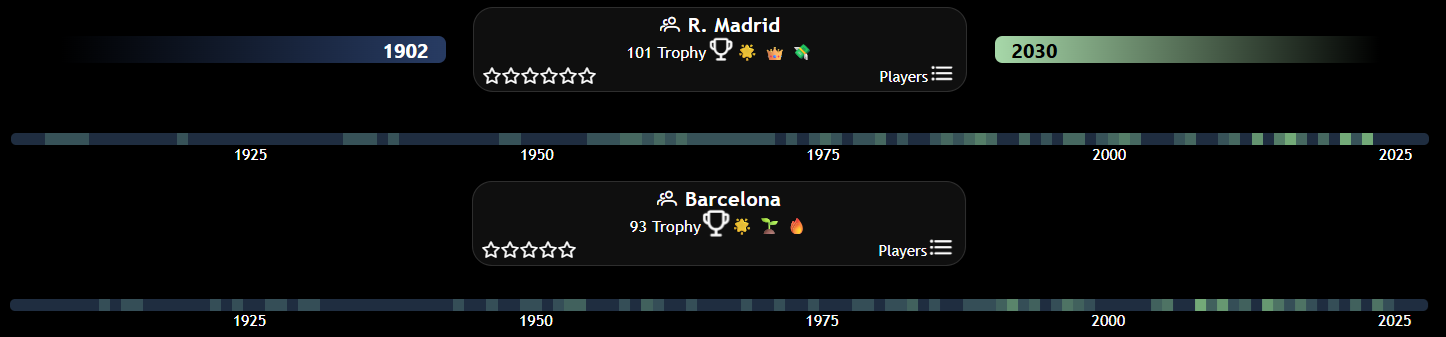
In the entire history of club football, no rivalry has produced more trophies, more narratives, or more genuine world-class dominance than the one between Real Madrid and FC Barcelona. Together, these two clubs account for more combined major titles than any other pair of clubs in the sport. Yet the story these timelines tell is not simply one of shared greatness. It is a story of alternating empires, of eras stolen and reclaimed, of two clubs that have spent 120 years trying to permanently outrun each other — and never quite managing it.
Reading their trophy timelines side by side is one of the most revealing exercises in football history. The clusters of success, the quiet periods, the sudden explosions of dominance — each tells you something not just about the clubs themselves, but about the coaches, the players, the financial realities, and the tactical philosophies of their respective eras.
The First Empire: Madrid's 1950s and the European Cup
Real Madrid's trophy timeline ignites in the mid-1950s with a density that is immediately visible even on a century-long chart. Between 1956 and 1960, Madrid won the first five European Cups in succession — a feat so extraordinary that the competition was essentially built around their dominance. These were not narrow victories or fortunate draws. Madrid's side of that era, featuring Di Stéfano, Puskás, and Gento, played a brand of attacking football that Europe had never witnessed at club level.
Barcelona's timeline in this same era is comparatively quiet. The club was winning domestic titles but had not yet found the formula to compete with Madrid on the European stage. This early asymmetry established a psychological dynamic that would shape the rivalry for decades: Madrid as the team of Europe, Barcelona as the team that wanted to be. That tension — never fully resolved — remains alive in the rivalry today.
The 1970s–1980s: A Rivalry in Low Gear
Looking at both timelines across the 1970s and into the 1980s, neither club dominates the chart in the way they would in later decades. Both Madrid and Barcelona were winning titles, but neither was constructing the kind of consecutive, multi-competition dominance that defines their greatest eras. Spanish football in this period was competitive and unpredictable — Athletic Bilbao, Real Sociedad, and Valencia all interrupted what might otherwise have been a cleaner duopoly.
For Barcelona, this was also a period of painful near-misses on the European stage. The arrival of Johan Cruyff as a player in 1973 had transformed the club's identity and briefly suggested a new direction, but sustained trophy success remained elusive. Madrid, meanwhile, continued to accumulate La Liga titles while struggling to recapture the European consistency of the Di Stéfano years.
Cruyff's Revolution: Barcelona Finds Its Identity
The most important moment in Barcelona's 20th-century trophy history is arguably not a single title but a coaching appointment. When Johan Cruyff returned to Camp Nou as manager in 1988, he did not just build a winning team — he installed a footballing philosophy that would define the club for the next four decades. His Dream Team of the late 1980s and early 1990s, featuring Koeman, Laudrup, Stoichkov, and a young Guardiola in midfield, won four consecutive La Liga titles and the club's first European Cup in 1992.
Barcelona's timeline thickens visibly in this period. The cluster of titles between 1991 and 1994 represents not just a run of success but the moment the club became structurally equipped to challenge Madrid's historical European status. The La Masia academy, the positional play, the pressing system — all of it traces back to Cruyff's Wembley win in 1992.
Madrid Responds: The Galácticos and the Return to Europe
Real Madrid's answer to Barcelona's philosophical reinvention was characteristically different in nature. Under Florentino Pérez and manager Vicente del Bosque in the late 1990s and early 2000s, Madrid pursued dominance through superstar acquisition — a strategy that produced two Champions League titles in three years with Zidane, Ronaldo, Figo, and Roberto Carlos. The 2002 final against Bayer Leverkusen, sealed by Zidane's legendary volley, is among the most iconic moments in the competition's history.
Madrid's timeline in this period reflects a club that had learned how to win in Europe again without waiting for a generational academy product to emerge. The Galácticos era was expensive, sometimes chaotic, and ultimately unsustainable — but it produced trophies at the highest level when it worked.
Real Madrid's 101 major trophies and Barcelona's 93 are separated by just eight titles across more than a century of competition. No other two clubs in world football come close to this level of sustained parallel excellence."Two clubs. One century. Still no winner."
The Greatest Era: Guardiola's Barcelona (2008–2012)
If one period stands out on Barcelona's timeline as an almost vertical spike, it is the four seasons between 2008 and 2012 under Pep Guardiola. With Messi, Xavi, Iniesta, Busquets, and Dani Alves at the core, Barcelona won 14 trophies in four seasons — including two Champions Leagues, three La Liga titles, and two Copa del Reys. More than the quantity, it was the manner of winning that made this era historic. The 2009 and 2011 Champions League victories were built on a style of football — possession-based, high-pressing, positionally sophisticated — that changed how the entire world thought about the game.
Madrid's timeline in this same window tells a story of a club in transition and then accelerating response. The appointment of José Mourinho in 2010 was a direct answer to Guardiola: Madrid needed a manager who could disrupt Barcelona's rhythm, win La Liga, and eventually reclaim European supremacy. Mourinho's three seasons produced one league title and consistent disruption of the Guardiola era, but the Champions League remained out of reach.
Messi vs Ronaldo: The Rivalry Within the Rivalry
Between 2009 and 2018, the fixture acquired a second layer that no previous version of El Clásico had carried: the direct, season-long competition between Lionel Messi and Cristiano Ronaldo for individual supremacy. Ronaldo joined Madrid in 2009, the same summer Guardiola's Barcelona began their peak run. What followed was nine years in which the two best players in the world faced each other repeatedly — in league games, cup ties, and Champions League knockouts — while simultaneously competing for the Ballon d'Or every single year.
Between them, Messi and Ronaldo won every Ballon d'Or from 2008 to 2017 without exception. In El Clásico specifically, both players produced performances that would have defined lesser careers in isolation. Ronaldo's hat-trick at Camp Nou in April 2012 — celebrated with his shirt raised to a hostile crowd — and Messi's last-minute winner at the Bernabéu in 2017 are moments that belong to both clubs' history equally, because they happened in the context of a fixture that was bigger than either player.
The Messi-Ronaldo era also inflated both clubs' trophy timelines in ways that are visible on the chart. Madrid's La Liga wins of 2012 and 2017 were driven in part by Ronaldo's 50-goal seasons. Barcelona's treble of 2015 was built around Messi at the apex of his powers alongside Suárez and Neymar. When Ronaldo left for Juventus in 2018 and both clubs entered transition periods, the fixture temporarily lost some of its individual theatre — but not its structural significance.
Madrid's Second European Dynasty: 2014–2018
What follows on Real Madrid's timeline after 2013 is perhaps the most extraordinary run in the modern Champions League era. Under Carlo Ancelotti and then Zinedine Zidane, Madrid won the competition four times in five seasons — including an unprecedented three consecutive titles between 2016 and 2018. The core of this run featured Cristiano Ronaldo at his peak, Sergio Ramos as the most dominant defender in European football, and Luka Modrić operating as perhaps the finest midfielder of his generation.
Barcelona's timeline in this same period is not empty — the club won the treble in 2015 under Luis Enrique, with Messi, Suárez, and Neymar forming arguably the most lethal attacking trio in Champions League history. But it cannot match the European consistency Madrid produced between 2014 and 2018. The departure of Guardiola, a series of management changes, and Barcelona's increasing difficulty finding a system that could replicate the Guardiola blueprint all contributed to a relative decline in European standing, even as domestic success continued.
Parallel Crises: 2019–2023
Both timelines thin noticeably in the early 2020s. Barcelona's financial collapse — the result of years of unsustainable wage structures and pandemic-driven revenue losses — forced the club into a period of painful austerity. The departure of Lionel Messi in the summer of 2021 was the most visible symbol of a crisis that ran far deeper than any single player. Domestically, Barcelona struggled to compete; in Europe, early exits became routine.
Madrid's crisis was less severe but visible nonetheless. The post-Ronaldo era required a reinvention of the club's attacking identity, and the Champions League victories of 2018 remained the last under that particular cycle of players. Yet Madrid's recovery was faster and more decisive than Barcelona's, rooted in financial stability and the emergence of Vinícius Júnior and Jude Bellingham as the core of a new generation.
The Present and What the Timelines Predict
Looking at both charts together in 2025, the pattern that emerges is one of the most consistent in sport: neither club stays down for long. Every quiet period on Madrid's timeline has been followed by a return to European dominance. Every crisis on Barcelona's has eventually given way to a rebuilt team capable of competing at the summit. The structural advantages both clubs possess — financial scale, global reach, world-class academies, institutional knowledge of winning — mean that short-term decline rarely becomes permanent.
Real Madrid currently hold 15 Champions League titles to Barcelona's 5. In La Liga, Madrid lead the all-time title count with 36 to Barcelona's 27. In the Copa del Rey, the balance reverses: Barcelona lead with 31 to Madrid's 20. Each competition tells a slightly different story about where each club has historically concentrated its greatest efforts — and where the rivalry remains genuinely open.
The gap in Champions League titles — 15 to 5 — is the clearest measure of Madrid's historical European superiority. But Barcelona's five wins came in five finals, a perfect record that no club has matched. Quality over quantity is not a defence against Madrid's volume, but it is not nothing either.
The timelines will continue to grow. Both clubs are rebuilding, both are investing, and both are already producing the next generation of players who will define another chapter. For anyone looking at those two lines of trophies stretching from the early 1900s to the present day, the most honest conclusion is also the most obvious one: this is not a rivalry that is moving toward a resolution. It is a rivalry that has decided, somewhere in its DNA, to never end.