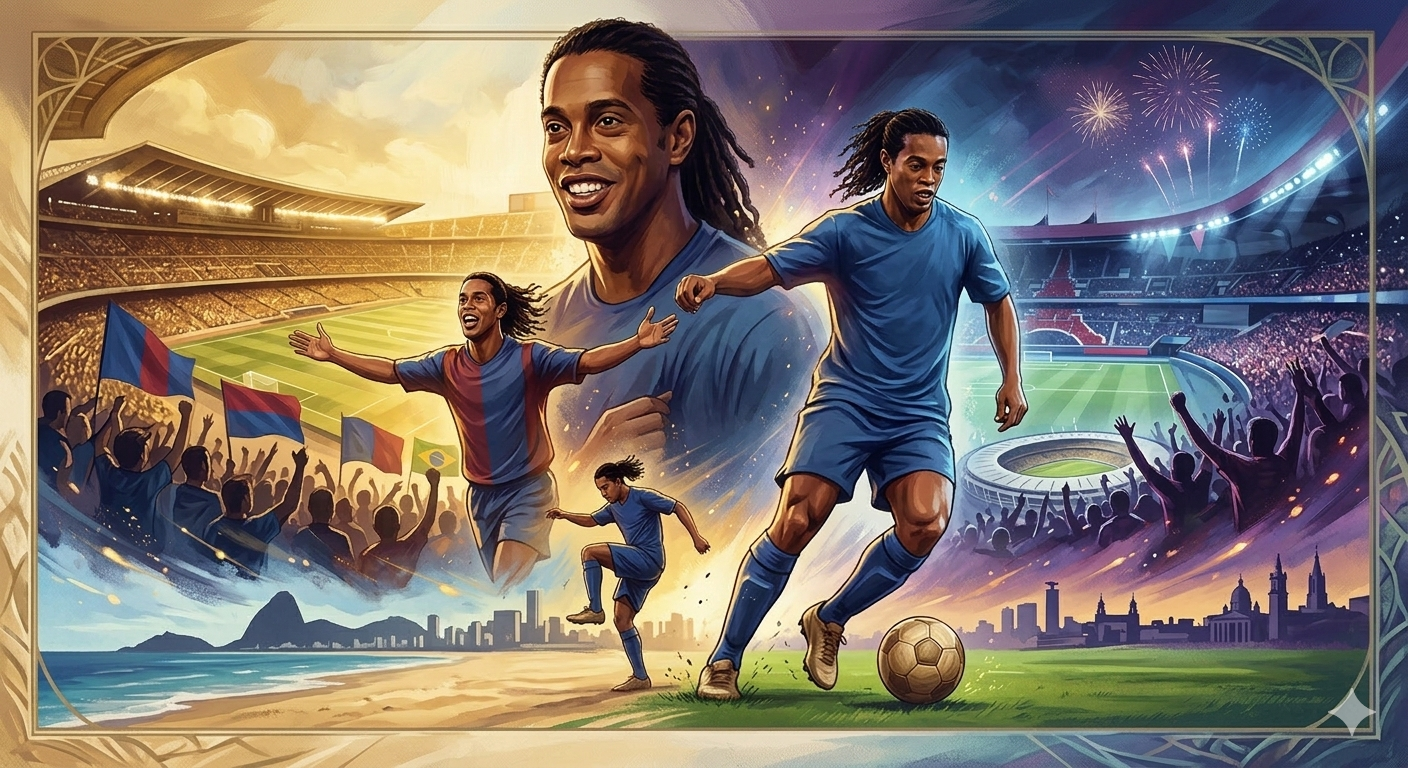
There have been footballers who were faster, players who were stronger, and athletes who were more disciplined. But there has never been a player who made the sport look quite as joyful as Ronaldinho. Ronaldo de Assis Moreira — known universally as Ronaldinho — scored 283 goals in 702 competitive club appearances, won the FIFA World Player of the Year award twice, and became the first player in history to receive a standing ovation at the Santiago Bernabéu as a visiting player. He won the World Cup, the Champions League, La Liga, and every individual honour the sport offers. But the trophies were secondary. What Ronaldinho gave football was something rarer — a reminder that at its core, the game is meant to be played.
Chapter I: Porto Alegre — The Boy from Vila Nova
Ronaldo de Assis Moreira was born on March 21, 1980, in Porto Alegre, the capital of the Rio Grande do Sul state in southern Brazil. The family lived in the working-class neighbourhood of Vila Nova, and football was the currency of childhood. His father, João, was an amateur footballer who worked at a steelworks. His older brother, Roberto de Assis Moreira — later his agent and closest advisor — was a talented player in his own right. When Ronaldinho was eight years old, his father died of a heart attack while swimming in the family pool. His mother, Miguelina, raised three children alone. The football continued.
The nickname Ronaldinho — simply "little Ronaldo" in Portuguese — was given to distinguish him from his more famous namesake, Ronaldo Nazário, who had emerged from Brazil just a few years earlier. At age thirteen, Ronaldinho scored all 23 goals in a youth tournament match — a feat reported in the local press and still cited as evidence that something extraordinary was present from the very beginning. He joined Grêmio, the Porto Alegre club, as a youth player, and made his professional debut in 1998 at age seventeen. Within two years, a queue of European clubs had formed.
Paris Saint-Germain moved first. In 2001, Ronaldinho joined PSG for approximately €5 million — a transfer that introduced European football to a player who would, within three years, be widely regarded as the best on the planet.
Chapter II: Paris Saint-Germain — Learning to Live in Europe
Ronaldinho's two seasons at PSG were not a triumph of silverware — Paris was still a decade away from becoming a power in European football — but they were an education. He scored 25 goals in 77 appearances and demonstrated, week by week, that the elastico, the no-look pass, and the heel flick were not street tricks. They were weapons. French defenders found them as difficult to handle as anyone else had.
His time in Paris was also complicated. A work-permit dispute in his first season threatened to derail the move entirely. He was suspended for a red card that, he argued, was the result of a misunderstanding caused by the language barrier. He missed games. He missed Brazil. But he never stopped smiling — and when his contract expired in 2003, every major club in Europe wanted him. The race came down to two: Manchester United and Barcelona. The story of how Barcelona won that race — and why — became one of the most consequential in the club's modern history.
Chapter III: Barcelona — The Resurrection of a Giant
When Ronaldinho arrived at the Camp Nou in the summer of 2003 for a fee reported at €30 million, Barcelona were not the club they would become. They had finished second in La Liga, their last Champions League title was a decade in the past, and the political and financial turbulence that had defined the club in the late 1990s had not entirely subsided. New president Joan Laporta had promised a renewal. Ronaldinho was to be its symbol.
He did not merely fulfil the brief — he exceeded it in ways that even Laporta could not have anticipated. In his first season, he won the Champions League's Best Forward award and finished third in the Ballon d'Or. In his second, he was named the best player on the planet. What he did for Barcelona was not just score goals and win matches — he transformed the culture of the club. The Camp Nou became, once again, a place where people came to be astonished rather than merely to win.
His tactical role was deceptively simple: play behind the striker, find space between the lines, and create. But the execution was anything but simple. Ronaldinho operated in a way that was structurally unpredictable — he would drift left, appear centrally, then suddenly be found on the right byline. Defenders could not position themselves against him because he did not have a fixed position. He had a philosophy: attack whenever possible, in whatever way presents itself.
Career Statistics by Club
| Club | Country | Years | Apps | Goals | Notable |
|---|---|---|---|---|---|
| Grêmio | Brazil | 1998–2001 | 55 | 23 | Debut at 17; local icon |
| Paris Saint-Germain | France | 2001–2003 | 77 | 25 | European breakthrough |
| Barcelona | Spain | 2003–2008 | 207 | 94 | 2× La Liga, 1× Champions League, 2× FIFA World Player of the Year |
| AC Milan | Italy | 2008–2010 | 95 | 20 | Struggled with form; serial injuries |
| Flamengo | Brazil | 2011 | 25 | 10 | Emotional homecoming |
| Atlético Mineiro | Brazil | 2012–2014 | 108 | 55 | 2× Copa Libertadores; Recopa Sudamericana |
| Fluminense | Brazil | 2015 | 30 | 11 | Final top-flight season in Brazil |
| Querétaro / Others | Mexico / etc. | 2014–2015 | 105 | 45 | Final seasons; farewell tour |
All competitions included. Career club total: approximately 283 goals in 702 appearances. International record: 33 goals in 97 caps for Brazil.
Chapter IV: The Numbers That Defined a Peak
The statistics from Ronaldinho's Barcelona peak are remarkable not only for their volume but for their context. Between 2004 and 2006, he won the FIFA World Player of the Year award in consecutive years — 2004 and 2005 — the first Barcelona player to achieve the feat, and one of only a handful of players to win it back-to-back in the award's history. What the numbers do not capture is the manner in which those contributions were made.
| Season | Club | Goals | Assists | All Comps Goals | Award |
|---|---|---|---|---|---|
| 2003–04 | Barcelona | 15 | 12 | 22 | Champions League Best Forward · Ballon d'Or 3rd |
| 2004–05 | Barcelona | 13 | 14 | 21 | FIFA World Player of the Year · Ballon d'Or Winner · La Liga |
| 2005–06 | Barcelona | 17 | 15 | 26 | FIFA World Player of the Year · Ballon d'Or Winner · Champions League · La Liga |
| 2006–07 | Barcelona | 21 | 13 | 27 | La Liga top scorer (Barcelona) · form beginning to fluctuate |
| 2007–08 | Barcelona | 9 | 8 | 13 | Final season; departure to Milan confirmed |
La Liga stats. In 2005–06, Ronaldinho registered 17 league goals and 15 assists — one of the most complete individual attacking seasons in La Liga history at the time.
Chapter V: The Bernabéu — A Standing Ovation
On November 19, 2005, Barcelona travelled to the Santiago Bernabéu for a La Liga fixture against Real Madrid. Barcelona won 3–0. Ronaldinho scored twice — a composed finish for the second and, late in the game, a curling shot with the outside of his right boot for the third that seemed to disobey the physics governing every other player on the pitch. Both goals were met with silence from the home crowd. Then, something without precedent occurred: the Real Madrid supporters rose to their feet and applauded a visiting player — a gesture so rare at the Bernabéu that journalists present described it as unique in living memory.
Ronaldinho ran back toward the centre circle with both arms raised and that smile — the widest smile in football — already forming. It was not the reaction of a man who had expected the reception. It was the reaction of a man who was genuinely, unperformatively, happy to be playing football. That quality — his authentic, visible joy in the act of playing — was as significant as any technical attribute he possessed. It was contagious. It made opponents want to watch him rather than stop him.
The scoreline when Ronaldinho scored his second goal at the Bernabéu on November 19, 2005 — the moment that prompted Real Madrid's own supporters to applaud a visiting player for the first time in modern memory. Barcelona won 3–0. "He did things that were impossible. And then he smiled about it." — Carles Puyol
Chapter VI: Brazil — A World Cup in the Veins
Ronaldinho's international career with Brazil spanned 97 caps and 33 goals from 1999 to 2013 — a record that placed him among the most-capped players in the Seleção's history. But one tournament defined his international legacy above all others.
At the 2002 FIFA World Cup in Japan and South Korea, Ronaldinho arrived as the tournament's most anticipated young player — and delivered. His free-kick goal against England in the quarter-finals, which looped over goalkeeper David Seaman from 35 yards and dropped under the bar, became one of the most debated goals of the tournament: was it a cross that caught the wind, or a deliberate shot? Ronaldinho's expression after scoring — the grin, the open arms, the look toward teammates — suggested he knew exactly what he had done. He was named in the Team of the Tournament as Brazil lifted the trophy, their fifth World Cup title and Ronaldinho's only one. He was 22 years old.
What followed at the 2006 World Cup in Germany was, by contrast, a disappointment — Brazil were eliminated in the quarter-finals by France, with Ronaldinho peripheral throughout. The 2010 World Cup came one cycle too late; he was not selected. The 2002 triumph remains the peak of his international record, and for many observers it remains sufficient. Winning a World Cup at 22 with the kind of performances he produced is not a career shortcoming. It is a career definition.
Five Goals That Defined a Career
| Date | Match | Club/Country | Description |
|---|---|---|---|
| Jun 2002 | England vs Brazil (WC QF) | Brazil | Looping 35-yard free-kick over David Seaman — intentional or the greatest accidental goal in World Cup history, depending on who you ask. Either way, it knocked England out. |
| Nov 2004 | Barcelona vs Chelsea (UCL) | Barcelona | No-look pass, then instant first-time finish after a give-and-go that Chelsea's defence simply did not see coming — a goal that announced him on the European stage in his debut Champions League campaign. |
| Nov 2005 | Real Madrid vs Barcelona | Barcelona | Second goal in a 3–0 win — curled with the outside of the right boot past the goalkeeper; prompted the Bernabéu standing ovation, the most celebrated reception any visiting player has ever received at that stadium. |
| Apr 2006 | Barcelona vs Chelsea (UCL SF) | Barcelona | Nutmeg, elastico and a finish from a tight angle — in a match Barcelona needed to win to reach their second consecutive Champions League final. The complete inventory of his technical gifts, assembled in one sequence. |
| Dec 2012 | Atlético Mineiro vs Danubio (Copa Libertadores) | Atlético Mineiro | A chip from outside the box, into the top corner, in the Copa Libertadores group stage — proof, at 32, that the magic had not diminished; it had simply moved continents. |
Chapter VII: AC Milan and the Decline — A Very Human Story
In the summer of 2008, Ronaldinho left Barcelona for AC Milan in a deal worth approximately €21 million. He was 28 years old — ordinarily the beginning of a player's prime years. What followed was not a second peak, but it was not, as sometimes portrayed, a collapse.
At Milan, Ronaldinho produced moments of genuine quality — he scored 20 goals in 95 appearances and delivered several performances that recalled his Barcelona years. But the consistency was gone. A combination of factors — lifestyle choices that were widely reported in the Italian press, an ankle injury in his first season, and a Milan squad that was aging around him — meant that the player who had arrived was not quite the player fans expected. By 2010, it was clear that the next chapter would be written in Brazil.
Chapter VIII: The Return Home — Libertadores and Late Magic
What followed Ronaldinho's departure from Milan was, in many ways, the most underappreciated phase of his career. After brief spells at Flamengo and Atlético Mineiro, the latter provided him with his most significant late-career success. With Atlético Mineiro, Ronaldinho won the Copa Libertadores in 2013 — South America's premier club competition — becoming one of the few players in history to win both the Copa Libertadores and the UEFA Champions League.
He was named the Copa Libertadores Best Player in 2013 at the age of 32 — a reminder that while the pace had gone and the athleticism had diminished, the intelligence, the technique and the instinct remained. He left Atlético for Fluminense in 2015, and retired at 35 after brief stints in Mexico and with the national team of Querétaro FC.
The Trophy Cabinet
| Trophy | Times | Details |
|---|---|---|
| FIFA World Cup | ×1 | Brazil 2002 — Team of the Tournament |
| UEFA Champions League | ×1 | Barcelona 2005–06 |
| La Liga | ×2 | Barcelona 2004–05, 2005–06 |
| Copa Libertadores | ×1 | Atlético Mineiro 2013 — Tournament Best Player |
| Recopa Sudamericana | ×1 | Atlético Mineiro 2014 |
| FIFA Club World Cup | ×1 | Barcelona 2009 (squad member) |
| Copa del Rey | ×1 | Barcelona 2008–09 (squad member) |
| Campeonato Brasileiro | ×1 | Flamengo 2011 (runner-up era; Atlético won in 2012) |
| FIFA World Player of the Year | ×2 | 2004, 2005 — first Barcelona player to win the award |
| Ballon d'Or | ×1 | 2005 — highest-ever score at the time (225 points) |
| UEFA Club Footballer of the Year | ×1 | 2006 |
| Champions League Best Forward | ×1 | 2006 |
| Copa Libertadores Best Player | ×1 | 2013 |
| Brazilian Footballer of the Year | ×1 | 2004 |
| Onze de Bronze (Onze Mondial) | ×3 | 2004, 2005, 2006 |
Chapter IX: The Legacy — What Ronaldinho Actually Changed
The debate about Ronaldinho's place in the pantheon of the all-time greats is, in part, a debate about what we value in football. If the metric is longevity and consistency across a full career, Ronaldinho ranks below Messi and Cristiano Ronaldo, both of whom sustained their levels for a decade or more beyond his own peak. If the metric is the intensity of a peak — the years between 2004 and 2006 when he was, without serious dispute, the best player on earth — the comparison becomes much more complicated.
But Ronaldinho's legacy is not purely statistical, and it is not purely competitive. His contribution to football was cultural. He was inducted into the Brazilian Football Museum Hall of Fame and the FIFA World Cup Hall of Fame, and in 2020 he was named by Pelé among the 125 greatest living footballers. More significantly, he is the player most often cited by the generation of footballers who came after him — including Messi himself, who has spoken repeatedly about the influence Ronaldinho had on his development during their years together at Barcelona — as the reason they fell in love with football.
Goals scored for Barcelona across all competitions in 207 appearances — a record of contribution that helped transform the club from mid-table La Liga contenders back into champions of Europe. "When I was young and thought about football, I thought about Ronaldinho." — Lionel Messi
His influence on the next generation is visible in the style of play that defines modern football — the willingness to attempt skill moves in tight spaces, the value placed on creativity over caution, the understanding that a player does not have to choose between entertaining and winning. Ronaldinho proved that the two things were, at their best, the same thing.
The game he played was not perfect. His career was shorter than it should have been, interrupted by personal choices that he has been open about in the years since retirement. But no player in the modern era has been watched by more people who simply wanted to see what he would do next. That quality — the sense that anything was possible, that the next touch might be the best thing anyone had ever seen — is not a statistic. It is a relationship between a player and the people who watched him. Ronaldinho had it in abundance, and football has not seen its like since.
He retired in 2018 — officially ending a playing career that had continued in various forms — and was inducted into the Brazilian Football Museum Hall of Fame. The smile that followed him through every dressing room, every press conference and every pitch remains the most recognisable thing about him. It was not a performance. It was an honest report on how he felt about football, every single time he played it.