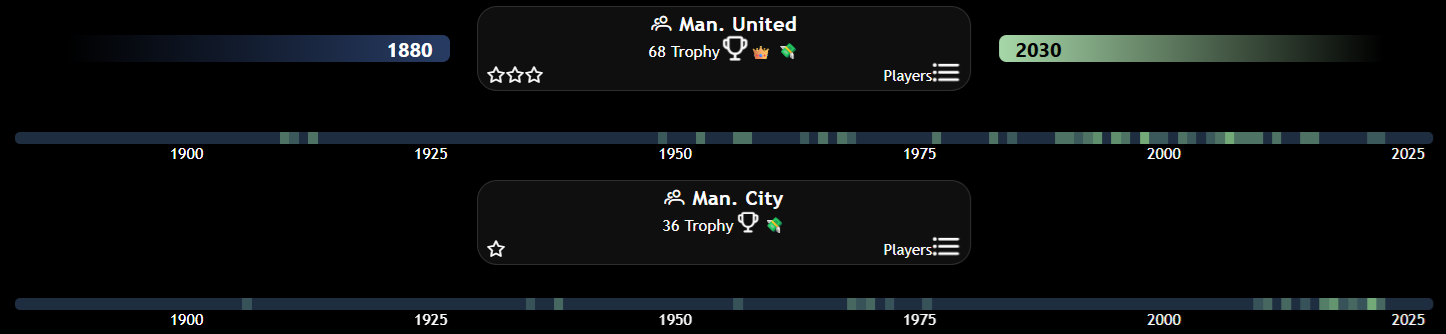
The Manchester derby is one of the most watched club fixtures on the planet. But for most of its history, it was not a rivalry in any meaningful sense of the word. Manchester United spent the better part of a century building one of the greatest trophy records in English football. Manchester City spent much of that same period in the second division, struggling for relevance in a city their neighbours had long since claimed. The timeline comparison tells that story with brutal clarity: United's line of trophies runs deep from the early 1900s onward, while City's chart stays thin until a single inflection point changes everything.
That inflection point is 2008. The Abu Dhabi United Group's takeover of Manchester City did not just bring money to the club — it brought a structural transformation so complete that within fifteen years, City had accumulated 36 major trophies and become the most dominant force in English football. The question the two timelines now pose is one of the most interesting in the sport: when one club builds its identity over a century and another builds it over fifteen years, which foundation is more durable?
United's First Century: Building the Template
Manchester United's trophy timeline through the early and mid-twentieth century is not spectacular by volume — English football in this period was genuinely competitive, and sustained dominance was harder to construct than it would become in the Premier League era. But United were consistently present at the top of the game in a way City were not. FA Cup wins in 1909 and 1948 established the club's early identity, and the First Division title of 1952 signalled a return to the summit after the disruption of the war years.
What United were building in this period was not just a trophy cabinet but a culture. The appointment of Matt Busby as manager in 1945 began a process of institutional construction that would define the club for decades. Busby did not just develop players — he developed a playing philosophy, a youth structure, and an identity that survived even the Munich air disaster of 1958, when eight of his players were killed and the club was forced to rebuild from almost nothing.
The Busby Years: Europe and the First Empire
The 1960s represent the first genuine spike on United's timeline. With Bobby Charlton, Denis Law, and George Best forming one of the most gifted attacking trios English football had ever produced, United won the First Division in 1965 and 1967 before becoming the first English club to win the European Cup in 1968. That Wembley final against Benfica, ten years after Munich, remains one of the most emotionally charged evenings in the club's history.
City's timeline in this same period is not entirely empty — they won the First Division in 1968 and the European Cup Winners' Cup in 1970 — but the contrast in volume and sustained ambition is visible. United were competing for the biggest prizes in European football. City were competitive at home but had not yet found the consistency to challenge for the sport's highest honours across multiple seasons.
The Long Wait: United's Quiet Decades
Between 1968 and 1993, United did not win the First Division title once. This is the longest quiet period on their timeline — twenty-six years in which the club won FA Cups and the Cup Winners' Cup but could not reclaim the league. Liverpool dominated English football through the 1970s and 1980s in a way that pushed United into the role of frustrated challenger. For City, this same period was even more turbulent, featuring relegations, financial difficulties, and a complete absence from the European stage.
The appointment of Alex Ferguson as United manager in November 1986 is the moment that changes the shape of the United timeline permanently. Ferguson's first six years at the club were difficult — he famously came close to being sacked before an FA Cup run in 1990 saved his position — but the infrastructure he was quietly building during that period would eventually produce the most sustained period of English club dominance the modern game has seen.
The Ferguson Era: Twenty-Seven Years of Dominance
From 1993 to 2013, United's trophy timeline becomes almost unreadable in its density. Thirteen Premier League titles, five FA Cups, four League Cups, and two Champions League trophies represent a level of sustained excellence that no English club has matched before or since. The 1998–99 treble — Premier League, FA Cup, and Champions League in a single season, sealed by two stoppage-time goals against Bayern Munich in Barcelona — is the single most dramatic achievement in United's history and one of the most extraordinary nights in the sport.
City during this same period were irrelevant to the title conversation for most of it. They were relegated to the third tier of English football in 1998 — the same year United were winning the treble — and spent years rebuilding before Sheikh Mansour's takeover in 2008 changed the club's trajectory entirely.
Manchester United's 68 major trophies were accumulated over more than a century. Manchester City's 36 were built almost entirely within fifteen years of the Abu Dhabi takeover in 2008. No acquisition in football history has compressed a club's trophy timeline more dramatically."United built an empire. City bought one. Both are real."
The Takeover and the Transformation: City After 2008
The 2008 takeover is the single most important event on City's timeline, and its effect is visible immediately. Within three years, City had won the FA Cup in 2011 — their first major trophy in thirty-five years. Within four, they had won the Premier League in the most dramatic circumstances in the competition's history: Sergio Agüero's goal in the 93rd minute of the final day of the 2011–12 season, against QPR, gave City the title on goal difference from United. It is the most celebrated moment in City's history, and one of the most watched goals ever scored in English football.
What followed was not a flash of success but a systematic construction of one of the most complete squads in the world. Roberto Mancini, Manuel Pellegrini, and then Pep Guardiola — appointed in 2016 — each added layers to a club that was being built to win not occasionally but consistently. Guardiola's arrival in particular accelerated City's development into something the English game had never seen: a club willing to spend whatever was necessary to play a specific brand of football, and prepared to lose titles in the short term rather than compromise on the philosophy.
The Guardiola Era: Six Titles in Seven Years
Between 2018 and 2024, City won six Premier League titles in seven seasons — a rate of dominance that exceeded even Ferguson's United at their peak. The 2017–18 season, in which City accumulated 100 points, was widely regarded as the most dominant single-season performance in English football history. The 2022–23 treble — Premier League, FA Cup, and Champions League — was the first in City's history and placed them alongside United in an exclusive company of English clubs to have achieved that feat.
United's timeline during this same period is at its thinnest since the pre-Ferguson years. After Ferguson's retirement in 2013, United cycled through David Moyes, Louis van Gaal, José Mourinho, Ole Gunnar Solskjær, Ralf Rangnick, and Erik ten Hag in rapid succession, winning an FA Cup and a League Cup but failing to mount a serious Premier League challenge. The structural advantages Ferguson had built — the scouting network, the youth pipeline, the institutional authority of the manager — proved difficult to replicate once he was gone.
What the Gap of 32 Trophies Actually Means
The 68 to 36 gap in major trophies tells an accurate story but requires context. United's advantage is almost entirely a product of the Ferguson years and the century of football that preceded City's transformation. If you isolate the period from 2008 to the present, City have won more than United — it is not even particularly close. The question of which club is now the dominant force in Manchester, and in England, has a clear answer in the short term.
The longer-term question is more interesting. United's trophy record includes 20 league titles to City's 10, and 3 Champions League trophies to City's 1. In the competitions that carry the most historical weight, United still lead. But City are accumulating at a rate that, if sustained, will close those gaps within a generation. At their current pace, City will match United's total league title count sometime in the 2030s.
Two Models, One City
What makes this rivalry genuinely fascinating from an analytical perspective is that the two clubs represent opposite models of how sustained success is built. United's identity was constructed over decades through youth development, managerial continuity, and the kind of institutional knowledge that only time can provide. City's was constructed in fifteen years through financial investment, elite recruitment, and a coaching philosophy imported wholesale from one of the game's most sophisticated tactical thinkers.
Neither model is inherently superior — both have produced genuine dominance. But the trophy timelines suggest that United's model, when it works, produces a more broadly distributed pattern of success. City's, by contrast, is concentrated and intense: fewer years of winning, but a higher rate of winning within those years.
Both clubs are currently in transition. United are attempting, under new ownership following the Glazer era, to rebuild the structural foundations that Ferguson's departure exposed. City are managing the post-Guardiola succession question that every club built around a single manager's philosophy eventually faces. The timelines will continue to grow, and the gap between 68 and 36 will continue to narrow. Whether it ever closes — and which club defines Manchester football for the next generation — is the question the next chapter of this rivalry will answer.