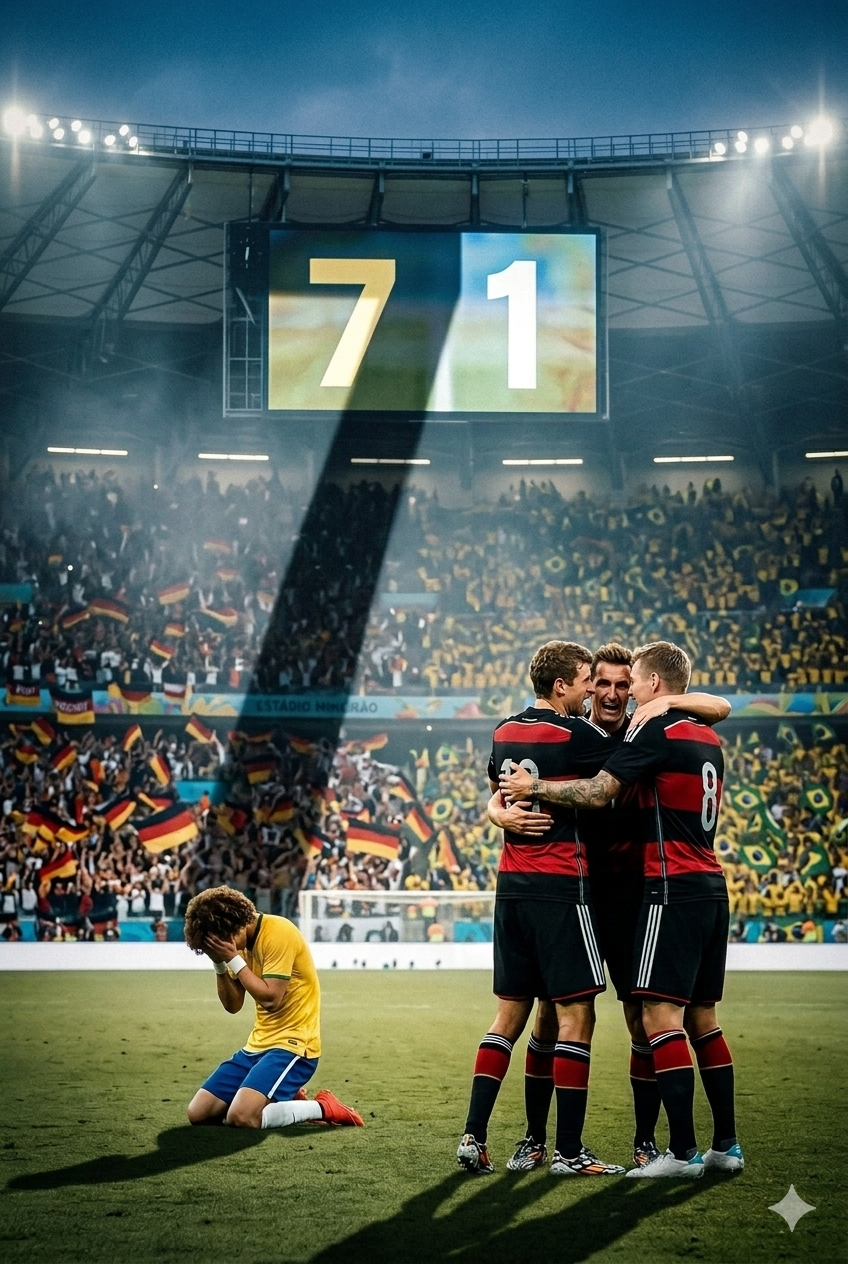
On July 8, 2014, the 2014 FIFA World Cup semi-final between host nation Brazil and Germany produced the largest margin of victory in World Cup semi-final history. In the space of six minutes — between the 23rd and 29th — Germany scored four goals against the five-time world champions on their own soil. The final score, 1–7, remains Brazil's heaviest defeat in World Cup history, the fastest four-goal sequence in the competition's history, and a night that permanently altered how Brazilian football understood itself.
The Weight of Expectation
No national team has ever carried the burden of hosting a World Cup quite like Brazil in 2014. The memory of the 1950 Maracanazo — the devastating home defeat to Uruguay in the final round of that tournament — had haunted the country's football culture for 64 years. The 2014 tournament was widely understood not merely as a sporting event but as an opportunity for national redemption. Coach Luiz Felipe Scolari, who had won the World Cup with Brazil in 2002, stated on the eve of the tournament: "There is no other objective we are interested in."
Brazil's path to the semi-final had been turbulent. They scraped past Chile on penalties in the round of 16 and beat Colombia 2–1 in the quarter-finals — but in that match Neymar, their captain and most creative player, suffered a fractured third vertebra from a knee to the back from Colombian defender Juan Zúñiga. He would take no further part in the tournament. Then, in the semi-final, defender and captain Thiago Silva was suspended after accumulating yellow cards. Brazil faced Germany without the two players most central to everything they did.
Germany's Systematic Build-Up
Germany arrived in Belo Horizonte as one of the competition's strongest sides. Under Joachim Löw, they had spent years developing a style built on high pressing, rapid ball circulation, and positional fluidity. Their squad combined experienced leaders — Philipp Lahm, Bastian Schweinsteiger, Miroslav Klose — with technically brilliant younger players: Toni Kroos, Mesut Özil, André Schürrle, Thomas Müller. This was Germany's fourth successive World Cup semi-final. They were not here to lose again.
The Starting Line-Ups
| Brazil | Germany |
|---|---|
| Júlio César | Manuel Neuer |
| Maicon | Philipp Lahm |
| Dante | Jerome Boateng |
| David Luiz | Mats Hummels |
| Marcelo | Benedikt Höwedes |
| Fernandinho | Sami Khedira |
| Luiz Gustavo | Bastian Schweinsteiger |
| Ramires | Toni Kroos ★ |
| Oscar | Thomas Müller |
| Hulk | Miroslav Klose |
| Fred | Mesut Özil |
★ Toni Kroos named Man of the Match: 2 goals, 1 assist, 93% pass accuracy. Thiago Silva (suspended) and Neymar (injured) absent for Brazil. André Schürrle came on as substitute in the second half and scored twice.
Goal by Goal: The Collapse
| Min | Scorer | Score | How |
|---|---|---|---|
| 11′ | Müller (GER) | 0–1 | Corner kick, close-range finish — Brazil defence ball-watching |
| 23′ | Klose (GER) | 0–2 | Rebound after save — Klose's 16th World Cup goal, surpassing Ronaldo's record of 15 |
| 24′ | Kroos (GER) | 0–3 | Left-foot strike from edge of area after Lahm cross deflected |
| 26′ | Kroos (GER) | 0–4 | Steals ball from Fernandinho, one-two with Khedira, taps in — 4 secs after kick-off |
| 29′ | Khedira (GER) | 0–5 | Runs onto Özil through ball, finishes calmly — Brazil in total disarray |
| 69′ | Schürrle (GER) | 0–6 | Sub, 14 mins on pitch — drives low shot past Júlio César |
| 79′ | Schürrle (GER) | 0–7 | Powerful top-corner finish — Germany's seventh in 79 minutes |
| 90′ | Oscar (BRA) | 1–7 | Consolation goal — Brazilian supporters cheer sarcastically |
Rows highlighted in red mark the six-minute sequence (23′–29′) — the fastest four goals in World Cup history. Half-time score: 0–5. Between the 20th and 30th minute, Germany completed just 25 passes but scored four times.
Four goals in six minutes. Germany completed just 25 passes in that ten-minute window but attempted six shots and scored four times. The fastest four-goal sequence in World Cup history — breaking the previous record set by Austria in 1954 (seven minutes). "This is not happening." — every commentator simultaneously.
The Six Minutes in Detail
The anatomy of Brazil's collapse reveals a team that had stopped functioning as a unit almost entirely. Germany's second goal, in the 23rd minute, came from a Toni Kroos–Thomas Müller combination that split Brazil's centre-backs; Miroslav Klose reacted to the goalkeeper's parry and tapped in. The goal made Klose the all-time top scorer in World Cup history with 16 goals, surpassing Ronaldo's previous record of 15. The irony was complete — the record was broken against Brazil, with Ronaldo himself watching from the commentary booth.
One minute later, Kroos struck a left-footed shot from the edge of the area after a deflected cross. Then, in the 26th minute — just four seconds after Brazil had kicked off following Germany's third goal — Kroos intercepted a Fernandinhopass in midfield, played a quick one-two with Sami Khedira, and slotted the ball into the bottom corner. Brazil had not even had time to reach their own half. Three minutes later Khedira ran onto an Özil through ball and calmly finished for 5–0. The half-time whistle was met with stunned silence from 58,141 spectators, many of whom were already in tears.
The Human Cost
Inside the dressing room at half-time, Scolari's Brazil faced an impossible task not merely tactically but psychologically. Several players were visibly shaking. David Luiz — deputising as captain in Thiago Silva's absence — later described the dressing room as a scene he could never fully put into words. Striker Fred, who was subjected to boos from his own supporters throughout, later said: "When the match ended, I wanted to climb into a hole and never come back. I was booed at the Mineirão, my home."
The aftermath for Brazilian football was severe. Of the squad members who played in 2014, 10 players never represented Brazil againafter the tournament: Júlio César, Dante, Maxwell, Henrique, Ramires, Hernanes, Bernard, Jô, Fred and Victor. An entire generation of international footballers effectively ended their Brazil careers on the night of July 8th.
Match Statistics
| Brazil | Stat | Germany |
|---|---|---|
| 1 | Final Score | 7 |
| 47% | Possession | 53% |
| 18 | Total Shots | 14 |
| 8 | Shots on Target | 10 |
| 7 | Corners | 5 |
| 1 | Yellow Cards | 0 |
| Luiz Gustavo | Yellow Card | — |
| Toni Kroos | Man of the Match | — |
| Luiz F. Scolari | Manager | Joachim Löw |
Despite having more total shots than Germany (18 vs 14), Brazil conceded seven. Germany scored with 50% of their shots on target. Brazil's pass accuracy was 86% — the collapse was tactical and psychological, not statistical.
The Records That Fell
The scale of what happened at the Mineirão can be measured partly through the records it produced. It was Brazil's heaviest ever World Cup defeat, surpassing their 3–0 loss to France in the 1998 final. Germany equalled Austria's 7–5 win over Switzerland in 1954 as the most goals ever scored by a single team against a World Cup host nation. Germany's seven goals moved them past Brazil to become the all-time highest-scoring nation in World Cup history — a record that still stands. And Klose's record of 16 World Cup goals, set on that night, remains unbroken.
Germany went on to defeat Argentina 1–0 in the final, with Mario Götze scoring the winner in extra time. The Mineirazo was not a fluke — it was the semi-final performance of a team that completed the tournament without conceding in open play in either their semi-final or final. Brazil, meanwhile, lost their third-place play-off 0–3 to the Netherlands.
A Name That Entered the Language
The word Mineirazo — coined immediately after the match, echoing the Maracanazo of 1950 — entered the Brazilian football vocabulary permanently. It is used not only to describe the result but the particular character of what occurred: a collapse so complete, so public, and so symbolically loaded that it could not be explained by tactics or absences alone. It represented something about the gap between expectation and reality, about the fragility of national identity when placed entirely on the outcome of a football match.
More than a decade later, the images from that night endure: a Brazilian supporter in the stands with tears streaming down his face, the scoreboard reading 0–5 at half-time, David Luiz collapsing to his knees on the final whistle. In a sport that produces dramatic moments with regularity, the Mineirazo stands apart — not because of a single goal or a single save, but because of everything it destroyed in the space of six minutes.