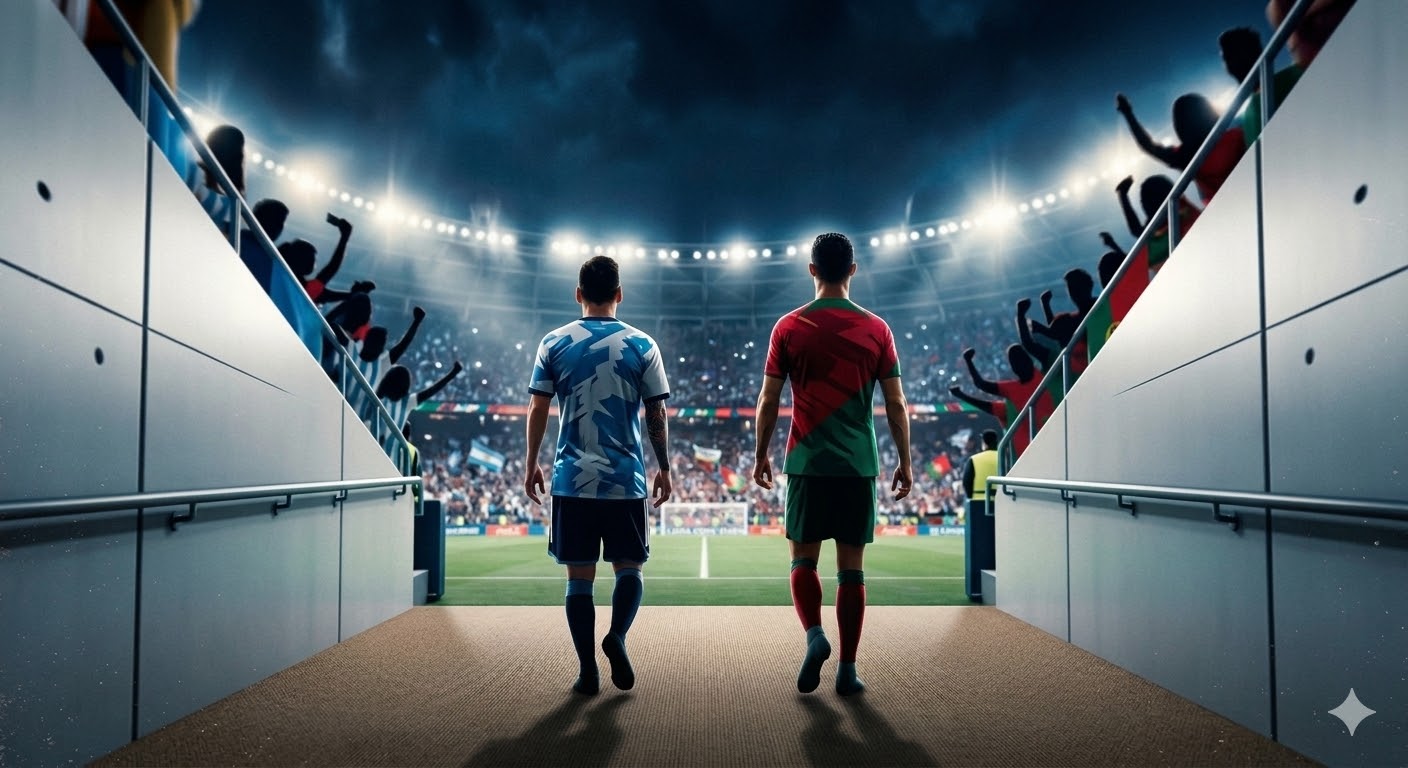
For more than a decade, world football revolved around two extraordinary players: Lionel Messi and Cristiano Ronaldo. Their rivalry defined an entire era of the sport. Week after week, season after season, the two superstars pushed each other to new levels of performance, rewriting records and captivating billions of fans across the globe. Between them they have scored over 1,000 senior career goals, claimed 13 Ballon d'Or awards, and appeared in seven Champions League finals. No individual rivalry in the history of football has produced numbers like theirs — and no debate has ever divided supporters so passionately or so joyfully.
The Rise of Two Icons
Lionel Messi emerged from FC Barcelona's famous La Masia academy as one of the most technically gifted players the sport had ever seen. Born in Rosario, Argentina in 1987, he made his competitive debut for Barcelona at just 17 years old in October 2004. His low centre of gravity, extraordinary close control, and natural playmaking instincts made him nearly impossible to defend. From the 2008–09 season under Pep Guardiola onwards, Messi became the undisputed focal point of the greatest club side of his generation — a team that won the treble twice, in 2009 and 2015.
Cristiano Ronaldo's path was different. Born in Funchal, Madeira in 1985, he rose through the ranks at Sporting CP before a move to Manchester United at the age of 18 announced him to European football. Ronaldo developed into one of the most physically dominant athletes the game had ever witnessed. His speed, strength, aerial ability, and devastating shooting made him a constant threat from any position. In 2009 he became the subject of what was then the most expensive transfer in history — a move to Real Madrid for €94 million — and it was there that he evolved into the most prolific goal scorer the sport has ever seen.
The two first faced each other in the 2007–08 UEFA Champions League semi-finals, when Manchester United were drawn against Barcelona. Almost immediately, journalists and supporters began pitting them as rivals. The debate had begun — and it would last two decades.
The Ballon d'Or Era
Between 2008 and 2017, the Ballon d'Or was won by nobody else. Ronaldo claimed it first in 2008 with Manchester United, the year he also won the Champions League and the Premier League. Messi then seized four consecutive awards from 2009 through 2012, an unprecedented run of dominance that coincided with Barcelona's most successful period. Ronaldo struck back with back-to-back wins in 2013 and 2014, driven by Champions League glory with Real Madrid, then again in 2016 and 2017as Madrid won three consecutive European titles.
Messi reclaimed the lead with a sixth award in 2019, then a seventh in 2021 and an eighth in2023 — the last of those coming after his crowning achievement with Argentina at the 2022 FIFA World Cup. The final tally: Messi 8, Ronaldo 5. In 2024, for the first time since 2003, neither player was nominated among the thirty candidates — a moment widely described as the end of an era.
Messi's eight Ballon d'Or awards against Ronaldo's five represent the most decorated individual duel in football history. Between 2008 and 2023, they shared every award but one — Luka Modrić's solitary win in 2018, which Modrić himself described as coming from players "at another level.""Every time one raised the standard, the other responded."
The Numbers That Define an Era
Statistics alone cannot capture the full story, but they help frame the scale of what both players achieved. Messi is the all-time top scorer in La Liga history with 474 goals in 520 appearances — a Guinness World Record. He finished as Barcelona's all-time top scorer with 672 goals in 778 official appearances for the club, and scored a record 91 goals in a single calendar year in 2012. In the Champions League, he scored 129 goals across his career, making him the competition's second-highest scorer of all time. He won the European Golden Shoe six times.
Ronaldo's numbers carry a different kind of weight — built on relentless accumulation across multiple leagues and clubs. He is the all-time leading scorer in Champions League history with 141 goals, and became the first player ever to reach 100 in the competition. At Real Madrid alone he scored 451 goals in 438 appearances, averaging more than a goal per game. He is the only player in history to score 50 or more goals in the Premier League, La Liga, and Serie A. His international record of 143 goals in 226 appearances for Portugal makes him the most prolific international scorer in the history of the sport. His total senior career tally stands above 960 goals for club and country.
Head-to-Head: Career Statistics
| Stat | Messi | Ronaldo |
|---|---|---|
| Ballon d'Or Awards | 8 | 5 |
| Champions League Goals | 129 | 141 ★ |
| Champions League Titles | 4 | 5 |
| La Liga Goals | 474 ★ | 311 |
| Goals for Primary Club | 672 (Barcelona) | 451 (Real Madrid) |
| International Goals | 115 (Argentina) | 143 ★ (Portugal) |
| European Golden Shoe | 6 ★ | 4 |
| Goals in a Calendar Year | 91 ★ (2012) | 69 (2013) |
| World Cup / Euro | World Cup 2022 ★ | Euro 2016 ★ |
| League Titles | 11 (La Liga) | 7 (PL/La Liga/SA) |
★ denotes the higher figure in each category. Stats reflect senior career totals as of early 2026.
The El Clásico Era
The rivalry reached its most intense pitch between 2009 and 2018, when Messi and Ronaldo faced each other regularly in Spain's legendary El Clásico clashes. Messi led Barcelona's attacking brilliance while Ronaldo spearheaded Real Madrid's relentless pursuit. No El Clásico encounter between the two clubs during that era ever finished goalless. Messi became the all-time top scorer in El Clásico history with 26 goals against Real Madrid. In a March 2014 fixture alone — one described as one of the greatest Clásicos ever played — Messi scored a hat-trick as Barcelona won 4–3, while Ronaldo scored from the penalty spot to temporarily put Madrid ahead. Millions tuned in worldwide not only for the match itself but to see which superstar would deliver the decisive moment.
Champions League Records
In Europe's premier club competition, both players rewrote the record books in ways that are unlikely to be matched for decades. Ronaldo became the first player to score in three Champions League finals and won the competition five times in total — once with Manchester United in 2008 and four times with Real Madrid between 2014 and 2018. In the 2013–14 season he set the record for most goals in a single Champions League campaign with 17. He was also the competition's top scorer in seven different seasons.
Messi won the Champions League four times with Barcelona and was the competition's top scorer in six different seasons. He scored in 18 consecutive editions of the tournament — a record — and is the only player to have scored in 16 successive campaigns for the same club. Between them, the two players dominated the Champions League's individual scoring charts for twelve consecutive seasons from 2008 to 2019.
Different Styles, Same Greatness
What made the rivalry so compelling was the stark contrast in playing styles. Messi's game was built on creativity, subtle movement, and extraordinary technical precision. He could glide past defenders with effortless dribbling and create scoring opportunities from seemingly impossible positions — operating most dangerously as a false nine or second striker, dropping deep to collect the ball before driving forward with devastating effect.
Ronaldo, on the other hand, represented the ultimate expression of physical excellence combined with relentless dedication. His powerful shooting, incredible jumping ability — famously reaching heights above 2.5 metres at the peak of his career — and tireless work ethic made him one of the most complete attacking players ever seen. Where Messi dazzled with artistry, Ronaldo dominated with athleticism. One made football look effortless. The other made it look inevitable.
The Messi Question: World Cup and International Glory
For many years, one shadow hung over Messi's legacy in a way that Ronaldo — a European champion with Portugal in 2016 — could use to his advantage in the debate. Messi had reached three Copa América finals and a World Cup final before the 2021 Copa América finally delivered Argentina's first international trophy since 1993, with Messi lifting the cup at the Maracanã. Then came the 2022 FIFA World Cup in Qatar — where Messi scored 7 goals and 3 assists across seven matches before lifting the trophy after a penalty shootout victory over France in a 3–3 final. At 35, he had achieved the one title that had eluded him throughout his career, and in doing so silenced the last remaining argument against his claim to greatness.
Beyond Competition
While the debate among supporters was often fierce, both players repeatedly acknowledged each other's achievements. Their competition pushed them to standards of consistency that had never been seen before — Messi scoring 30 or more goals in thirteen consecutive seasons, Ronaldo reaching 50 goals in three different top-flight leagues. Younger generations of players grew up with Messi and Ronaldo as the definition of what elite football looked like. For over a decade, they were not merely the two best players in the world — they existed in a category entirely of their own.
In September 2024, neither player appeared among the thirty candidates for the Ballon d'Or for the first time in over twenty years. It was, in every sense, the closing of an era. Messi, at 38, continues to play for Inter Miami in Major League Soccer. Ronaldo, at 41, remains an active scorer for Al Nassr in Saudi Arabia. The rivalry may have left the European stage, but its place in football history is permanent.
Messi vs Ronaldo was never only about statistics or trophies. It represented the relentless pursuit of greatness, the power of competition to elevate both participants, and football at its absolute highest level. For a generation of supporters, it remains the greatest individual rivalry the sport has ever seen — and in all likelihood, the greatest it ever will.