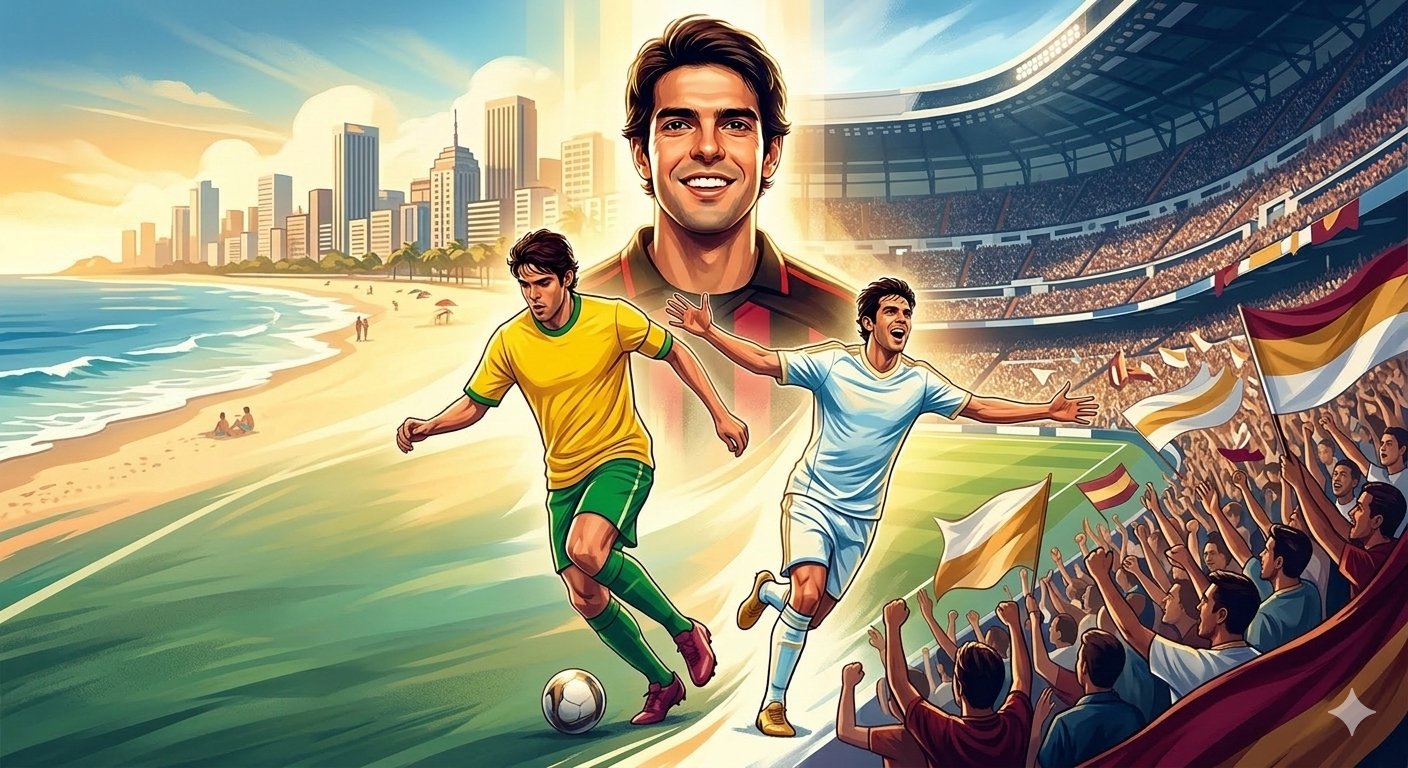
There is a window in football history — roughly 2005 to 2007 — when neither Lionel Messi nor Cristiano Ronaldo had yet claimed the sport's highest individual honour. Into that window stepped one player: Ricardo Izecson dos Santos Leite — known to the world as Kaká — who won the 2007 Ballon d'Or and FIFA World Player of the Year ahead of Messi and Ronaldo, becoming one of only eight players in history to win the FIFA World Cup, the UEFA Champions League and the Ballon d'Or. He was fast, elegant, technically immaculate, and deeply faithful — a player who wore his religion on his shirt and his talent everywhere else. In an era already transitioning toward the extraordinary, Kaká was the last of a kind: the pure number ten, the classic trequartista, the player who made the assist as beautiful as the goal.
Chapter I: Gama — The Accident That Changed Everything
Ricardo Izecson dos Santos Leite was born on April 22, 1982, in Gama, a satellite city of Brasília in the Federal District of Brazil. His father, Bosco, was a civil engineer; his mother, Simone, an elementary school teacher. The family later moved to São Paulo, where Kaká — a childhood nickname given by his younger brother Rodrigo, who could not pronounce "Ricardo" — joined the youth academy of São Paulo FC at the age of eight.
At eighteen years old, before a single senior appearance, Kaká suffered a spinal fracture in a swimming pool accident. The impact was severe enough that doctors considered the possibility of permanent paralysis. He recovered fully — a recovery he has attributed, consistently and without equivocation, to his Christian faith. The experience transformed him. From that point forward he played with a purpose that extended beyond football, writing "I belong to Jesus" on the back of his shirt after every significant goal. The habit became his signature — as recognisable, in its way, as the acceleration that left defenders standing.
He made his senior debut for São Paulo on February 1, 2001, scoring 12 goals in 27 appearances in his first season. In his second, 10 goals in 22 matches. By the time he left in 2003 with 23 goals in 58 appearances, the queue of European clubs waiting to sign him had been forming for two years. The club that moved first — and fastest — was AC Milan.
Chapter II: AC Milan — Arrival at the San Siro
Milan signed Kaká in the summer of 2003 for a reported €8.5 million — a sum their owner Silvio Berlusconi would later describe as "peanuts." He was 21 years old. Within a month of arriving he had displaced the experienced Rui Costa in the attacking midfield role behind Shevchenko, Inzaghi and Tomasson. The transition was immediate and complete.
His first season brought a Serie A title — Milan's 17th Scudetto — and Kaká contributed 10 goals and several decisive assists, including the cross that set up Andriy Shevchenko's title-deciding header. He was named the UEFA Club Midfielder of the Year in 2004–05 after leading Milan back to the Champions League final, where they suffered the infamous defeat to Liverpool in Istanbul on penalties — one of the most painful results in the club's history, and one that set the stage for everything that followed two years later.
His role at Milan was the purest expression of the trequartista — the attacking midfielder who operates in the space between the opposition's midfield and defensive lines. Kaká would receive the ball facing goal, carry it at pace through central channels, and either shoot from distance or thread a through ball to the strikers arriving late. What made him exceptional was not just the technique but the speed: he was among the fastest players at the club, and his combination of pace with close control in tight spaces was something Italian football had rarely seen in that position.
Career Statistics by Club
| Club | Country | Years | Apps | Goals | Notable |
|---|---|---|---|---|---|
| São Paulo | Brazil | 2001–2003 | 58 | 23 | Torneio Rio-São Paulo title; European interest begins |
| AC Milan | Italy | 2003–2009 | 307 | 104 | 1× Serie A, 1× Champions League, Ballon d'Or, FIFA World Player of the Year |
| Real Madrid | Spain | 2009–2013 | 120 | 29 | 1× La Liga, 1× Copa del Rey; hampered by injuries throughout |
| AC Milan (2nd spell) | Italy | 2013–2014 | 35 | 10 | Free transfer; 100th Milan goal vs Atalanta; 300th appearance for the club |
| Orlando City SC | USA | 2015–2017 | 74 | 24 | MLS Designated Player; MLS All-Star 2015; retired Dec 2017 |
| São Paulo (loan) | Brazil | 2014 | 14 | 3 | Brief MLS off-season loan to boyhood club |
All competitions included. Career club total: approximately 193 goals in 608 appearances. International record: 29 goals in 92 caps for Brazil.
Chapter III: 2006–07 — The Perfect Season
The 2006–07 UEFA Champions League campaign is the defining chapter of Kaká's career, and one of the most dominant individual performances in the tournament's history. Kaká scored 10 goals in 13 Champions League matches that season — finishing as the tournament's top scorer — and led AC Milan to the final in Athens, where they defeated Liverpool 2–1 to claim their seventh European title. The Ballon d'Or that followed was not a surprise. It was a confirmation.
The campaign produced moments that have entered Champions League folklore. Against Celtic in the round of sixteen, with the tie level and regulation time expiring, Kaká picked up the ball on the edge of the area, drove past the last defender, and curled a left-footed shot under the goalkeeper in the 93rd minute. Against Bayern Munich in the quarter-finals, he scored in both legs. But it was the semi-final against Manchester United that confirmed him as the best player on earth.
Chapter IV: Old Trafford — The Goal Against the World
On April 24, 2007, AC Milan travelled to Old Trafford for the first leg of the Champions League semi-final. In a match Milan eventually lost 3–2, Kaká scored twice — overturning Cristiano Ronaldo's early goal with a left-footed finish and then a solo run described by UEFA as going down in Rossoneri history, leaving both Gabriel Heinze and Patrice Evra powerless to intervene. The 3–2 deficit Milan took back to the San Siro was, in context, almost irrelevant. The second leg — a 3–0 victory at the San Siro so complete it was dubbed "The Perfect Match" — confirmed what the first leg had demonstrated: Kaká was operating in a different register from everyone else in European football.
Goals scored by Kaká in the 2006–07 Champions League — the tournament's top scorer, finishing comfortably clear of the field on six goals. His ten goals in 13 matches came from midfield, not from a striker's position. "A player at the peak of his powers — a cut above his peers right across the tie." — UEFA.com, on Kaká's semi-final performance against Manchester United
Chapter V: The Numbers Behind the Peak
Kaká's statistical output at Milan, particularly between 2004 and 2008, represented something unusual for a player who was not a striker. Across his entire AC Milan career he scored 104 goals and registered 85 assists in all competitions — numbers that remain exceptional for an attacking midfielder, and a record for the position in the club's modern history.
| Season | Club | Serie A Goals | UCL Goals | All Comps Goals | Award |
|---|---|---|---|---|---|
| 2003–04 | AC Milan | 10 | 4 | 17 | Serie A title · UEFA Super Cup |
| 2004–05 | AC Milan | 7 | 6 | 14 | UEFA Club Midfielder of the Year · UCL runner-up |
| 2005–06 | AC Milan | 14 | 4 | 20 | Serie A top assists; UEFA Club Footballer nominee |
| 2006–07 | AC Milan | 8 | 10 | 20 | Ballon d'Or · FIFA World Player of the Year · UCL top scorer · UCL winner |
| 2007–08 | AC Milan | 15 | 5 | 22 | FIFA Club World Cup · UEFA Super Cup |
| 2008–09 | AC Milan | 9 | 4 | 14 | Final season at Milan; Real Madrid move confirmed |
All competitions. In 2006–07 Kaká's 10 UCL goals came from midfield across 13 matches — he finished the tournament well clear of the field, with the next-highest scorers on six goals each.
Five Goals That Defined a Career
| Date | Match | Club | Description |
|---|---|---|---|
| Mar 2007 | AC Milan vs Celtic (UCL R16) | AC Milan | 93rd minute: solo run from deep, past the last defender, composed left-footed finish under the keeper — the goal that kept Milan in the tournament. He had described it as the moment the entire 2006–07 campaign was decided. |
| Apr 2007 | Man United vs AC Milan (UCL SF) | AC Milan | His finest goal in a Milan shirt, by his own admission: controlling a headed flick from Dida's throw, going past Heinze, and finishing right-footed past van der Sar — at Old Trafford, in a semi-final. The stadium applauded. |
| Nov 2006 | AC Milan vs Anderlecht (UCL) | AC Milan | Hat-trick in 56 minutes in the Champions League group stage — three different finishes from midfield in one match. His 10th, 11th and 12th goals of the season, in November. The clearest single performance of what he was capable of. |
| Apr 2006 | AC Milan vs Chievo (Serie A) | AC Milan | His first hat-trick for the Rossoneri — all three scored in the second half, all from midfield range. Proof that the 2007 peak had been years in the making, not a sudden emergence. |
| Jan 2014 | AC Milan vs Atalanta (Serie A) | AC Milan | His 100th goal for Milan, at 31, in his second spell — scoring twice in the same match on his return. A number that few pure midfielders have reached at a single club; a moment that confirmed the depth of what he had given the Rossoneri over a decade. |
Chapter VI: Brazil — A World Cup at Twenty
Kaká's international career began in January 2002at nineteen years old, and within six months he was a World Cup winner. At the 2002 FIFA World Cup in Japan and South Korea, Kaká was part of a Brazil squad so rich in talent — Ronaldo, Ronaldinho, Rivaldo, Roberto Carlos — that he later recalled not fully understanding the scale of what they had achieved until the team returned home to Brazil. He was twenty years old, starting games from the bench, and a world champion. It remains the only World Cup winners' medal of his career.
Over the following decade he earned 92 international capsand scored 29 goals for Brazil — a record for an attacking midfielder from his country in his generation. He captained the side at the 2006 World Cup in Germany, where Brazil were eliminated in the quarter-finals by France. At the 2010 World Cup in South Africa, injury and inconsistent form limited his impact, and Brazil again fell in the quarter-finals, this time to the Netherlands. The 2002 triumph remained both the beginning and the peak of his international story.
Chapter VII: Real Madrid — €67 Million and a Knee That Would Not Hold
In the summer of 2009, Real Madrid paid €67 million for Kaká — the second-highest transfer fee in history at the time. He arrived at the Bernabéu as the reigning Ballon d'Or winner. Kaká was the last player to hold the Ballon d'Or before Messi and Ronaldo began their decade-long duopoly — the two players he had beaten in 2007 went on to claim the award for the following eleven years combined. What followed at Madrid was four seasons interrupted almost continuously by injury.
A chronic left knee problem required surgery in August 2010. He returned, played, and then suffered an iliotibial band injury in 2011. By the time he was fit again, the Madrid midfield had been reorganised around different players and a different system. He contributed 29 goals and 32 assists in 120 appearances across four seasons — numbers that, for almost any other player, would represent a successful European tenure. For Kaká, given what he had been, they represented a kind of quiet diminishment that no one had anticipated. He won La Liga in 2011–12 and the Copa del Rey in 2010–11, and left by mutual consent in August 2013.
The Trophy Cabinet
| Trophy | Times | Details |
|---|---|---|
| FIFA World Cup | ×1 | Brazil 2002 — winner at age 20 |
| UEFA Champions League | ×1 | AC Milan 2006–07 — tournament top scorer with 10 goals in 13 matches |
| Serie A | ×1 | AC Milan 2003–04 |
| La Liga | ×1 | Real Madrid 2011–12 |
| Copa del Rey | ×1 | Real Madrid 2010–11 |
| FIFA Club World Cup | ×1 | AC Milan 2007 |
| UEFA Super Cup | ×2 | AC Milan 2003, 2007 |
| Supercoppa Italiana | ×1 | AC Milan 2004 |
| Confederations Cup | ×2 | Brazil 2005, 2009 |
| Ballon d'Or | ×1 | 2007 — ahead of Cristiano Ronaldo and Lionel Messi |
| FIFA World Player of the Year | ×1 | 2007 — last Brazilian to hold the award to date |
| UEFA Club Footballer of the Year | ×1 | 2007 |
| UCL Top Scorer | ×1 | 2006–07 — 10 goals, finishing clear of the field on six |
| UEFA Club Midfielder of the Year | ×1 | 2004–05 |
| Brazilian Footballer of the Year | ×2 | 2006, 2007 |
Chapter VIII: Return to Milan, Orlando and the End
In September 2013, Kaká returned to AC Milan on a free transfer. He was made vice-captain on arrival, tore an adductor muscle in his first competitive appearance, and characteristically refused to accept wages from the club while injured. When fit, he delivered moments that justified every sentiment attached to the return: scoring his 100th goal for Milan against Atalanta in January 2014, and appearing in his 300th match for the club two months later. The contract was terminated by mutual consent in June 2014 after Milan failed to qualify for European competition.
He joined Orlando City SC in MLS in January 2015, becoming their first Designated Player. He played three seasons in Florida, was named an MLS All-Star in 2015, and retired in December 2017 at 35. He is one of only a handful of players to have scored 100 goals for a European club from a midfield position, and one of even fewer to have done so at a single club before a second spell added to the count.
Goals for AC Milan across both spells — a record for any attacking midfielder in the club's history. The 85 assists registered alongside them complete the picture: Kaká was not a scorer who also created. He was a creator who also scored. "He won it ahead of Messi and Ronaldo — the two players who would then split the award between them for the following eleven years." — Goal.com, on the 2007 Ballon d'Or
Chapter IX: The Legacy — The Player Between Two Eras
Kaká's place in history is defined, in part, by timing. He won the Ballon d'Or in 2007 — the last year in which it was possible to do so without being either Messi or Ronaldo. The two players who finished behind him that evening in Zurich went on to claim the award for eleven of the following twelve years. In a FIFA interview, Kaká reflected on their sustained dominance with characteristic generosity, calling it "fair" given what both players produced year after year — while noting that the gap between his era and theirs had made it harder for Brazilian football to produce the next winner.
What he represented tactically was a position that no longer exists in quite the same form. The classic trequartista — operating between the lines, receiving with his back to midfield and turning at pace, running through central channels rather than from wide positions — has been largely absorbed by the demands of modern pressing systems. Kaká played the role in its purest form at the highest level, and was the best player on the planet doing so. The position that defined his career was being phased out by football at exactly the moment his own career was beginning to wind down.
He retired in 2017 as one of only eight players in the history of the game to have won the FIFA World Cup, the UEFA Champions League and the Ballon d'Or. The shirt he wore at every goal celebration — the one that read "I belong to Jesus" — was as much a part of his identity as the number 22. He was the rare athlete who seemed entirely at peace with what he was doing and why he was doing it. In a sport that rewards ego, Kaká was conspicuously without one. That quality, combined with the speed of thought and foot that made him extraordinary, meant that those who watched him remember not just the goals but the manner in which they were scored: with something close to serenity.