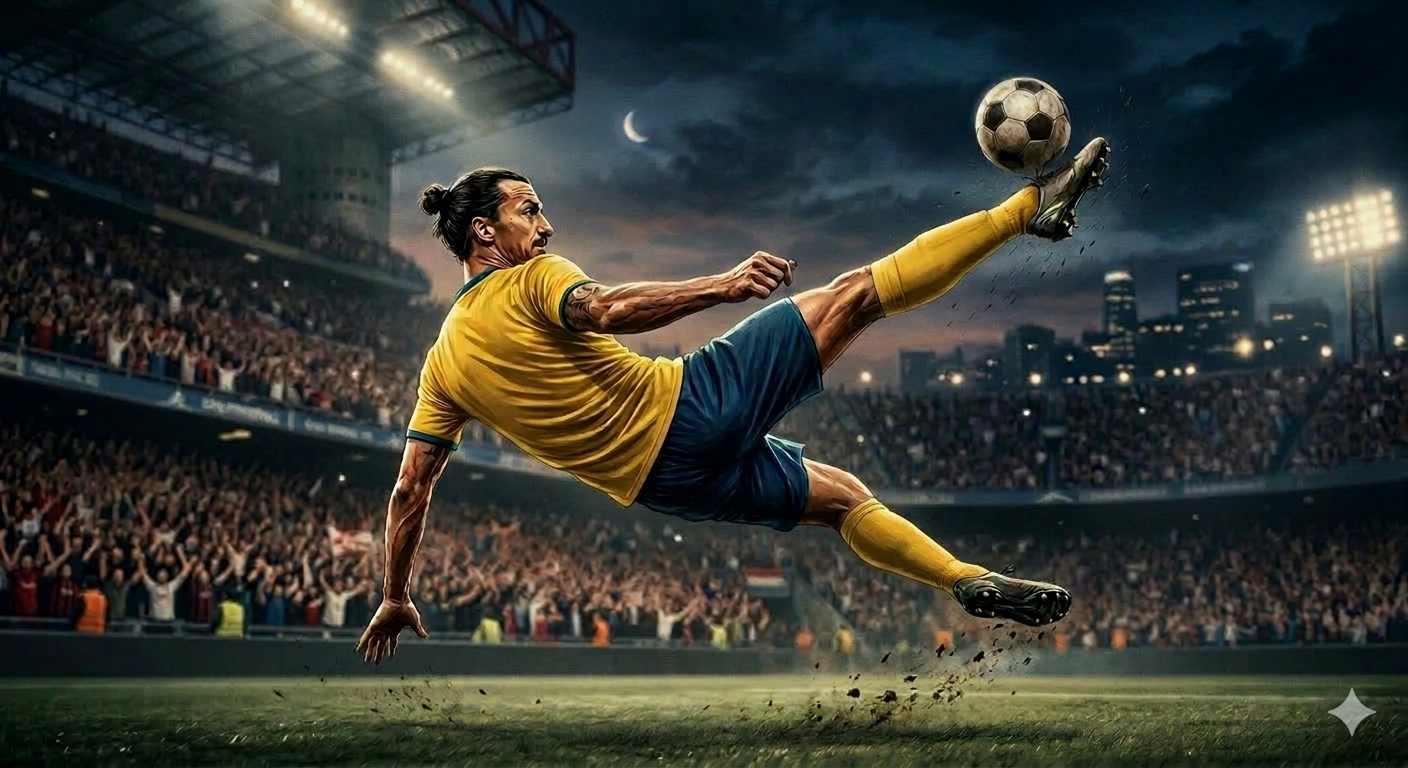
There has never been a footballer quite like Zlatan Ibrahimović — a striker who won league titles in six different countries across a 24-season career. In an era defined by the binary rivalry of Lionel Messi and Cristiano Ronaldo, he stood apart — not competing for their crown, but refusing to acknowledge it existed. He scored more than 570 goals, won league titles in Sweden, the Netherlands, Italy, Spain, France and England, and remained one of the most feared strikers on the planet well into his forties. He was vain, brilliant, infuriating, and unforgettable — a six-foot-five centre-forward who could produce overhead kicks from 30 yards and dribble past defenders half his age. No other player in the history of the game combined his physical authority with his technical extravagance. He was, in every sense, the last of his kind.
Chapter I: Rosengård — Where It All Began
Zlatan Ibrahimović was born on October 3, 1981, in Malmö, Sweden, to a Bosnian father and a Croatian mother who had emigrated to Sweden in the 1970s. He grew up in Rosengård, a densely populated suburb on the eastern edge of Malmö with high unemployment and a large immigrant population. It was, by most conventional measures, a difficult environment — but football was everywhere. Zlatan played on concrete pitches and in cramped cages from the age of six, developing an improvised, acrobatic style born from playing in tight spaces with older, bigger boys.
His talent was unmistakable from early childhood. He joined Malmö FF's youth academy at ten and quickly stood out for his combination of strength, technique and an almost pathological self-belief. At fifteen, he nearly quit football entirely — frustrated with his lack of first-team opportunities — but was persuaded to stay by his youth coach. It was a decision that would change the history of European football. By seventeen, he had broken into Malmö's first team. By eighteen, he was the best young striker in Scandinavia. By nineteen, he was sold to Ajax Amsterdam for €8.7 million — the most expensive transfer in Swedish football history at the time.
Chapter II: Ajax — Learning to Be Extraordinary
At Ajax, Ibrahimović encountered the most technically demanding footballing environment of his young life. The club's legendary coaching structure — built on positional discipline, first-touch precision and total football principles — challenged every instinct he had developed on the streets of Rosengård. Co Adriaanse, his first coach at the club, reportedly told Ibrahimović early in his Ajax career that he would never succeed because he couldn't head the ball. According to Zlatan, his response was simple: "I don't head balls. That's for lesser players."
Whether apocryphal or not, the story captures something true about his four years in Amsterdam. He was not always easy to manage. He fell out with teammates. He demanded the ball in positions coaches did not always sanction. And yet the goals kept coming — and the technical quality of his performances grew with every season. Under Ronald Koeman and later Co Adriaanse, he developed the full repertoire that would define his career: the roulette turn, the no-look pass, the bicycle kick, the laser-guided long-range finish. In four seasons at Ajax he scored 48 goals in 110 appearances and won two Eredivisie titles. He was, at 22, the most exciting young striker in European football.
Career Statistics by Club
| Club | Country | Years | Apps | Goals | Trophies |
|---|---|---|---|---|---|
| Malmö FF | Sweden | 1999–2001 | 40 | 18 | 1× Allsvenskan |
| Ajax | Netherlands | 2001–2004 | 110 | 48 | 2× Eredivisie |
| Juventus | Italy | 2004–2006 | 92 | 26 | 2× Serie A* |
| Inter Milan | Italy | 2006–2009 | 117 | 66 | 3× Serie A |
| Barcelona | Spain | 2009–2010 | 46 | 22 | 1× La Liga |
| AC Milan | Italy | 2010–2012 | 85 | 56 | 1× Serie A |
| PSG | France | 2012–2016 | 180 | 156 | 4× Ligue 1 |
| Manchester United | England | 2016–2018 | 53 | 29 | 1× Europa League |
| LA Galaxy | USA | 2018–2019 | 58 | 53 | — |
| AC Milan (return) | Italy | 2020–2023 | 61 | 35 | 1× Serie A |
* Juventus's 2004–05 and 2005–06 Serie A titles were stripped due to the Calciopoli match-fixing scandal. Appearances and goals include all competitions. Second AC Milan spell listed separately for clarity.
Chapter III: Juventus — The Education of a Superstar
In the summer of 2004, Juventus paid Ajax €16 million for Ibrahimović — doubling his transfer fee in three years. Turin was a different world from Amsterdam: a club of European aristocracy, Champions League semi-finals and deeply conservative tactical philosophy. His manager, Fabio Capello, was not a coach who tolerated self-expression at the expense of function. He demanded discipline, defensive work rate and positional rigour from every player, including his most talented ones.
Ibrahimović adapted. Under Capello's demanding system he became a more complete footballer — learning to link play, to drop deep, to hold the ball under pressure and bring teammates into the game. He won two league titles with Juventus — though both were subsequently stripped following the Calciopoli scandal of 2006, in which Juventus were found to have engaged in systematic match-fixing and were relegated to Serie B. It remains one of the most bittersweet chapters of his career: his finest football of that period, and nothing officially to show for it.
When Juventus were relegated, Ibrahimović had already been sold. Inter Milan, under the extraordinary José Mourinho, paid €24.8 million for him — and the most productive phase of his Italian career was about to begin.
Chapter IV: Inter Milan — Mourinho, Scudetti and the Making of a Legend
The three seasons Ibrahimović spent at Inter Milanbetween 2006 and 2009 were the years he became genuinely irreplaceable. Under José Mourinho — who understood better than perhaps any other coach how to get the maximum from elite, difficult personalities — Zlatan won three consecutive Serie A titles and established himself as the best striker in the world outside of Barcelona.
The relationship between player and manager was one of mutual respect and occasional friction. Mourinho indulged Ibrahimović's eccentricities while demanding total commitment when the team needed it. He deployed him in a deep-lying role that allowed him to influence play from all areas of the attacking third — a tactical decision that transformed Ibrahimović from a penalty-box predator into a complete centre-forward. His numbers in Milan were extraordinary: 66 goals in 117 appearances, including a Serie A top scorer award in the 2008–09 season with 25 league goals.
Then, at the summit of Italian football, he made the most controversial decision of his career.
Chapter V: Barcelona — The Year That Defined Him
In the summer of 2009, Barcelona — freshly crowned Champions League winners under Pep Guardiola — signed Ibrahimović for a world-record €69.5 million, with Samuel Eto'o going the other way as part of the deal. It was, on paper, the perfect marriage: the world's greatest team and one of the world's two or three greatest individual players. In practice, it lasted barely twelve months and ended in what Ibrahimović would later describe, in characteristically direct terms, as one of the most psychologically damaging experiences of his career.
The problem was not his goals — he scored 22 in 46 appearancesand won La Liga in his only season. The problem was Guardiola's system. Barcelona's positional play demanded that every player — including the centre-forward — operate within strictly defined spatial zones, pressing from the front and vacating areas for overlapping midfielders to exploit. Ibrahimović, whose entire identity was built on improvisation and freedom of movement, found the constraints suffocating. The relationship with Guardiola deteriorated rapidly. In his autobiography, Zlatan wrote with barely disguised contempt about the Catalan coach — describing him as a man who hid behind his philosophy rather than confronting problems directly.
The world-record fee Barcelona paid for Ibrahimović in 2009 — only for the experiment to end after a single season. He was loaned to AC Milan twelve months later. "He told me I wasn't in his plans. I said, 'You don't deserve me.'"
After just one season, Ibrahimović was loaned to AC Milan. The world-record signing had become an inconvenience. It was, he later admitted, the moment he understood that talent alone was not enough — that football, at the highest level, was also a political game. He left Barcelona with a league title, a wound, and a determination to prove that the world's greatest team had made a catastrophic mistake.
Chapter VI: AC Milan — The Redemption
The loan to AC Milan in the summer of 2010 was supposed to be a footnote. It became one of the most productive spells of his entire career. Free of Barcelona's tactical straitjacket, Ibrahimović rediscovered his joy. Under Massimiliano Allegri, he led Milan to the 2010–11 Serie A title — his fourth Italian league championship — with 28 goals in all competitions. The loan was made permanent the following summer for €24 million.
His two seasons at Milan produced 56 goals in 85 appearancesand two of the most celebrated goals of his career. Against Napoli in January 2012, he produced a scorpion kick from six yardsthat left the goalkeeper and 80,000 spectators entirely stationary. Against Cesena, he scored from the halfway line with a calmly placed chip over the goalkeeper — a goal that seemed to belong to a different sport entirely.
Five Goals That Defined a Career
| Date | Match | Club | Description |
|---|---|---|---|
| Nov 2004 | Juventus vs Lecce | Juventus | Roulette turn past four defenders, composed finish — later voted Serie A goal of the season |
| Nov 2009 | Barcelona vs Inter Milan | Barcelona | Instinctive overhead kick volley inside the six-yard box against his former club |
| Jan 2012 | AC Milan vs Napoli | AC Milan | Scorpion kick from close range — possibly the most technically audacious goal ever scored in Serie A |
| Nov 2012 | Sweden vs England | Sweden NT | Two goals including a 35-yard bicycle kick that won the 2013 FIFA Puskás Award |
| Oct 2018 | LA Galaxy vs Toronto FC | LA Galaxy | Bicycle kick from 20 yards in the 85th minute to win an MLS playoff match — at age 36 |
Chapter VII: PSG — King of Paris
In the summer of 2012, Paris Saint-Germain — newly taken over by Qatari sovereign wealth fund QSI and determined to build one of Europe's great clubs from scratch — signed Ibrahimović on a free transfer. He was thirty years old. What followed was the most statistically dominant period of his entire career.
Over four seasons at the Parc des Princes, Ibrahimović scored 156 goals in 180 appearances — an extraordinary return for a player in his thirties — and won four consecutive Ligue 1 titles. He was not merely the best player in France; he was in a different category entirely. In the 2015–16 season alone he scored 50 goals in all competitions, becoming only the second player in PSG's history to reach that mark in a single campaign. He won the Ligue 1 top scorer award four times. He captained the side. He became, in the fullest sense, the face and symbol of the new PSG project.
His most celebrated moment in a PSG shirt came on November 14, 2012, in a friendly international that had nothing to do with club football — but everything to do with who Zlatan Ibrahimović was. Playing for Sweden against England at Friends Arena in Stockholm, he scored four goals, the last of which — a 35-yard overhead bicycle kick that was voted the 2013 FIFA Puskás Award winner with 48.7% of the fan vote — looped over Joe Hart and into the top corner. England manager Roy Hodgson, asked about the goal afterwards, paused for several seconds before describing it simply as an extraordinary strike.
Chapter VIII: Manchester United — The Mourinho Reunion
When his PSG contract expired in the summer of 2016, Manchester United — and José Mourinho, his old manager from Inter — came calling. At 34, most observers expected a brief, decorative final chapter. Instead, Ibrahimović produced one of the most remarkable late-career seasons in Premier League history. He scored 28 goals in 46 appearancesin his first season, winning the League Cup and the UEFA Europa League — the first and only European trophy of his club career.
Then, in April 2017, he suffered a complete rupture of the anterior cruciate ligamentin his right knee during the Europa League quarter-final against Anderlecht. At 35, with that injury, most careers would have ended. Ibrahimović was not most careers. He returned to United seven months later, scored twice more, and was released at the end of the season. Almost every observer assumed he was finished.
Chapter IX: LA Galaxy, Milan Return & The Final Chapter
LA Galaxy signed Ibrahimović in March 2018. The announcement alone broke MLS's social media records. His debut was the stuff of legend: introduced as a substitute with his side two goals down against LAFC, he equalised with a long-range finish, then won the match with a bicycle kick from 20 yardsin the 85th minute. He was 36 years old and playing in a league many considered semi-professional. Over 58 appearances he scored 53 goals — almost a goal per game — and brought genuine star power to North American football for the first time since David Beckham's arrival a decade earlier.
In January 2020, at 38, he made the decision that surprised everyone: a return to AC Milan, the club where he had been happiest. The move was greeted with widespread scepticism — but Ibrahimović silenced every critic. He scored 38 goals across three seasons, including 15 league goals in the 2020–21 Serie A title-winning campaign — Milan's first Scudetto in eleven years. He was 39 years old. He became the oldest player to score in Serie A since the Second World War.
Persistent knee problems — the long-term legacy of his 2017 ACL injury — eventually forced him out of the game. He underwent surgery in May 2022 and returned for a final handful of appearances before announcing his retirement in June 2023. He was 41. His final club, Bologna, saw him make two appearances with zero goals — a quiet, almost accidental final note for the loudest career in football history.
The Trophy Cabinet
| Trophy | Times | Clubs |
|---|---|---|
| Serie A | ×5 | Juventus (×2*), Inter (×3), AC Milan (×1, second spell) |
| Ligue 1 | ×4 | PSG (×4) |
| Eredivisie | ×2 | Ajax (×2) |
| Allsvenskan | ×1 | Malmö FF |
| La Liga | ×1 | Barcelona |
| UEFA Europa League | ×1 | Manchester United (2016–17) |
| UEFA Champions League | ×0 | — (semi-finals with Inter: 2002–03, 2008–09) |
| Coppa Italia | ×3 | Inter Milan (×3) |
| Coupe de France | ×3 | PSG (×3) |
| Coupe de la Ligue | ×4 | PSG (×4) |
| EFL Cup | ×1 | Manchester United (2016–17) |
| Swedish Golden Ball | ×12 | 12 times in total (2005–2020), including 10 consecutive from 2007 to 2016 — a record |
| FIFA Puskás Award | ×1 | 2013 (35-yard bicycle kick vs England) |
* Juventus's 2004–05 and 2005–06 Serie A titles were stripped due to the Calciopoli scandal. Ibrahimović was never personally implicated in any wrongdoing.
Chapter X: The Question Without an Answer — Where Does He Rank?
The debate about Zlatan Ibrahimović's place in football history is inseparable from one uncomfortable fact: he never won the UEFA Champions League. He reached two semi-finals — with Inter in 2003 and 2009 — but the final remained forever out of reach. His single season at Barcelona, the club best equipped to win it during his peak years, ended in acrimony rather than glory. For those who believe the Champions League is the ultimate arbiter of greatness, this is a permanent asterisk beside his name.
And yet the scale of what he did achieve is almost without parallel. Nine league titles across five different countries.Goals in six top-flight European leagues. A career spanning 24 years. A goals-per-game return — approximately 0.65 across his entire career — that compares favourably with any centre-forward in football history. The Swedish Golden Ball twelve times — a record that will almost certainly never be broken. And goals — overhead kicks, scorpion kicks, 30-yard chips, long-range volleys — that no other player in history has consistently produced at the elite level.
League titles won across five different countries — Sweden, Netherlands, Italy, Spain and France. No other outfield player in football history has won domestic league titles in as many different top European leagues. "I am Zlatan. No one else can say that."
What sets Ibrahimović apart from almost every other great player is the sheer improbability of his longevity — and how he maintained it. He was not a player who preserved himself through simplicity; he never became a penalty-box poacher content to score tap-ins. At 36 he was still producing bicycle kicks. At 39 he was still winning league titles. At 41 he was still, in a very real sense, Zlatan Ibrahimović — the same player who had terrorised Serie A defenders in 2004 and Ajax's Eredivisie rivals in 2002.
The Champions League will always be the gap in his résumé. But consider what fills the space around it: a career of extraordinary goals, extraordinary theatre and extraordinary achievement, sustained across a quarter of a century at the very top of professional football. There are players who have won more. There are players who have been more consistently brilliant within a single system. But there has never been — and there may never be again — a footballer who combined elite achievement with such relentless, almost theatrical self-expression.
Zlatan Ibrahimović did not merely play football. He performed it. And the world — for 24 uninterrupted years — could not look away.