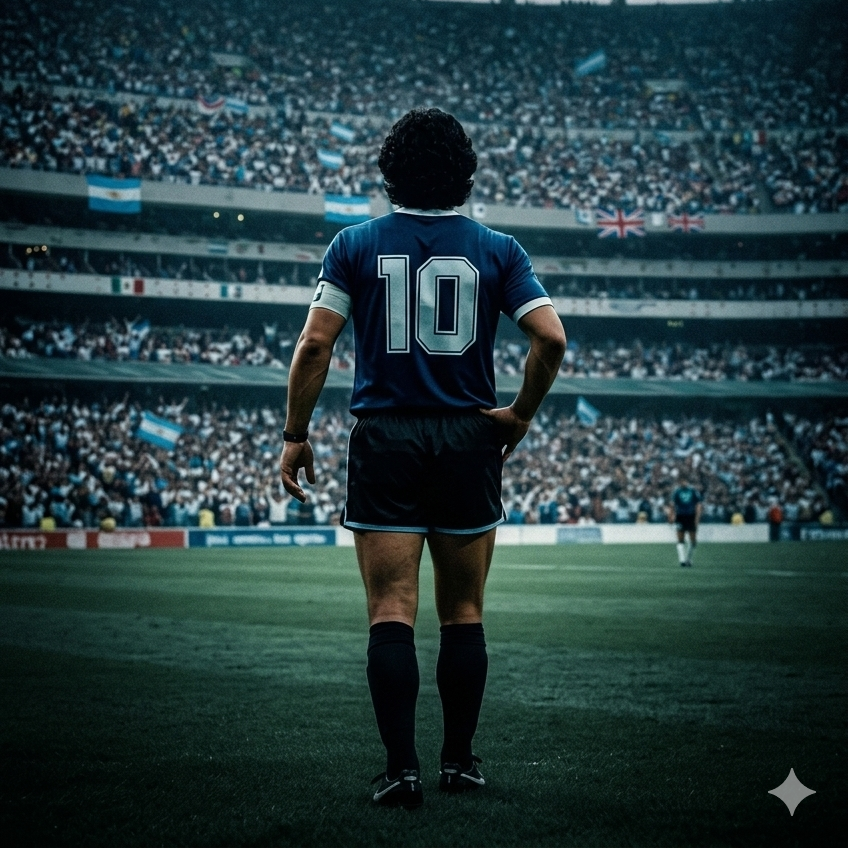
On June 22, 1986, the FIFA World Cup quarter-final between Argentina and England at the Estadio Azteca in Mexico City produced two of the most extraordinary goals ever scored on a football pitch — within four minutes of each other, by the same player. Diego Maradona, 25 years old and at the absolute peak of his powers, first punched the ball into the net with his left hand and then dribbled past five defenders across 60 metres to score what FIFA voters would later name the "Goal of the Century" in a 2002 online poll. Argentina won 2–1. The match has never left the football conversation in the four decades since.
The Political and Emotional Context
The match carried a weight that no fixture in club football could replicate. Only four years before the World Cup, Argentina and Great Britain had fought the Falklands War — a brief but brutal ten-week conflict over the disputed islands in the South Atlantic that resulted in 255 British and 649 Argentine deaths. The two countries had no diplomatic relations at the time of the match. Argentina's football federation had formally protested when the draw placed them in the same bracket as England, arguing the fixture was politically inappropriate. Their objection was ignored.
Maradona himself later confirmed what most already suspected — that he viewed the match through the lens of the conflict. After the game he stated that although football had nothing to do with the Malvinas war, "we knew they had killed a lot of Argentine boys there, killed them like little birds. And this was revenge." For the 114,000 spectators inside the Azteca and the millions more watching on television around the world, the match was never simply a quarter-final.
Maradona's Road to the Quarter-Final
To understand the significance of what happened against England, it is necessary to understand the form Maradona had been in throughout the tournament. He had arrived in Mexico off the back of a remarkable season at Napoli, where he was in the process of single-handedly transforming a club from southern Italy that had never won a Serie A title into genuine challengers. At the World Cup, he was even better.
In the group stage, Argentina faced Italy, Bulgaria and South Korea. Against South Korea, Maradona provided three assists in a 3–1 win. Against Italy — the reigning world champions — he scored Argentina's equaliser in a 1–1 draw despite being man-marked throughout. Against Bulgaria, he created the decisive goal in a 2–0 win. By the time England awaited him in the quarter-final, Maradona had already been fouled 53 times — more than twice the total of any other player in the tournament — and had still been the most influential figure at the competition.
The Starting Line-Ups
| Argentina | England |
|---|---|
| Nery Pumpido | Peter Shilton |
| José Luis Cuciuffo | Gary Stevens |
| Oscar Ruggeri | Terry Fenwick |
| José Luis Brown | Terry Butcher |
| Julio Olarticoechea | Kenny Sansom |
| Sergio Batista | Peter Reid |
| Ricardo Giusti | Trevor Steven |
| Héctor Enrique | Steve Hodge |
| Jorge Burruchaga | Peter Beardsley |
| Diego Maradona ★ | Gary Lineker |
| Jorge Valdano | Glenn Hoddle |
★ Maradona captained Argentina. Manager: Carlos Bilardo (Argentina), Bobby Robson (England). England substitute John Barnes came on in the 74th minute and transformed the second half. Steve Hodge — whose mistimed clearance led directly to the Hand of God — swapped shirts with Maradona after the match; that shirt sold at auction in 2022 for £7.1 million.
The First Half: Caution and Tension
The opening 45 minutes were tight and tactical. England manager Bobby Robson had set up his side to be compact and hard to break down, aware that Maradona would need to be contained rather than confronted directly. Argentina probed patiently but created little of clear quality. Maradona was closely shadowed by Peter Reid and Terry Fenwick throughout. The half ended goalless.
The "Hand of God" Goal — 51st Minute
Six minutes into the second half, the moment that football still argues about today. England midfielder Steve Hodge — attempting to clear a long ball played over the top — miscued his clearance, sending the ball looping backwards into his own penalty area. Maradona and goalkeeper Peter Shilton both moved to meet it. Shilton, at 6ft 1in, had every physical advantage over the 5ft 5in Maradona. He should have claimed it comfortably.
What happened next occurred in a fraction of a second. As both players jumped, Maradona raised his left fist and punched the ball downward into the net. Shilton wheeled around in fury. England's players surrounded Tunisian referee Ali Bennaceur, protesting with increasing desperation. Bennaceur — who had no assistant positioned at the right angle to see the foul — awarded the goal. Argentina led 1–0.
Hodge's miscued clearance. Maradona's raised fist. Shilton's fury. Bennaceur's raised flag. In 1986 there was no VAR, no goal-line technology, no second look. The goal stood. "A little with the head of Maradona, and a little with the hand of God."
After the match, Maradona was asked directly whether he had handled the ball. His answer became one of the most quoted lines in football history: "A little with the head of Maradona, and a little with the hand of God."The phrase — simultaneously an admission, a deflection, and a piece of theatre — gave the goal its permanent name. In 2005, nearly two decades later, Maradona finally confirmed publicly on Argentine television what everyone had always known: "I was waiting for my teammates to embrace me, and no one came. I told them, 'Come hug me, or the referee isn't going to allow it.' It was the hand of Diego."
The "Goal of the Century" — 55th Minute
Four minutes later, the same player who had just cheated produced one of the greatest individual goals in the history of the sport. The contrast was almost designed to be incomprehensible.
Maradona received the ball in his own half from Héctor Enrique, roughly 60 metres from goal. What followed lasted approximately 10 seconds. He dribbled past Peter Beardsley, then Peter Reid, then Terry Fenwick (who was booked for attempting to foul him), then Terry Butcher, then Butcher again as he tracked back, and finally rounded goalkeeper Peter Shilton— the same man whose goal he had punched in four minutes earlier — before rolling the ball into an empty net. Five outfield players beaten. The goalkeeper beaten. The crowd inside the Azteca rose as one.
60 metres. 10 seconds. Five defenders beaten. One goalkeeper beaten. One composed finish. In 2002, FIFA invited supporters around the world to vote for the greatest goal in World Cup history. Maradona's second goal against England won by an overwhelming majority.
In 2002, FIFA held a global online vote to identify the greatest goal in World Cup history. Maradona's second against England won by a considerable margin, officially confirmed as the "Goal of the Century."The Estadio Azteca later erected a statue of Maradona frozen in the moment of that run, placed at the entrance to the ground. It remains there today.
England's Fightback and the Final Whistle
England did not capitulate. Manager Bobby Robson introduced John Barnes as a substitute in the 74th minute — a decision that transformed England's attacking threat. Barnes, running at the Argentine defence with pace and directness, began to pin back Argentina's left flank. In the 80th minute, one of those crosses found Gary Lineker, who drove a low finish past Pumpido to make it 2–1. Lineker — who would finish the tournament as its Golden Boot winner with six goals — came agonizingly close to equalising with three minutes remaining, stretching to reach another Barnes cross but unable to connect cleanly enough to score. The final whistle confirmed Argentina's passage to the semi-finals.
Match Statistics
| Argentina | Stat | England |
|---|---|---|
| 2 | Final Score | 1 |
| Maradona 51′ (hand), 55′ | Goals | Lineker 80′ |
| Carlos Bilardo | Manager | Bobby Robson |
Maradona's 1986 Tournament — The Numbers
| Stat | Maradona | Next best |
|---|---|---|
| Matches played | 7 (630 mins) | All others |
| Goals | 5 | Lineker: 6 (Golden Boot) |
| Assists | 5 | Next best: 2 |
| Goal involvements | 10 / 14 (71%) | No other player reached 10 |
| Dribbles completed | 53 | ~17 (next best) |
| Fouls won | 53 | Next best: ~27 |
| Shots attempted | 30 (56% of team total) | — |
| Key passes | 27 | — |
| Award | Golden Ball (unanimous) | — |
No player since 1966 has scored and assisted five or more goals at a single World Cup. The record remains Maradona's alone.
Argentina's Path to the Final
After eliminating England, Argentina faced Belgium in the semi-finals. Maradona scored both goals in a 2–0 win — the second another solo dribbling effort that prompted comparisons to the goal against England. In the final against West Germany, Argentina led 2–0 before the Germans fought back to equalise at 2–2 with seven minutes remaining. With time running out, Maradona played a perfectly weighted through ball to Jorge Burruchaga, who scored the winner in the 83rd minute. Argentina won 3–2. Maradona — directly involved in 10 of Argentina's 14 tournament goals — was awarded the Golden Ball as player of the tournament by unanimous vote.
The Shirt, the Statue, and the Legacy
The Hand of God has never left football culture. It appears in every serious discussion about refereeing, technology, and the ethics of gamesmanship. The shirt Maradona wore in that match — exchanged with Steve Hodge at full time and on loan to the National Football Museum in Manchester for two decades — was sold at Sotheby's in May 2022 for £7,142,500 — simultaneously breaking the Guinness World Records for the most expensive football shirt and most expensive piece of sports memorabilia ever sold at auction.
Maradona's relationship with the match was typically complex. He never fully apologised for the handball — though he eventually admitted it — and described the entire afternoon as the moment he most cherished in his career. In a sport that had rarely seen one man dominate a World Cup in the way Maradona dominated Mexico 1986, the quarter-final against England stands as the centrepiece: a match containing both the most controversial and the most celebrated goal in the history of the competition, scored four minutes apart, by the same left foot and the same left hand.
For forty years, football has never quite recovered from the contradiction of that afternoon. It probably never will.