When analysts debate the greatest footballing nations in history, the conversation often drifts toward Brazil's five World Cups or Germany's tactical consistency across decades. Yet when the lens narrows to European competition, one nation stands completely apart. Spain has not merely competed at the top level — it has redefined what dominance looks like, both through its clubs and its national team, across every major UEFA tournament simultaneously.
The data is unambiguous. Across the UEFA Champions League, the UEFA Europa League, the UEFA Super Cup, and the European Championship, no country comes close to matching Spain's collective haul. This is not a story of one great era, one great club, or one generation of players. It is a story of structural superiority — of a football culture so deeply embedded and so consistently productive that excellence has become almost routine.
The Champions League: Spain's Private Trophy
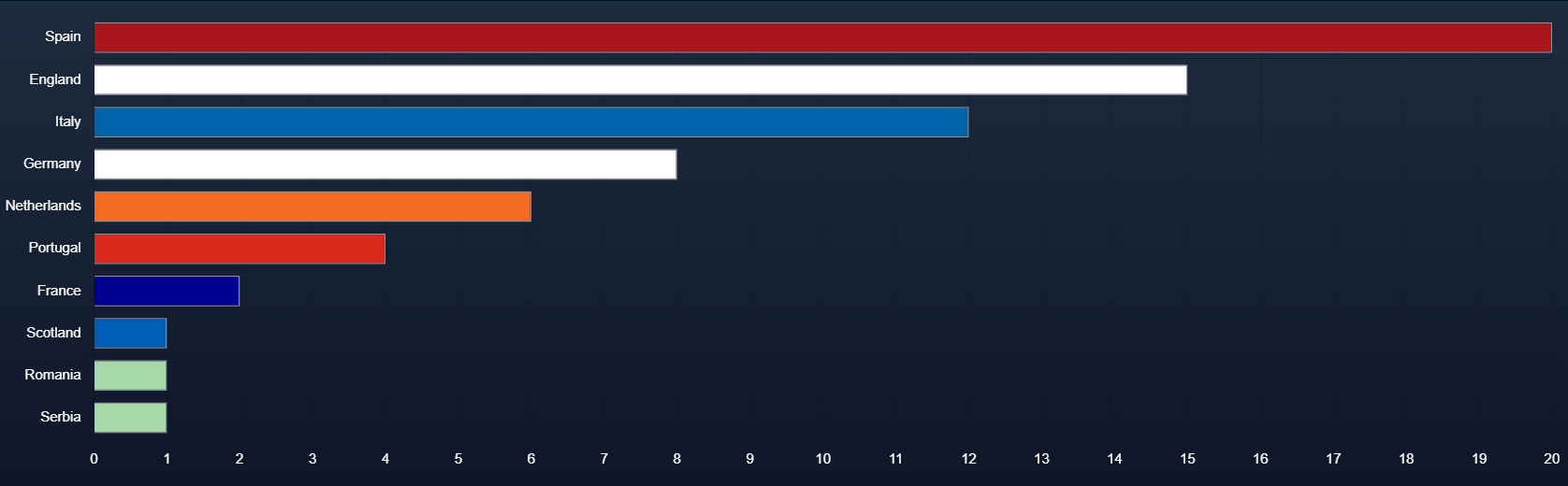
The UEFA Champions League is the most prestigious club competition on the planet, and Spain's record in it borders on the absurd. Spanish clubs have won the title 20 times — more than England's 15 and Italy's 12, a number built almost entirely by two clubs operating in the same domestic league. No other country has sustained this level of Champions League dominance across the modern era.
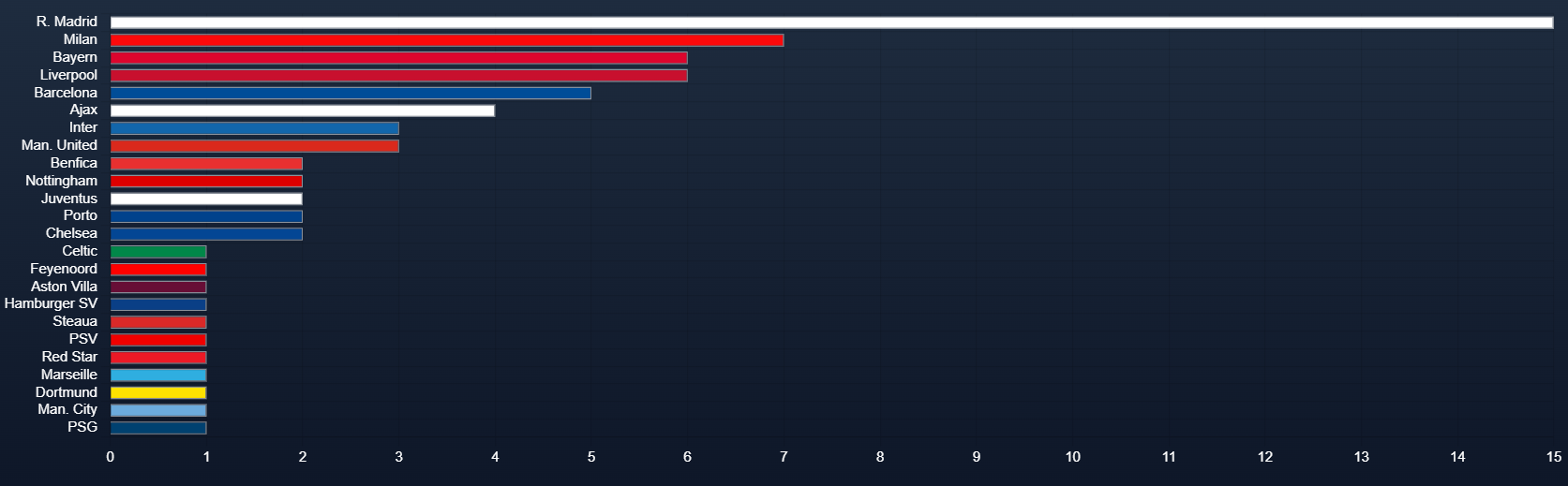
At the center of this story stands Real Madrid, the most decorated club in the history of the competition. With 15 European Cup and Champions League titles, Madrid's total is so far ahead of the field that the gap looks almost manufactured — yet every trophy was won on the pitch. Behind them, Barcelona have added five of their own, creating a two-club Spanish axis that accounts for the country's entire Champions League haul between them.
What makes these numbers even more striking is the consistency across different eras. Real Madrid dominated the original European Cup throughout the late 1950s, returned to dominance in the 1990s, and then launched an unprecedented run of four titles in five seasons between 2014 and 2018. Barcelona, meanwhile, constructed arguably the greatest club side ever assembled under Pep Guardiola between 2009 and 2011. These are not the achievements of a single golden generation — they span seven decades of sustained excellence.
The Europa League: Even the Second Tier Belongs to Spain
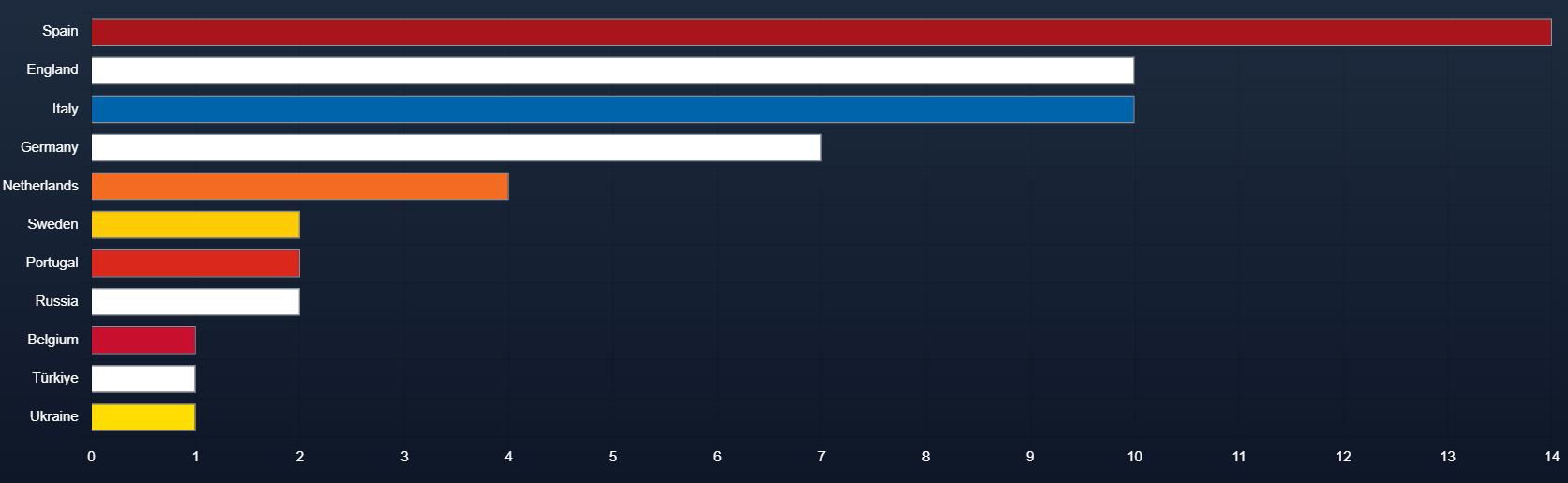
If the Champions League numbers alone were not enough, Spain's record in the UEFA Europa League removes any remaining doubt. Spanish clubs have won the competition 14 times in total — Sevilla 7, Atlético Madrid 3, Real Madrid 2, Villarreal 1, Valencia 1 — compared to England's 10 and Italy's 10. No other country leads both major UEFA club competitions simultaneously.
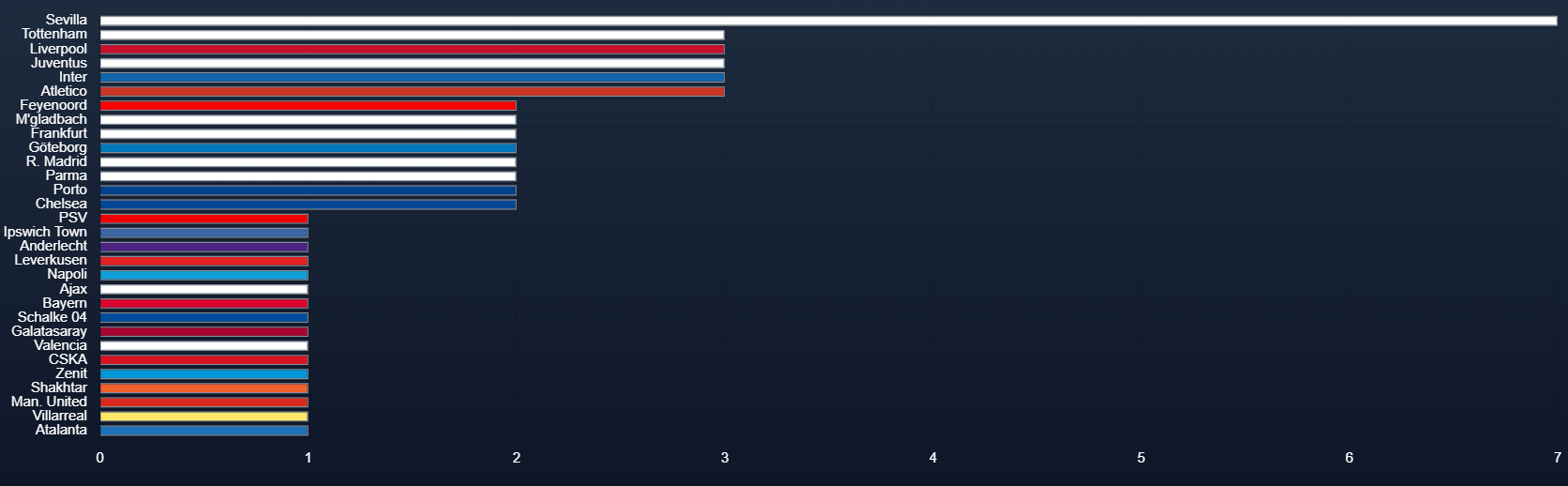
The dominant force here is Sevilla FC, a club that has essentially made the Europa League its personal property. With 7 titles — including three in a row from 2014 to 2016 — Sevilla's record in this competition is one of the most remarkable achievements in modern club football. No other club in the world has come remotely close to that total. The fact that a club from the same country as Real Madrid and Barcelona has also become the single most successful team in a separate major European competition illustrates just how deep Spain's football infrastructure runs.
Atlético Madrid have contributed 3 Europa League titles alongside their Champions League campaigns. Spain's depth is not limited to two or three clubs — it extends down through a league system that has consistently produced title-winning European squads across multiple tiers of competition simultaneously.
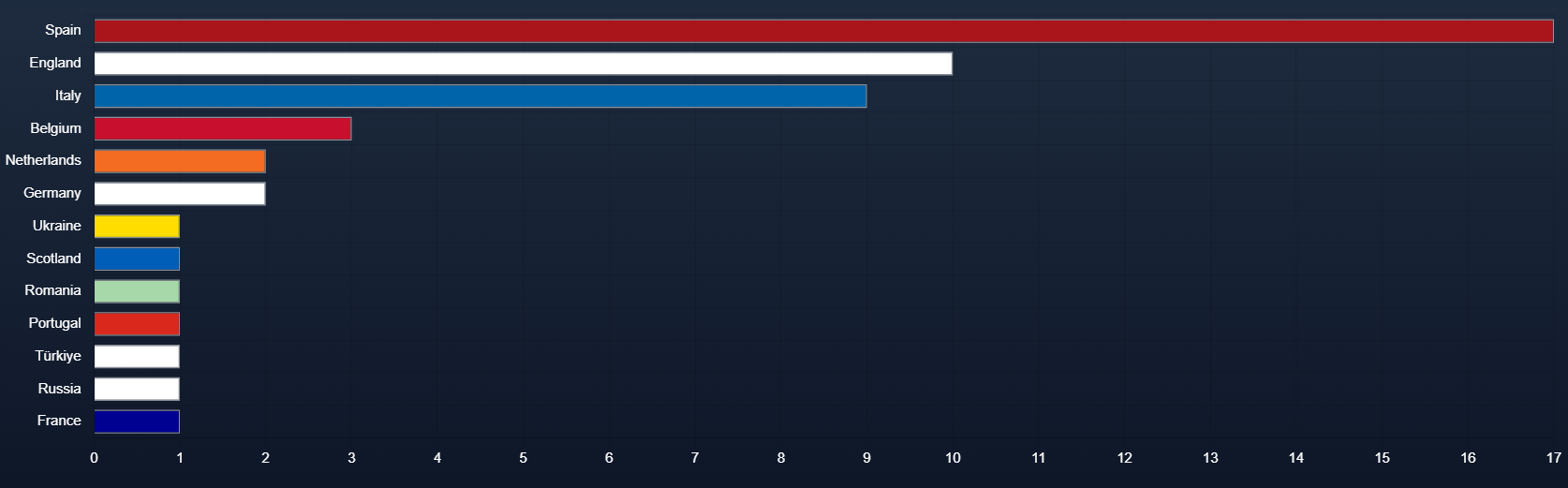
Spanish clubs have won 20 Champions League titles, 14 Europa League titles, and 17 UEFA Super Cups. No other nation leads even two of those three competitions. Spain leads all three."Spain doesn't just produce champions. It produces dynasties."
The Super Cup: Completing the Set
The UEFA Super Cup, contested annually between the Champions League and Europa League winners, offers yet another dimension to Spain's dominance. With 17 Super Cup titles, Spain leads England's 10 and Italy's 9 by a significant margin — a natural consequence of winning so many of the competitions that feed into it.
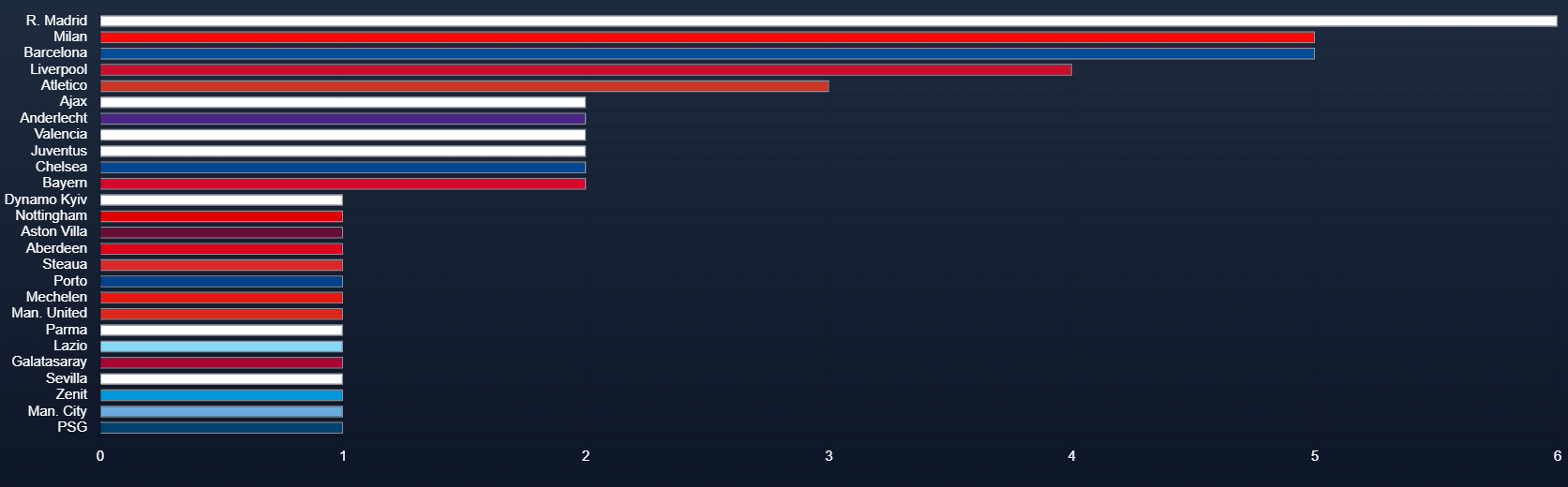
The pattern is clear: whichever European competition you examine, Spanish clubs appear at or near the summit of the all-time rankings. This is not coincidence. It reflects a football ecosystem that has been carefully built over decades — elite academies, world-class coaching, and a domestic league tough enough to prepare clubs for the highest European stages.
La Roja: When the National Team Joined the Party
The club-level story would be remarkable enough on its own. But Spain's dominance extends beyond club football into international competition in a way that no other nation has managed in the modern era. Spain have won the European Championship four times — in 1964, 2008, 2012 and 2024 — more than any other country, and remain the only nation to have won consecutive editions.
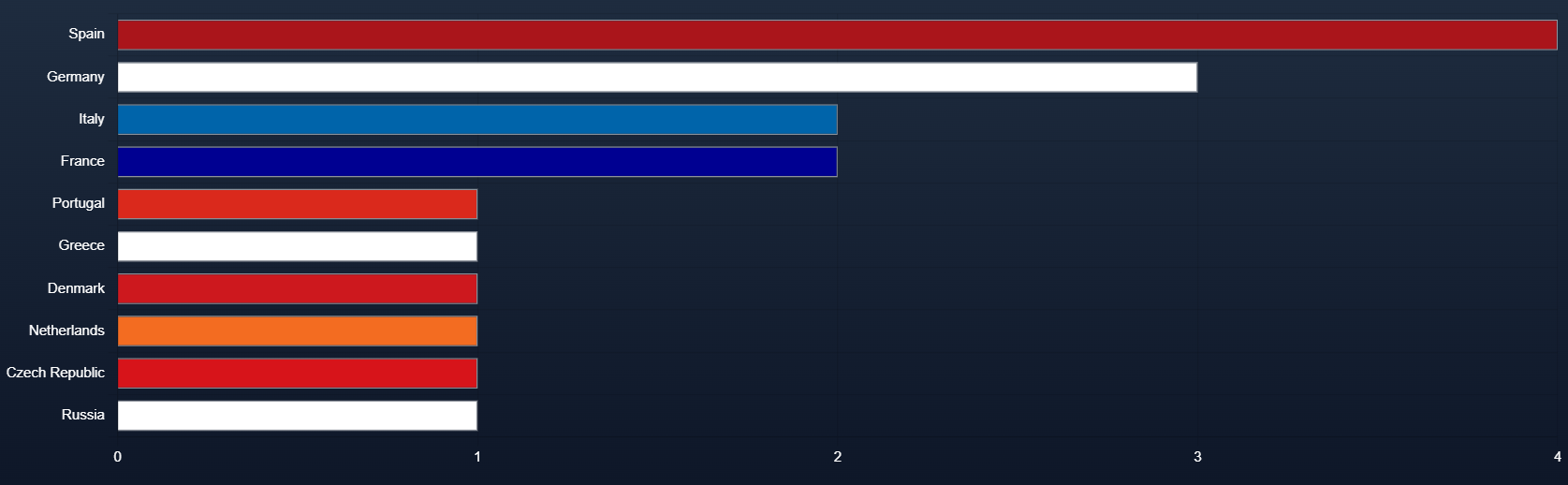
Germany follow with three titles, while Italy and France have two each. But the gap between Spain and the rest tells its own story. Between 2008 and 2012, Spain became the first national team in history to win three consecutive major tournaments — Euro 2008, the 2010 World Cup and Euro 2012 — a feat no team had ever achieved before and none has matched since.
That golden generation — built around the passing philosophy known as tiki-taka, and drawing heavily from the Barcelona and Real Madrid squads of the era — transformed how the world thought about international football. Players like Xavi Hernández, Andrés Iniesta, David Villa, and Iker Casillas became global symbols of a style that was both aesthetically breathtaking and devastatingly effective.
Spain's Euro 2024 victory proved that the national team's excellence is not confined to a single generation. A new wave of Spanish talent delivered another European title — reinforcing the idea that Spain's dominance is systemic rather than circumstantial.
Why Spain? The Structure Behind the Statistics
Numbers this consistent do not emerge by accident. Spain's football dominance is rooted in a set of structural advantages that other nations have struggled to replicate. La Masia, Barcelona's legendary academy, and Real Madrid's Castilla development pathway have produced generation after generation of technically gifted players. The wider Spanish federation has applied similar principles at youth level, creating a national pipeline that feeds both club and international competition simultaneously.
La Liga itself has played a crucial role. A domestic league that consistently tests clubs against the highest quality opposition has prepared Spanish teams for European campaigns in a way that leagues in smaller countries simply cannot. The financial muscle of Real Madrid and Barcelona has allowed them to recruit the world's best players while simultaneously developing elite homegrown talent — a combination that has proven almost impossible to sustain elsewhere.
Spain also benefits from a coaching culture that has spread far beyond its own borders. Managers trained in the Spanish system — from Pep Guardiola to Luis Enrique to Unai Emery — have taken Spanish footballing philosophy to clubs and countries across Europe and beyond, in some cases using those ideas to win trophies against Spanish opponents. The irony is that Spain's greatest export may be the very blueprint that rivals now try to use against it.
A Dominance Without Parallel
Taken together, the statistics across all four competitions paint a picture that is simply without equal in European football history. Spain leads the all-time table in the Champions League by country with 20 titles, leads in the Europa League with 14, leads in the Super Cup with 17, and leads in the European Championship with 4. No other nation can claim the top position in even two of those four competitions simultaneously.
England has produced some of the most iconic moments in club football. Italy has given the world tactical sophistication and defensive mastery. Germany has built a reputation for ruthless efficiency and reinvention. But when the final tally is counted across every trophy, every final, every decade — Spain stands alone at the summit of European football.
The numbers will continue to evolve. New Spanish talents are already emerging through the same academies that produced previous champions. Real Madrid and Barcelona remain among the wealthiest and most ambitious clubs on the continent. La Roja continues to recruit from a system designed to produce technical excellence. For rival nations hoping to close the gap, the most uncomfortable truth may be this: Spain's dominance does not look like it is ending. It looks like a permanent feature of the European football landscape.