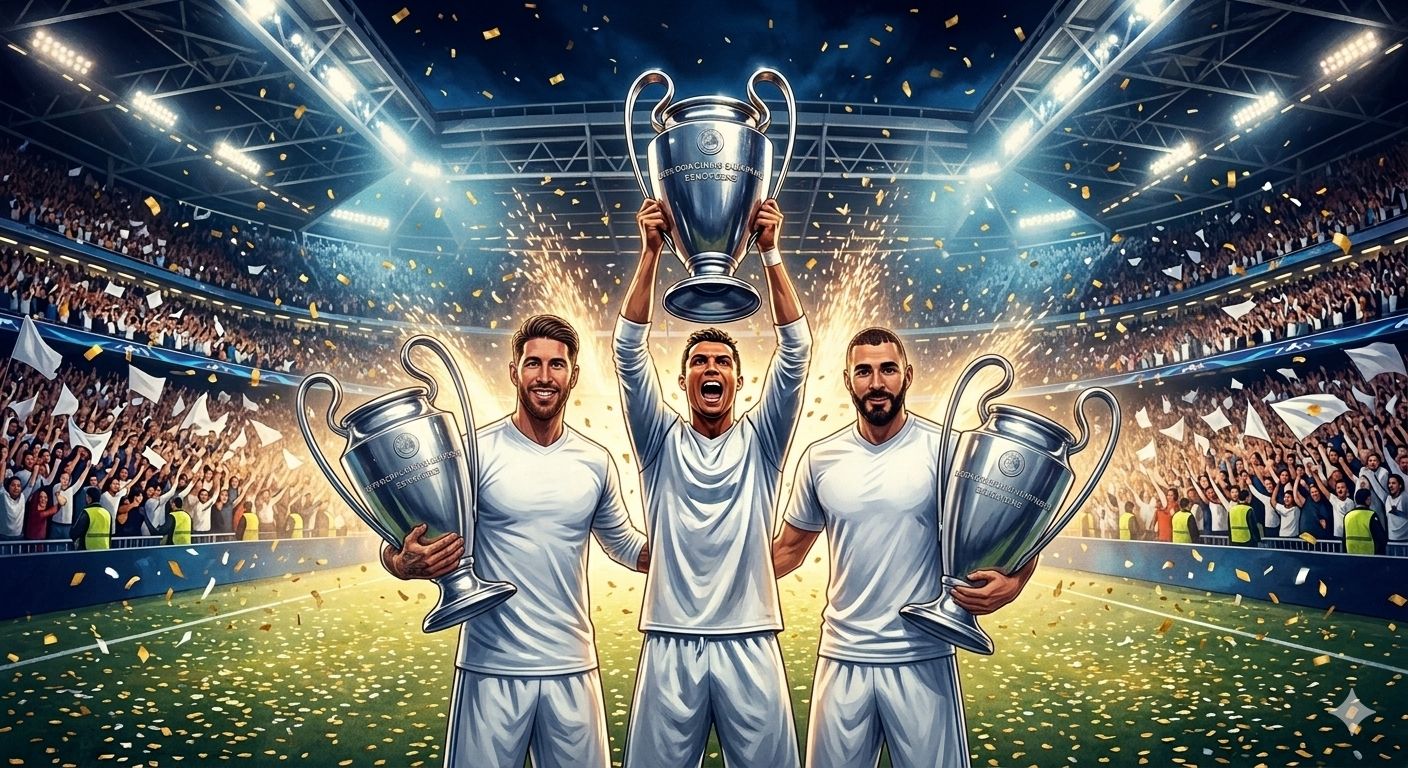
Between 2016 and 2018, Real Madrid did something no club in the Champions League era had ever done: they won Europe's premier club competition three consecutive times. Under Zinedine Zidane — a manager who had never managed a first team before January 2016 — Real Madrid defeated Atlético Madrid on penalties in Milan, crushed Juventus 4–1in Cardiff, and beat Liverpool 3–1 in Kyiv. In those three finals, Cristiano Ronaldo scored in each one, becoming the first player in Champions League history to achieve the feat. Nine players started all three finals. The last club to win three consecutive European Cups was Bayern Munich — in 1974, 1975 and 1976. Nobody had done it since. Nobody has done it since Madrid.
Zidane: The Manager Who Should Not Have Won It Once
The context around Zidane's appointment matters enormously. He replaced Rafa Benítez, who had been sacked in January 2016 after a run of poor results left Madrid third in La Liga. Zidane had been working as Benítez's assistant and had managed only Real Madrid's reserve side, Castilla, at senior level. He had never managed a top-flight club. He took over with five months of the season remaining, steered Madrid to the La Liga title — their first since 2012 — and then won the Champions League by beating city rivals Atlético on penalties. He was named UEFA's best coach of the year in each of the three seasons that followed.
Zidane himself later acknowledged that he was not a tactical innovator. His strength lay elsewhere: in man-management, in the calm authority that came from having been one of the best players in the world himself, and in an ability to keep an extraordinarily talented squad motivated and performing under relentless pressure. Toni Kroos said after the third title that he had not believed it was possible to defend the trophy — let alone win it three times. Zidane made it seem inevitable.
The Core: Nine Players, Three Finals
| Player | 2016 Milan | 2017 Cardiff | 2018 Kyiv | UCL Goals (3 yrs) |
|---|---|---|---|---|
| Keylor Navas | ✅ | ✅ | ✅ | 0 |
| Dani Carvajal | ✅ | ✅ | ✅ | 1 |
| Sergio Ramos | ✅ (1 goal) | ✅ | ✅ | 3 |
| Marcelo | ✅ | ✅ | ✅ | 1 |
| Casemiro | ✅ | ✅ (1 goal) | ✅ | 3 |
| Toni Kroos | ✅ | ✅ | ✅ | 2 |
| Luka Modrić | ✅ | ✅ | ✅ | 1 |
| Karim Benzema | ✅ | ✅ | ✅ (1 goal) | 5 |
| Cristiano Ronaldo ★ | ✅ (pen) | ✅ (2 goals) | ✅ (1 goal) | 25 |
| Gareth Bale | ✅ sub | ✅ sub (Cardiff native) | ✅ sub (bicycle kick) | 4 |
★ Ronaldo scored in all three finals — the first player in Champions League history to achieve this. He was also the competition's top scorer in each of the three seasons, finishing with 25 UCL goals across the three campaigns combined. Bale scored one of the greatest goals in UCL final history in Kyiv. Modrić won the Ballon d'Or in 2018, the first non-Messi/Ronaldo winner in a decade.
2016 — La Undécima: Milan, Penalties, Ramos
The first title of the three-peat arrived on May 28, 2016at the San Siro in Milan against city rivals Atlético Madrid — a repeat of the 2014 final, which Real had also won. For Atlético manager Diego Simeone, this was a second consecutive near-miss in the competition's showpiece event.
Sergio Ramos opened the scoring in the 15th minute from a Kroos free kick, becoming only the fifth player to score in two Champions League finals. The referee later admitted that the goal should have been ruled out for offside. Atlético levelled in the 79th minute through Yannick Carrasco — the first Belgian to score in a Champions League final. Neither side could find a winner in 120 minutes.
In the shootout, Atlético's Antoine Griezmann had already missed a penalty during normal time — striking the crossbar in the 47th minute. In the shootout itself, seven of the first eight kicks were scored before Juanfran struck the post with Atlético's fourth attempt. Ronaldo, who had specifically requested to take the fifth and decisive kick — telling Zidane before it that he had "a vision" he would score the winner — converted into the top-right corner. Real Madrid won 5–3 on penalties. La Undécima. Their 11th European Cup. Zidane became the first French coach to win the Champions League and the seventh person to win it as both player and coach.
2017 — Cardiff: First Club to Defend the Title
One year later, in Cardiff on June 3, 2017, Real Madrid became the first club in the Champions League era to defend their title — defeating Juventus 4–1 in a result that flattered Madrid somewhat, given how competitive the first half had been.
Ronaldo opened in the 20th minute from a Carvajal cutback, the ball deflecting in off Leonardo Bonucci. Seven minutes later, Juventus equalised through one of the great individual Champions League final goals: Mario Mandžukić chested down a Higuaín pass and hooked the ball over his shoulder with an overhead kick from 14 metres — a goal compared by many to Zidane's famous volley in the 2002 final. At half-time, 1–1, Juventus had been the better side.
The second half was a different match. A deflected long-range strike fromCasemiro in the 61st minute restored Madrid's lead. Three minutes later, Ronaldo finished from a Modrić cutback for his second. Substituted Juventus midfielder Juan Cuadrado was sent off in the 84th minute for a second yellow, and Asensio added a fourth in injury time from a Marcelo assist. Juventus captain Gianluigi Buffon — in what many expected would be his final opportunity to win the trophy — was left empty-handed. Kroos noted afterwards that Juventus had conceded only three goals in their entire Champions League campaign before the final, and Madrid scored four.
Three consecutive Champions League finals. Three victories. Milan, Cardiff, Kyiv. Nine players started all three.Ronaldo scored in every final. Zidane won every trophy in every season he managed the club — then resigned five days after the third. "Nobody had ever won three in a row. We are a great group."
2018 — Kyiv: Bale's Bicycle Kick, Karius's Night
The third and final chapter arrived on May 26, 2018 in Kyiv against Liverpool — managed by Jürgen Klopp and powered by a front three of Salah, Firmino and Mané that had dismantled opponents across Europe all season. The match was defined by two goalkeeping errors and one of the most spectacular goals in the competition's history.
In the 25th minute, Mohamed Salah left the pitch in tears after his shoulder was caught in a tussle with Ramos, forcing him off injured. Liverpool lost their most dangerous attacker before half-time. The match was level at 0–0 when, in the 51st minute, Liverpool goalkeeper Loris Karius threw the ball directly into the path of Karim Benzema, who bundled it in. Sadio Mané equalised almost immediately to make it 1–1.
Then came the goal. Substitute Gareth Bale — who had spent much of the season injured and barely featured in the run-up to the final — entered the pitch in the 61st minute. Two minutes later, a cross from Marcelo arrived at head height. Bale, with his back to goal, launched himself into an overhead bicycle kick that flew into the top corner of Karius's net. It was later featured by UEFA among the greatest goals in Champions League history. Bale then added a second in the 83rd minute when his long-range shot burst through Karius's hands for another error. Real Madrid won 3–1.
The Three Finals: Goals and Scores
| Year | Venue | Opponent | Score | Real Madrid Goals | Scorers (opponent) |
|---|---|---|---|---|---|
| 2016 | San Siro, Milan | Atlético Madrid | 1–1 (5–3 pens) | Ramos 15′ | Carrasco 79′ |
| 2017 | Principality Stadium, Cardiff | Juventus | 4–1 | Ronaldo 20′, Casemiro 61′, Ronaldo 64′, Asensio 90′ | Mandžukić 27′ |
| 2018 | NSC Olimpiyskiy, Kyiv | Liverpool | 3–1 | Benzema 51′, Bale 63′ (bicycle), Bale 83′ | Mané 55′ |
Ronaldo scored in all three finals. The 2016 final was decided on penalties (5–3) after 1–1 at full time. The 2017 final is the only time in the three-peat that Madrid won by more than one goal in 90 minutes. Bale's 2018 bicycle kick was later featured by UEFA among the greatest goals in Champions League final history.
The End of an Era
Five days after the Kyiv final, Zidane resigned. He gave no detailed public explanation, saying only that the club needed a change after three years and that he could no longer guarantee the same level of performance from himself. Within months, Ronaldo left for Juventus in a £105 million transfer, ending a nine-year spell in which he had scored 450 goals for the club. Modrić won the 2018 Ballon d'Or — the first player other than Messi or Ronaldo to win the award since Kaká in 2007.
The three-peat remains one of the most studied achievements in modern football. It has been noted that Madrid finished third in La Liga in 2017–18 — the season of the third title — suggesting that their squad's energy and focus had been entirely channelled into the Champions League at the expense of domestic form. What makes the record more remarkable is that 12 consecutive knockout round wins across three seasons were required to achieve it — against opponents including Bayern Munich, Juventus, Atlético Madrid, Manchester City, Dortmund, and PSG. Real Madrid won all 12. No other club in the Champions League era has come close to matching that sequence.