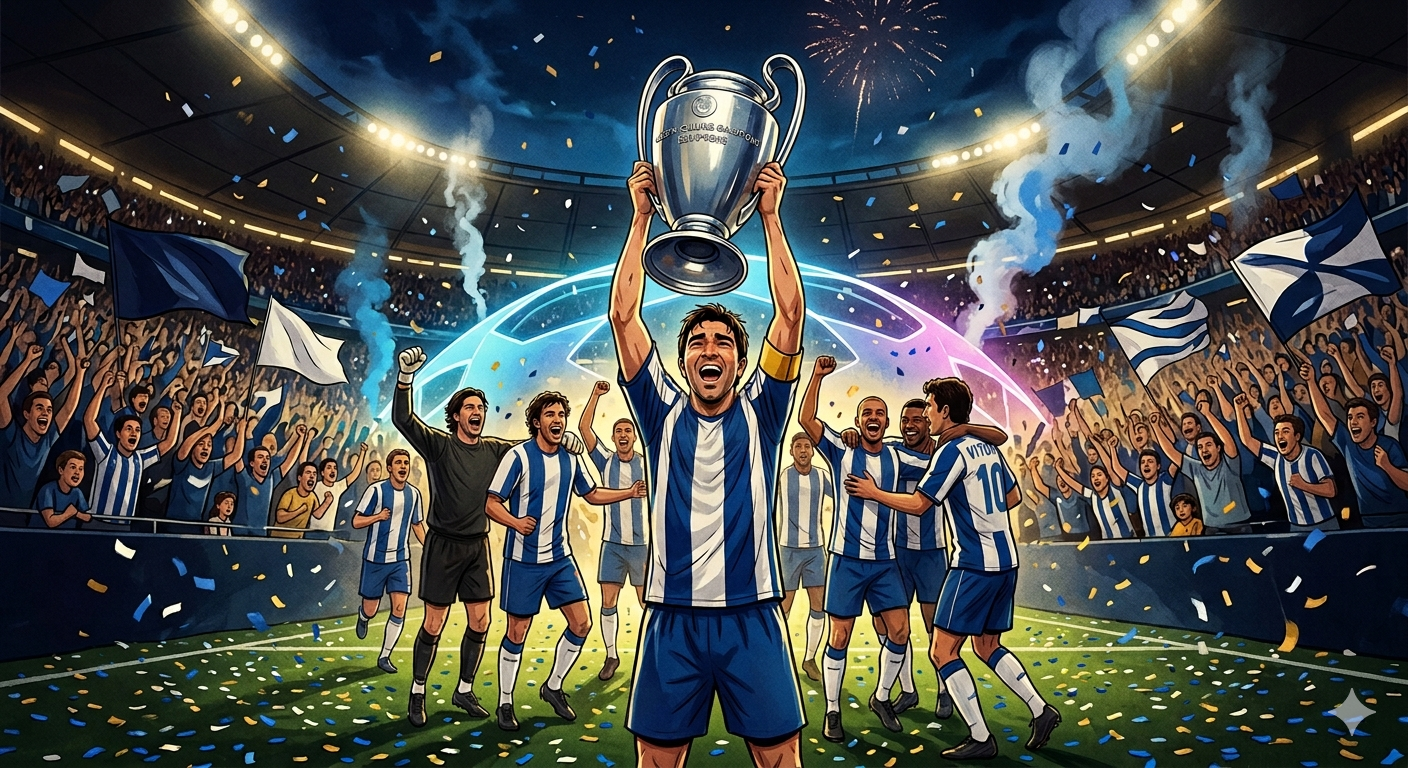
On the night of May 26, 2004, José Mourinho stood on the presentation podium at the Arena AufSchalke in Gelsenkirchen, accepted a Champions League winner's medal, and immediately took it off. He had already been linked with Chelsea for weeks; his thoughts were elsewhere. The players celebrated without him. What they had achieved, though, was not diminished by his distraction — if anything, it was made more remarkable by it. Porto's 2003–04 Champions League triumph is the last time a club from outside Europe's traditional big-five leagues has won the competition — a record that, more than two decades later, still stands. They beat Manchester United, Olympique Lyonnais and Deportivo La Coruña on the way to the final, then defeated Monaco 3–0 with a display of such control that Mourinho later said he felt like a European champion before the final whistle blew. Three weeks later, in his first press conference as Chelsea manager, he told the room not to call him arrogant. He was, he said, a special one. He had earned the right to say it.
The Context: A Club Built to Punch Above Its Weight
To understand Porto's 2004 Champions League, you have to understand the nature of the club and the league they came from. The Primeira Liga is among the most technically competitive leagues in Europe, but its clubs cannot match the financial resources of the Premier League, La Liga or Serie A. Porto, Benfica and Sporting operate in a market where their best players will always be sold to richer clubs, and where the Champions League knockout stage must be navigated without the safety net of squad depth that the wealthiest clubs take for granted.
José Mourinho had been appointed Porto manager in January 2002, aged 39, after spells as assistant to Bobby Robson at Barcelona and Louis van Gaal at the same club, then a head coaching stint at Leiria that had caught Porto's attention. He inherited a squad in mid-table and immediately reorganised it around a pressing system, collective defensive shape, and a culture of belief that he later described as his primary coaching tool. In his first full season, 2002–03, Porto won the Primeira Liga and the UEFA Cup. The following season, they entered the Champions League group stage alongside Real Madrid's galácticos. Nobody thought they would get further than the knockout stage, if that.
The Road to Gelsenkirchen
Porto navigated the group stage alongside Real Madrid, finishing second behind the Spanish giants — drawing at the Bernabéu in a result Mourinho later called a turning point in the squad's belief. Then came the round of sixteen, and Manchester United. United led through a Quinton Fortune goal in the first leg at the Estádio do Dragão before Benni McCarthy scored twice to turn the tie. At Old Trafford, United led deep into the second leg and appeared on the verge of advancing — until Costinha struck in the 91st minute to level and send Porto through 3–2 on aggregate. Mourinho sprinted down the touchline with both arms raised, the image that introduced him to a global audience.
Olympique Lyonnais — then in the middle of their seven-title domestic dynasty — were eliminated in the quarter-finals. Deportivo La Coruña, who had famously eliminated AC Milan in the previous round with a 4–0 second-leg comeback, fell to a solitary Derlei penalty across two legs in the semi-finals. Porto conceded just once in the entire knockout stage. The defensive organisation Mourinho had built — anchored by Ricardo Carvalho and captained byJorge Costa — had proven unbreachable.
The Route to the Final
| Round | Opponent | Result (Agg) | Key Moment |
|---|---|---|---|
| Group Stage | Real Madrid, Marseille, Partizan | 2nd place | Drew at the Bernabéu; Mourinho: "We left with a sweet feeling" |
| Round of 16 | Manchester United | 3–2 (agg) | Costinha's 91st-minute goal at Old Trafford — Mourinho's touchline sprint |
| Quarter-final | Olympique Lyonnais | 4–2 (agg) | Deco masterclass across both legs; Lyon eliminated mid-dynasty |
| Semi-final | Deportivo La Coruña | 1–0 (agg) | Derlei penalty only goal — Porto conceded zero across 180 minutes |
| Final | AS Monaco | 3–0 | Carlos Alberto 39', Deco 71', Alenichev 75' — controlled from start to finish |
Porto conceded just one goal across the entire knockout stage — in the quarter-final second leg against Lyon. In the semi-final and final combined, they kept clean sheets in three of four legs.
The Squad: Players Who Made History
| Player | Pos | UCL Apps | UCL Goals | Next Club | Note |
|---|---|---|---|---|---|
| Vítor Baía | GK | 13 | — | Retired at Porto | Club legend; 80 Portugal caps; conceded 5 goals in 13 UCL matches |
| Ricardo Carvalho | CB | 13 | 0 | Chelsea (€25m) | Followed Mourinho immediately; cornerstone of the defensive system |
| Jorge Costa | CB | 11 | 0 | Standard Liège | Captain; Mourinho later called him "the player who cleans the garbage and lets the coach do his job" |
| Paulo Ferreira | RB | 13 | 0 | Chelsea (€15m) | Mourinho took him directly to Stamford Bridge |
| Costinha | DM | 12 | 1 | Dynamo Moscow | Scored the 91st-minute goal at Old Trafford that eliminated Manchester United |
| Maniche | CM | 12 | 4 | Dynamo Moscow | Scored the iconic 60-yard volley vs Deportivo; UCL campaign top scorer for Porto |
| Deco | AM | 13 | 3 | Barcelona (€15m) | Tournament best player; scored the second in the final; named UCL Breakthrough Player |
| Benni McCarthy | ST | 12 | 7 | Blackburn Rovers | Top scorer in the UCL knockout stage; scored twice at Dragão against Man United |
| Derlei | ST | 11 | 3 | Dynamo Moscow | Scored the only goal of the semi-final against Deportivo; pivotal in the quarter-final |
| Carlos Alberto | MF | 9 | 2 | Chelsea (loan) | Opened the scoring in the final with a precise right-footed finish |
By the start of the following season, Mourinho, Carvalho, Paulo Ferreira and Deco had all left. Ricardo Carvalho and Paulo Ferreira followed Mourinho directly to Chelsea. Deco joined Barcelona and won a second Champions League in 2006. The squad was dismantled within weeks of winning Europe's most prestigious trophy — the final act of a model that sold its best players as a matter of principle.
The Final: Monaco 0–3 Porto
Monaco had been the surprise package of the 2003–04 Champions League, eliminating Real Madrid in the quarter-finals and reaching the final under Didier Deschamps with a free-scoring side led by Fernando Morientes and Dado Pršo. They were expected to provide Porto with a difficult final. They did not. Carlos Alberto opened the scoring with a right-footed finish in the 39th minute; Deco — playing his last match for Porto before his move to Barcelona — added a precise second in the 71st; substitute Dmitri Alenichev completed the scoring in the 75th. Monaco managed no shots on target. Porto were never in danger. For Mourinho, the ease of the victory was the point. He had not built a side that would grind out results only to collapse at the final stage. He had built a machine, and it ran without interruption to the last whistle.
The minute of Costinha's goal at Old Trafford — the strike that eliminated Manchester United from the Champions League and sent Mourinho sprinting down the touchline in the image that introduced him to the world. Porto went on to win the competition. Mourinho went to Chelsea. The Special One era had begun. "In the 90th minute we were behind, we scored in the 91st minute and we qualified. We felt it couldn't go wrong." — José Mourinho, recalling the Manchester United tie
The Numbers Behind the Campaign
| Stat | Figure | Context |
|---|---|---|
| UCL matches played | 13 | Won 10, drew 2, lost 1 — the group-stage defeat to Real Madrid |
| Goals scored (UCL) | 23 | Across 13 matches — 1.77 per game average |
| Goals conceded (UCL) | 6 | Across 13 matches — 0.46 per game; just 1 in the knockout stage |
| Clean sheets (UCL KO) | 5 of 8 legs | Conceded once across four knockout ties before the final |
| Final scoreline | 3–0 vs Monaco | Porto's most comfortable UCL final performance historically |
| Benni McCarthy goals | 7 | Top Porto scorer in the UCL; scored twice against Man United in the R16 first leg |
| Deco rating | UCL Breakthrough Player | Named by UEFA as the standout emerging talent of the 2003–04 tournament |
| Mourinho departure | June 2, 2004 | Chelsea announced his appointment three weeks after the final |
| Carvalho transfer fee | €25m | To Chelsea; Paulo Ferreira followed for €15m; Mourinho rebuilt his defence with Porto players |
| Last non-big-five winner | Porto 2004 | Every subsequent UCL winner has come from England, Spain, Germany, Italy or France |
Deco: The Player Who Made It Work
The technical heart of Porto's Champions League campaign was Deco — a Brazilian-born midfielder who had gained Portuguese citizenship in 2002 and become the most complete playmaker in the Primeira Liga. Operating behind the strikers, he combined the ability to receive under pressure, turn quickly, play in tight spaces, and contribute decisive goals and assists in the biggest matches. Goal.com's retrospective ranking of 21st-century Champions League winners identifies Porto's 2004 campaign as potentially "the greatest underdog victory in the competition's entire history," citing Deco, Ricardo Carvalho and Maniche as players who "announced themselves on the biggest stage for the first time" under Mourinho's direction. Deco scored the second goal in the final, making it 2–0 and ending any lingering Monaco hope, before leaving for Barcelona the following week — where he would win a second Champions League in 2006 alongside Ronaldinho.
Mourinho Recalls the Night
Years later, Mourinho was asked to reflect on the 2004 Champions League final. His answer was, characteristically, unlike that of any other manager discussing a major trophy. "We felt it couldn't go wrong," Mourinho told UEFA. "We made it and we won very calmly. I always say I didn't celebrate it like a Champions League final, because it didn't feel like a Champions League final — the game was very calm and controlled. I didn't feel like a European champion after the referee blew the final whistle: I felt like a champion of Europe long before the game was finished". That confidence — unshakeable from the moment Porto drew Manchester United in the last sixteen — was both the product of his coaching method and its fullest expression. He had built a team that believed it could not lose. In 2003–04, it was correct.
The Aftermath: A Dynasty Dismantled in Weeks
The speed with which Porto's Champions League-winning squad was dispersed is one of the most striking features of the entire story. Within three months of the final, Mourinho, Carvalho, Paulo Ferreira and Deco had all left. Mourinho took his two defensive starters directly to Chelsea, where they would help the club win back-to-back Premier League titles in 2005 and 2006. Deco joined Barcelona and won the Champions League again in his first season. Maniche moved to Dynamo Moscow. McCarthy to Blackburn.
Porto rebuilt and remained competitive — winning the Primeira Liga in 2005–06, 2006–07 and 2007–08. But the specific combination that had beaten Europe's best clubs — Mourinho's tactical intelligence, Deco's creativity, Carvalho's defensive authority, and the collective belief that held it together — was gone by the time the new season began. The window had opened for exactly one year, produced one of the great Champions League campaigns, and closed again. That, too, was part of the model.
The Legacy: The Special One and the Record That Stands
On June 2, 2004, three weeks after the final in Gelsenkirchen, Mourinho sat in front of the English press at Stamford Bridge for the first time. "Please don't call me arrogant," he said. "But I'm European champion and I think I'm a special one." ESPN later noted that nobody since has come close to replicating his 2004 Champions League success with Porto — every subsequent winner has come from Europe's big five leagues. The "Special One" line became one of the most quoted sentences in football history. It was backed, entirely, by what had preceded it.
Porto's 2004 Champions League triumph occupies a unique position in the competition's modern history: the last victory by a club operating outside the financial ecosystem of the Premier League, La Liga, Serie A, Bundesliga and Ligue 1. Every subsequent winner — from Liverpool to Real Madrid, from Barcelona to Chelsea — has come from one of those five leagues. The structural changes in European football's financial landscape that followed — the explosion of television revenue, the expanding gap between the richest and the rest — made what Porto did progressively less likely with each passing season. Sky Sports, revisiting Mourinho's Chelsea unveiling, noted that he had won six trophies in two and a half years at Porto — the Champions League being the final and largest — before walking into a press room and, in one sentence, defining his public identity for the next two decades.
The last year a club from outside Europe's big five leagues won the UEFA Champions League. FC Porto. José Mourinho. Deco. Costinha's 91st-minute goal at Old Trafford. A 3–0 final. And a press conference in London three weeks later that gave football one of its most enduring phrases. "I'm European champion, I'm not one out of the bottle, I think I'm a special one." — José Mourinho, Chelsea press conference, June 2, 2004