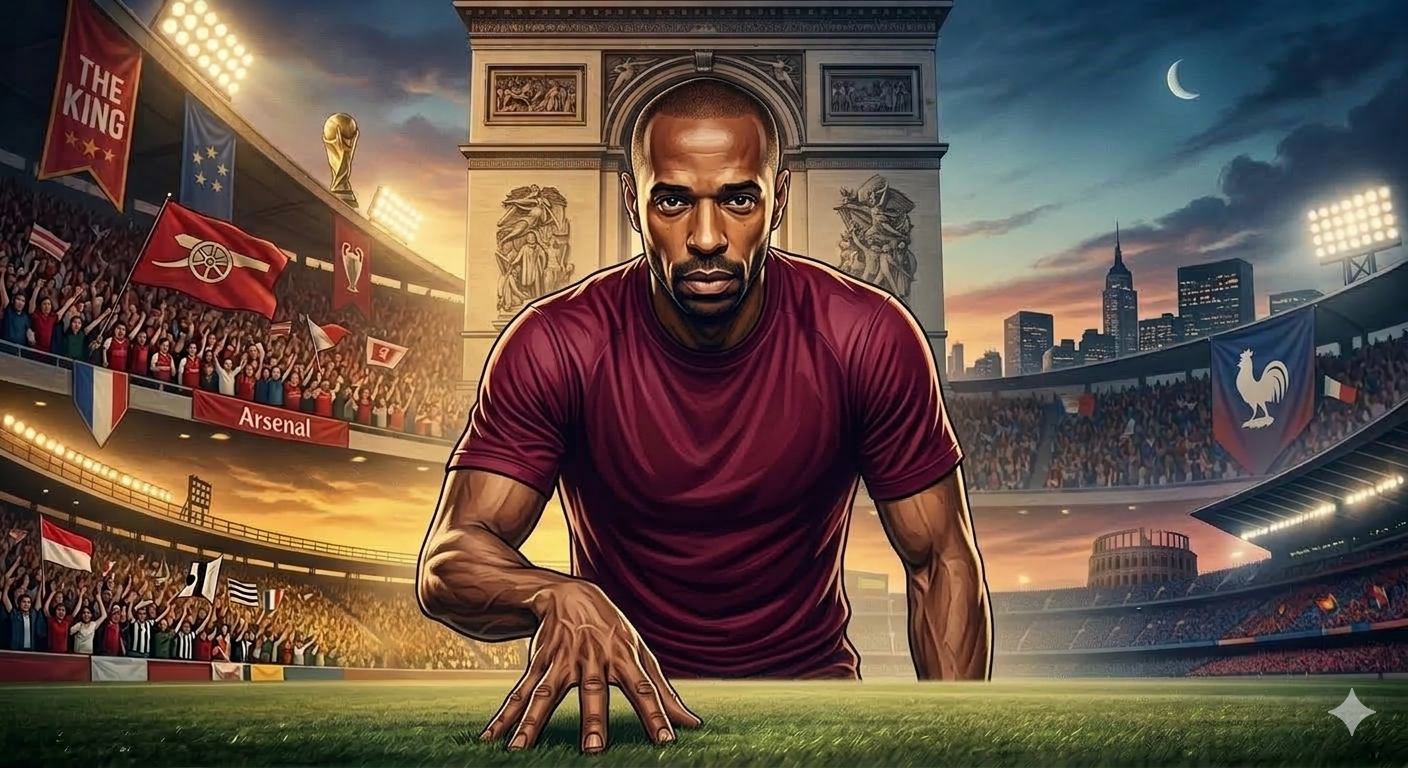
Some footballers are remembered for the number of goals they scored. Others for the trophies they lifted. A much smaller group is remembered for changing how the game is played. Thierry Henry belongs to that final category — over a 20-year career he scored 411 goals in 794 competitive appearances and became Arsenal's all-time record scorer with 228 goals, a number that still stands. He won the World Cup, the European Championship, the Champions League, two Premier League titlesand was not simply a finisher waiting in the box. He was a player who manipulated space, accelerated transitions and redefined what a forward could look like. In many ways, Henry was one of the first truly modern strikers — and the blueprint he created is still being copied two decades later.
Chapter I: Les Ulis — The Beginning
Thierry Daniel Henry was born on August 17, 1977, in Les Ulis, a commune in the Essonne department south of Paris. Like Ibrahimović's Rosengård, Les Ulis was a working-class suburb with a large immigrant community and football on every corner. Henry grew up playing in the streets and local pitches, developing the instinctive, free-flowing style that would define his career. His talent was spotted early — at thirteen he was admitted to the elite INF Clairefontaine academy, one of the most influential development systems in European football, where he trained alongside future internationals including Nicolas Anelka and William Gallas.
From Clairefontaine he joined AS Monaco as a youth player, signing professional forms and making his senior debut on August 31, 1994 — a 2–0 defeat to Nice — at just seventeen years old. His early manager at Monaco was a young Arsène Wenger, who deployed Henry primarily on the left wing, exploiting his pace and close control against full-backs. Wenger suspected that Henry's natural finishing instinct made him a striker in the making — but at Monaco, with a functioning attack already in place, the winger role came first.
The decision proved successful. Henry was named French Young Footballer of the Year in 1996, and in the 1996–97 season he contributed directly to Monaco winning the Ligue 1 title. In 1997–98, still only twenty, he helped Monaco reach the UEFA Champions League semi-final— scoring seven goals in the competition, a French record at the time. That performance alone would have secured his transfer to a major club. What came next accelerated the timeline considerably.
Chapter II: Juventus — The Detour That Defined Him
In January 1999, Juventus signed Henry for £10.5 million. It was, on paper, the natural next step — one of Europe's greatest clubs acquiring one of Europe's most exciting young forwards. In practice, it was the worst six months of his career. Juventus, under Carlo Ancelotti, deployed Henry in a system that offered him almost no freedom. He played wide, deep, and conservatively — the antithesis of everything that made him dangerous. In 16 appearances he scored just three goals. The club that had purchased him at the height of his powers had, in effect, switched him off.
The Juventus period is important not for what happened, but for what it provoked. Henry left Turin frustrated and, by his own admission, genuinely uncertain whether he would fulfil his early promise. When Arsène Wenger — now at Arsenal — offered him a route out in the summer of 1999, Henry accepted immediately. It was the most consequential transfer of his career, and one of the most consequential in Premier League history.
Chapter III: Arsenal — The Transformation
Wenger paid Juventus £11 million for Henry and immediately made a decision that changed everything: he would play as a striker. Not a winger. Not a wide forward. A central striker — though one who would be given the freedom to drift, create and attack space rather than simply occupy centre-backs. English football had never seen anything quite like it.
The Premier League of 1999 still favoured physically dominant centre-forwards — players who could hold the ball with their backs to goal, win headers and bring others into play. Henry was the opposite: fluid, mobile, explosive, and most dangerous when running at a defensive line rather than into it. He needed a few months to find his feet. By his second season, he was the best striker in England.
His tactical role at Arsenal was built on a single foundational idea: attack the space behind defenders, not in front of them. Henry would drift toward the left half-space, receive the ball facing goal, and either cut inside onto his right foot or accelerate to the byline. Defenders faced an impossible dilemma — show him outside and he would cross; show him inside and he would shoot. Either option was dangerous. The combination with Dennis Bergkamp — operating as a deep-lying forward, threading passes through the lines — became one of the most recognisable attacking partnerships in the history of the Premier League.
Career Statistics by Club
| Club | Country | Years | Apps | Goals | Notable |
|---|---|---|---|---|---|
| AS Monaco | France | 1994–1999 | 141 | 39 | 1× Ligue 1, UCL semi-final |
| Juventus | Italy | 1999 | 16 | 3 | — |
| Arsenal | England | 1999–2007 | 370 | 228 | 2× PL, 3× FA Cup, Invincibles |
| Barcelona | Spain | 2007–2010 | 121 | 49 | 1× Champions League, 2× La Liga |
| New York Red Bulls | USA | 2010–2014 | 135 | 52 | 1× MLS Supporters' Shield |
| Arsenal (loan) | England | 2012 | 8 | 5 | 2-month loan during MLS off-season |
All competitions included. Arsenal loan (2012) listed separately. Career total: 411 club goals + 51 international goals = 462 goals across all competitions.
Chapter IV: The Numbers Behind the Dominance
Henry's goal-scoring numbers during his Arsenal peak remain among the most remarkable in Premier League history. Between 2001 and 2006, he won the Premier League Golden Boot four times — an all-time record, now matched only by Mohamed Salah. He was the first player in history to win the European Golden Boot in consecutive seasons (2003–04 and 2004–05). But the raw numbers tell only part of the story.
| Season | PL Goals | PL Assists | All Comps Goals | Award |
|---|---|---|---|---|
| 1999–00 | 17 | 9 | 26 | — |
| 2000–01 | 17 | 10 | 22 | — |
| 2001–02 | 24 | 10 | 32 | PL Golden Boot |
| 2002–03 | 24 | 20 | 32 | PL Golden Boot · FWA Player of the Year |
| 2003–04 | 30 | 20 | 39 | PL Golden Boot · FWA · PFA Player of the Year · Invincibles |
| 2004–05 | 25 | 14 | 31 | PL Golden Boot · FWA Player of the Year · European Golden Boot ×2 |
| 2005–06 | 27 | 10 | 33 | FWA Player of the Year · Arsenal all-time top scorer |
| 2006–07 | 10 | 8 | 12 | — |
In 2002–03 and 2003–04, Henry recorded 20 assists in a single Premier League season — he remains the only player in the league's history to score at least 20 goals and register at least 20 assists in the same campaign.
What those numbers reveal is not just a scorer but a complete attacking footballer. In the 2002–03 season, Henry recorded 20 goals and 20 assists in the Premier League — a combination no player in the competition's history has replicated. He was simultaneously the primary finisher and the primary creator in Arsenal's attack. His 175 Premier League goals remain the most by any French player in the competition's history and the seventh-most of all time.
Chapter V: 2003–04 — The Invincibles Season
The 2003–04 Premier League season remains one of the most celebrated campaigns in English football history. Arsenal completed the entire league season unbeaten — 26 wins and 12 draws across 38 matches — finishing with 90 points and conceding just 26 goals. No team has gone unbeaten in the Premier League since. That team is remembered as The Invincibles.
Henry was the engine of it. His 30 league goalsled the division by a considerable margin. His movement was the reference point around which Arsenal's entire attack was organised — his constant drifting into the left channel forced opposing defences to make decisions they could not win. Follow him and leave space for Robert Pires to exploit. Hold position and allow Henry time on the ball facing goal. Neither option was comfortable, and no team found a consistent solution across an entire season.
Arsenal's unbeaten Premier League run during and after the Invincibles season — 38 games in 2003–04 plus 11 games across the preceding and following campaigns. Henry scored 30 league goals in that title-winning year alone. "He was the best player I have ever seen in the Premier League." — Dennis Bergkamp
Chapter VI: Real Madrid — The Goal That Stood Alone
If a single moment encapsulates what made Henry different from every other striker of his generation, it may be his goal against Real Madrid in the Champions League round of sixteen on February 21, 2006. With Arsenal needing to defend a 1–0 lead at the Bernabéu — one of the most hostile atmospheres in European football — Henry picked up the ball inside his own half, turned, and ran.
What followed was not a solo goal in the conventional sense. It was something closer to a geometric proof — a demonstration, conducted at pace and under pressure, of exactly how space could be created and exploited if a player understood the physics of a football pitch better than the defenders trying to stop him. He evaded three challenges, drew two more defenders out of position, and struck the ball past Iker Casillas with his left foot before the goalkeeper had time to set himself. The goal did not just win the tie. It confirmed Henry as the most complete attacker of his era.
Five Goals That Defined a Career
| Date | Match | Club | Description |
|---|---|---|---|
| Mar 2000 | Arsenal vs Spurs | Arsenal | Collecting a long ball on the left, accelerating past three defenders and finishing calmly — the goal that announced his Premier League arrival |
| Nov 2002 | Arsenal vs Tottenham | Arsenal | Picked up the ball on the halfway line, dribbled past five defenders over 60 yards and slotted into the far corner — voted the greatest north London derby goal ever |
| Feb 2006 | Real Madrid vs Arsenal | Arsenal | Solo run from inside his own half past three challenges; calmly finished left-footed past Casillas at the Bernabéu |
| Oct 2007 | Barcelona vs Villarreal | Barcelona | Controlled a chest-high pass and immediately volleyed into the top corner — Guardiola later said it was the best goal he witnessed as a manager |
| Jan 2012 | Arsenal vs Leeds (FA Cup) | Arsenal | Returning on loan after five years away, he came off the bench and scored the only goal — a moment of pure theatre from a player who had never truly left |
Chapter VII: Barcelona — Guardiola's Treble and Tactical Maturity
In the summer of 2007, Henry left Arsenal for Barcelonain a £16.1 million deal. The first season was difficult. Henry admitted publicly that he missed England and struggled to adapt to Barcelona's highly structured positional system. Under Frank Rijkaard, his role was ill-defined and his form inconsistent. He scored 19 goals — impressive by most standards — but clearly below his own.
Everything changed when Pep Guardiola took over in the summer of 2008. Guardiola reorganised Barcelona around three forwards — Henry on the left, Lionel Messi in the centre, Samuel Eto'o on the right — and demanded a level of positional discipline and collective pressing that Henry had never encountered at Arsenal. Rather than resist the constraint, he embraced it. The result was one of the most celebrated seasons in the history of club football.
In 2008–09, Henry scored 26 goals and contributed 10 assistsas Barcelona won La Liga, the Copa del Rey and the Champions League — the first treble in the club's history. Henry, Messi and Eto'o scored 100 goals between them that season. It was the culmination of a tactical evolution that had begun a decade earlier on the training pitches of Clairefontaine.
Chapter VIII: France — World Cup, Euro and 51 Goals
Henry's international career with France was as decorated as his club career. He earned his first cap in October 1997 and went on to win 123 international caps — the second-most by any French player in history at the time of his retirement.
His greatest international triumph came early. At the 1998 FIFA World Cup, played on home soil in France, Henry scored three goals as Les Bleus won the tournament for the first time — defeating Brazil 3–0 in the final. Two years later, he was part of the France squad that won UEFA Euro 2000, completing an extraordinary international double that only three nations — France, Germany and Spain — have ever achieved.
He finished his international career with 51 goals for France — a record he held until Olivier Giroud surpassed it in 2022, with Kylian Mbappé subsequently passing both. His record stood for more than fifteen years.
The Trophy Cabinet
| Trophy | Times | Details |
|---|---|---|
| Premier League | ×2 | Arsenal 2001–02, 2003–04 (Invincibles) |
| La Liga | ×2 | Barcelona 2008–09, 2009–10 |
| Ligue 1 | ×1 | AS Monaco 1996–97 |
| UEFA Champions League | ×1 | Barcelona 2008–09 |
| FA Cup | ×3 | Arsenal 2002, 2003, 2005 |
| Copa del Rey | ×1 | Barcelona 2008–09 |
| FIFA Club World Cup | ×1 | Barcelona 2009 |
| MLS Supporters' Shield | ×1 | New York Red Bulls 2013 |
| FIFA World Cup | ×1 | France 1998 |
| UEFA European Championship | ×1 | France 2000 |
| PL Golden Boot | ×4 | 2002, 2004, 2005, 2006 — all-time record (joint with Mohamed Salah) |
| European Golden Boot | ×2 | 2003–04, 2004–05 — first player to win in consecutive seasons |
| FWA Footballer of the Year | ×3 | 2003, 2004, 2006 |
| PFA Players' Player | ×2 | 2003, 2004 |
| France Footballer of Year | ×5 | 1999, 2000, 2003, 2004, 2005 |
Chapter IX: New York, The Loan Return and The Last Act
When Barcelona released Henry in 2010, he signed for New York Red Bulls in MLS. At 32, with Champions League medals and World Cup winners' medals, he could have commanded a final lucrative contract at any number of European clubs. Instead he chose New York — drawn, he said, by the city itself as much as the football.
What followed was four and a half seasons of consistent, intelligent football. Henry scored 52 goals in 135 appearancesfor the Red Bulls, became the club's all-time assist leaderwith 37, and helped them win the 2013 MLS Supporters' Shield. In January 2012, during the MLS off-season, he returned to Arsenal on a two-month loan — scoring five goals in eight appearances, including a late winner against Sunderland. The stadium sang his name as if he had never left.
Henry retired in December 2014 after 794 competitive matches and 462 goals across all competitions. He was 37 years old. Arsenal's record was still his. It still is.
Chapter X: The Legacy — Why Henry Still Matters
Henry's 175 Premier League goals are the seventh-most in the competition's history and the most by any French player. His 74 Premier League assists are the second-most ever recorded by a striker. He won the league's top scorer award four times. He went an entire season unbeaten. He broke every Arsenal goal-scoring record that existed.
Goals scored for Arsenal — a record that has stood since 2006 and shows no sign of being broken. The next-closest player in the club's history, Ian Wright, scored 185. "Va va voom." — Thierry Henry, 2003 Renault ad, accidentally coining a phrase that entered the English language.
But his most enduring legacy is not statistical. It is structural. Today's forwards — the modern number nines and false nines who drift wide, attack transitions, create for teammates and contribute to build-up play — resemble Henry far more than they resemble the traditional centre-forwards who preceded him. The role he performed at Arsenal between 1999 and 2007, largely without a template to follow, became the template itself.
Some players succeed within a tactical system. A few reshape it. Thierry Henry did both — and he did it with an elegance, an intelligence and a consistency that has not been matched at the same position since. He retired in 2014 as Arsenal's greatest ever goalscorer, France's greatest ever striker, and one of the most complete forwards the game has ever produced.
The statue outside the Emirates Stadium captures him in full stride, left arm raised, having just scored. It is the right image. Henry was always best when he was running — toward goal, toward space, toward the next thing no one else had thought of yet.