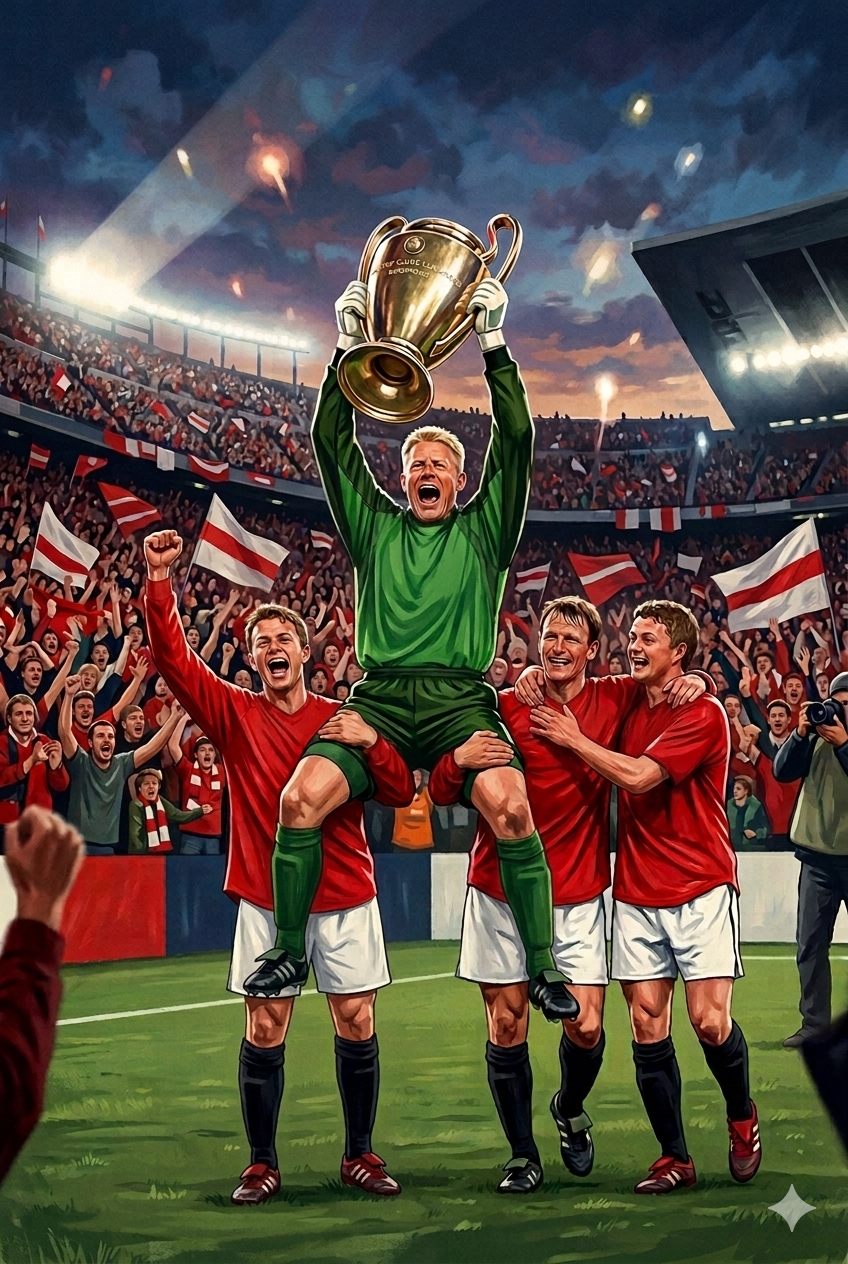
On May 26, 1999, at Camp Nou in Barcelona, Manchester United trailed Bayern Munich 1–0 with the clock showing 90 minutes and produced one of the most dramatic finales in the history of the competition. Their captain Roy Keane and midfielder Paul Scholes were watching from the stands, both suspended. Bayern had hit the post and the crossbar. The UEFA trophy was already being decorated with Bayern ribbons. Then, in the space of 102 seconds of injury time, United scored twice — through substitutes Teddy Sheringham and Ole Gunnar Solskjær — to win 2–1, complete the first English treble of the Premier League era, and produce what remains the most dramatic finale in the history of the competition. It was Peter Schmeichel's last match for the club. It was the night football ran out of words.
The Season That Built the Miracle
The 1998–99 season was not a procession. United had finished second to Arsenal the previous year and arrived at this campaign under pressure to respond. They lost the Charity Shield to Arsenal 3–0. They drew the Premier League opener against Leicester. They lost at home to Middlesbrough in December. Arsenal, the reigning double winners, were relentless competition. United led by 12 points at the start of March — then Arsenal won eight consecutive matches, cutting the gap to a single point going into the final day.
On the last day of the Premier League season, United trailed Tottenham 1–0 at Old Trafford — a result that would have handed the title to Arsenal. Andy Cole equalised, then Sheringham scored the winner. United won the title by a single point. A pattern — trailing, recovering, winning in the final minutes — had defined the entire campaign. It would define the final too.
Four days before Barcelona, United had beaten Newcastle 2–0in the FA Cup final at Wembley, with Sheringham and Scholes scoring. Keane was booked in the match, picking up the suspension that would rule him out of the Champions League final. Scholes was also suspended, having been booked twice in the Champions League campaign. The two most important players in United's midfield would watch from seats behind glass at Camp Nou while their teammates played the most important match in the club's modern history.
The Road to Camp Nou
| Round | Opponent | Agg. | Key moment |
|---|---|---|---|
| Group stage | Barcelona (H+A) | 3–3 / 3–3 | Two draws — United qualified as group runners-up |
| Group stage | Bayern Munich (H) | 1–1 | Keane goal; Salihamidžić equalised. Both clubs advanced. |
| Group stage | Brøndby (A+H) | 6–2 / 5–0 | Dominant wins — United's attacking depth on display |
| Quarter-final | Internazionale | 2–0 agg. | Yorke brace at Old Trafford sealed a controlled two-leg win |
| Semi-final | Juventus (A) | 3–2 agg. | Inzaghi 2 goals in 11 mins — then Keane, Yorke, Cole comeback |
The Juventus semi-final was the defining match before the final itself. Filippo Inzaghi scored twice in the first 11 minutes in Turin. Keane equalised, Yorke added a second, Cole scored the winner with seven minutes left. Keane was booked — ruling him out of the final.
Roy Keane: The Man Who Won the Final He Never Played
No account of United's 1999 triumph is complete without understanding Roy Keane's role — not in the final, but in making it possible. In Turin, trailing 2–0, Keane scored the first goal and then drove his teammates forward relentlessly across what Ferguson later described as the finest individual display he ever witnessed in 27 years at Old Trafford. United scored twice more to win 3–2 on the night and advance to the final.
He knew, in picking up a booking during that performance, that he would not play in the final. He celebrated the qualification with his teammates and then — by his own description — put the personal disappointment aside and spent the next two weeks ensuring the squad was mentally ready for Barcelona. In the dressing room before the final, Keane was among those speaking. His contribution to the 1999 treble remains one of the most celebrated examples of selfless leadership in European football history.
The Starting Line-Ups
| Man United (4–4–2) | Bayern Munich (3–4–2–1) |
|---|---|
| Peter Schmeichel ★ (capt) | Oliver Kahn (capt) |
| Gary Neville | Markus Babbel |
| Ronny Johnsen | Thomas Linke |
| Jaap Stam | Samuel Kuffour |
| Denis Irwin | Michael Tarnat |
| David Beckham | Stefan Effenberg |
| Nicky Butt | Jens Jeremies |
| Ryan Giggs | Lothar Matthäus |
| Jesper Blomqvist | Mario Basler |
| Dwight Yorke | Carsten Jancker |
| Andy Cole | Giovane Élber |
Keane and Scholes absent through suspension. Schmeichel captained United in Keane's absence — his final match for the club. Sheringham and Solskjær started on the bench. Subs used: Sheringham (67′ for Blomqvist), Solskjær (81′ for Cole). Bayern subs: Mehmet Scholl (58′ for Basler), Hasan Salihamidžić (71′ for Matthäus), Thorsten Fink (88′ for Jeremies).
The Match: 84 Minutes of Pain
From the sixth minute, United faced a mountain. Ronny Johnsenfouled Carsten Jancker just outside the area, and Mario Baslerplaced a low free kick around the United wall, swerving it into the bottom corner past Schmeichel. Bayern 1–0 United.
What followed was 84 minutes of near-constant Bayern control. Without Keane and Scholes, United's midfield lacked its usual authority. Beckham was man-marked by Jens Jeremies throughout. Cole and Yorke — who had scored 53 goals between themacross all competitions that season — were isolated and starved of service. United had chances, but Bayern were the more dangerous side. In the second half, Mehmet Scholl chipped Schmeichel and watched the ball bounce back off the post. Minutes later, Carsten Janckerattempted an overhead kick that struck the crossbar. Had either gone in, the match was over.
Ferguson made his first substitution in the 67th minute, sending on Sheringham for Blomqvist to add a more direct option in attack. Then, with nine minutes remaining, Solskjærreplaced Cole. Both of United's substitutes — the two players who would score the goals — were now on the pitch. In the stands, Keane and Scholes watched.
Sheringham. Then Solskjær. Two corners. Two goals. 102 seconds that changed everything. The UEFA trophy ribbons had already been switched to Bayern's colours. The Bayern players had already begun to celebrate. "And Solskjær has won it!"
102 Seconds That Rewrote History
In the 91st minute, United won a corner. Beckham delivered to the near post. The ball was partially cleared but fell to Giggs, whose scuffed shot was turned in from close range by Sheringham. 1–1. Bayern's players stood motionless. The United bench erupted.
The momentum was now entirely with United. Ninety seconds later, another corner. Beckham again. Sheringham flicked the ball on at the near post — and Solskjær, arriving at the far post, stabbed it into the roof of the net with his right instep. 2–1. Solskjær wheeled away, arms out, barely able to process what had just happened. Bayern's Samuel Kuffour sank to his knees and punched the turf repeatedly. The referee, Pierluigi Collina, blew for full time moments later.
Match Statistics
| Man United | Stat | Bayern Munich |
|---|---|---|
| 2 | Final Score | 1 |
| Sheringham 90+1, Solskjær 90+3 | Goals | Basler 6′ |
| 45% | Possession | 55% |
| 8 | Total Shots | 11 |
| 5 | Shots on Target | 6 |
| Sir Alex Ferguson | Manager | Ottmar Hitzfeld |
The Treble — Three Trophies, One Season
United's win in Barcelona completed a treble that had never been achieved by an English club — making United the first English side to be crowned European champions since the Heysel ban ended in 1990. It has only been matched once since — by Manchester City in 2022–23. The three trophies were won across 26 days: the Premier Leagueon May 16, the FA Cup on May 22, and the Champions League on May 26. Across all competitions, United went on a remarkable 33-match unbeaten run from December 26 all the way to the end of the campaign.
Ferguson was knighted in the subsequent honours list. Beckham finished runner-up to Rivaldo for the Ballon d'Or and was named UEFA Club Footballer of the Year. Schmeichel, in his final appearance for the club he had served for eight years, lifted the European Cup as captain. Keane — watching from the stands as his teammates celebrated — did not lift the trophy that night, despite being enshrined in the National Football Museum Hall of Fame for his role in making the treble possible. He had done more to win it than almost anyone on the pitch.
More than two decades later, the images from Camp Nou — Schmeichel cartwheeling on the pitch, Kuffour on his knees, Solskjær's outstretched arms — remain among the most reproduced in football history. The 1999 Champions League final is not simply remembered as a dramatic result. It is remembered as the defining proof of what Ferguson's United stood for: that no match was over, no lead was safe, and no moment was too late to produce something extraordinary.