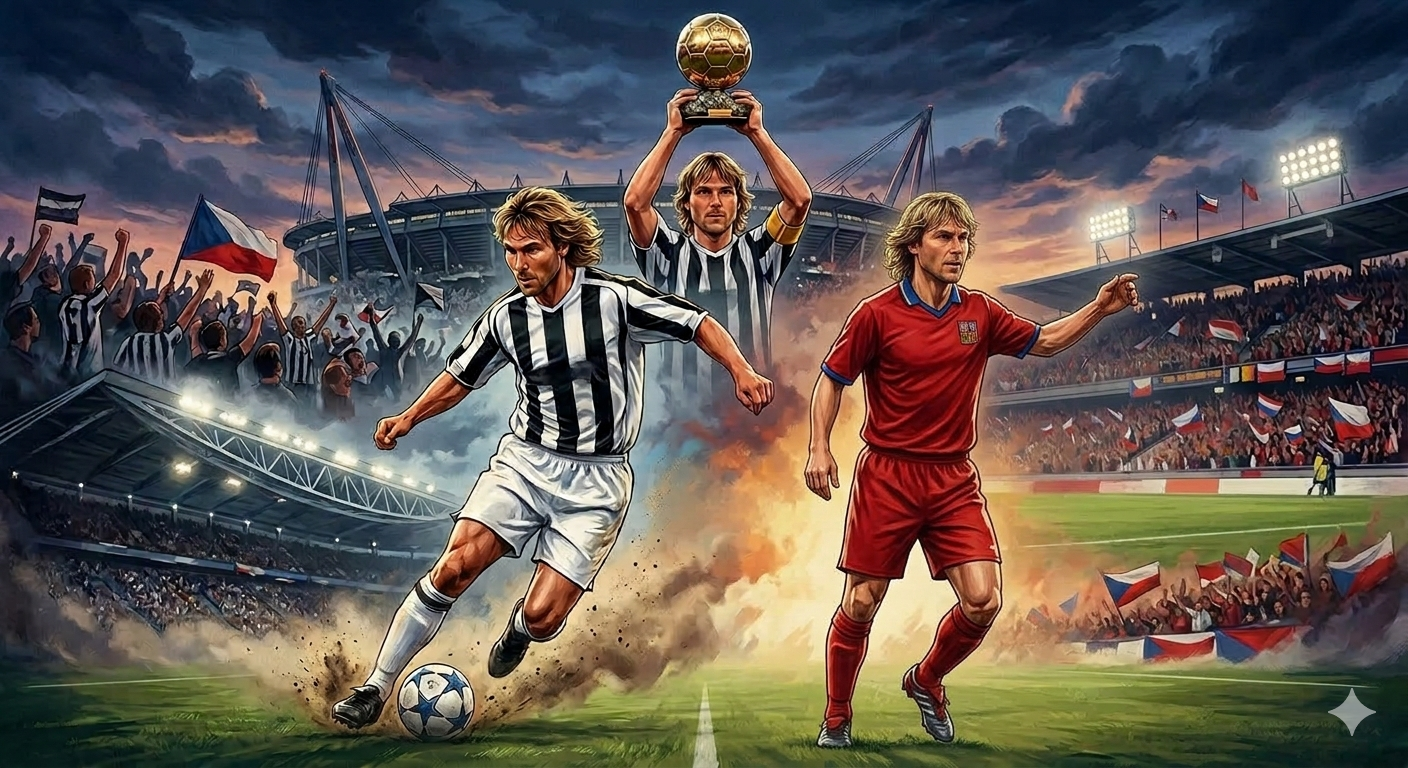
In May 2003, Pavel Nedvěd scored one of the great Champions League semi-final goals, picked up a yellow card moments later, and earned the right to watch the final he had almost single-handedly created from the stands. That image — a player magnificent enough to win the Ballon d'Or and yet denied the stage his season deserved — captures something essential about his career. Pavel Nedvěd played 501 league matches across his career, scored 110 league goals, won 91 caps for Czech Republic and Czechoslovakia, and became the only Czech player in history to win the Ballon d'Or — an honour he collected in 2003, beating Thierry Henry and Paolo Maldini. He was nicknamed Furia Ceca — Czech Fury — by Italian fans. The name was accurate. He played every minute of every match as though it was the last match he would ever play.
Chapter I: Skalná — A Child of the Revolution
Pavel Nedvěd was born on August 30, 1972, in Cheb, a town in what was then Czechoslovakia, close to the West German border. He grew up in the nearby village of Skalná — a place so small, so far from the centres of football power, that his eventual arrival at Juventus as the replacement for Zinedine Zidane reads almost as fiction. The Velvet Revolution of 1989, which ended Communist rule in Czechoslovakia, was the defining event of his adolescence. He was seventeen years old when it began. Within three years he was a professional footballer.
He joined Sparta Prague in 1992, winning three consecutive Czech league titles between 1993 and 1995 — the first three seasons of the newly independent Czech Republic's league, formed after the dissolution of Czechoslovakia. His performances for Sparta, and more significantly for the Czech national team at UEFA Euro 1996, brought him to the attention of the biggest clubs in Europe. At those finals in England, Nedvěd was one of the outstanding players of the tournament. He scored the opening goal against Italy in the group stage, drove his unfancied nation to the final, and was identified immediately as a player who could succeed at the highest level. Lazio moved first.
Chapter II: Lazio — The Foundation Years in Rome
Nedvěd joined Lazio in the summer of 1996 for approximately €4 million. He was 23 years old and had never played outside Czechoslovakia. What followed was five seasons of sustained excellence in one of the most demanding leagues in the world, and a trophy haul that would define Lazio's most successful era in the modern game.
At Lazio, under coaches Sven-Göran Eriksson and later Dino Zoff, Nedvěd developed from a winger with exceptional energy into a complete attacking midfielder — one capable of operating centrally, switching flanks, contributing defensively, and scoring regularly from range. Eriksson called him a "totally complete" midfielder; the assessment was not hyperbole. In five seasons at the Olimpico, Nedvěd contributed to a Serie A title, two Coppa Italia trophies, the UEFA Cup Winners' Cup and the UEFA Super Cup. In the 1999 Cup Winners' Cup final against Mallorca, he scored the decisive goal that completed Lazio's European triumph — the last competitive match ever played in that competition, which was discontinued after that edition.
Despite signing a new four-year contract with Lazio in April 2001, the club's deteriorating financial position — the result of the spectacular collapse of the Cragnotti business empire — forced them to sell their most valuable assets. Nedvěd and Juan Sebastián Verón were sold against fan protests in the summer of 2001. Nedvěd's destination: Juventus, for €38.7 million. His replacement there: Zinedine Zidane had just left for Real Madrid. Nedvěd arrived to fill the vacancy. The pressure was not subtle.
Career Statistics by Club
| Club | Country | Years | Apps | Goals | Notable |
|---|---|---|---|---|---|
| Sparta Prague | Czech Republic | 1992–1996 | 117 | 26 | 3× Czech Liga titles; Euro 1996 breakthrough |
| Lazio | Italy | 1996–2001 | 196 | 43 | 1× Serie A, 2× Coppa Italia, 1× Cup Winners' Cup, 1× UEFA Super Cup |
| Juventus | Italy | 2001–2009 | 327 | 65 | 2× Serie A, 1× Coppa Italia, Ballon d'Or 2003; most appearances by a non-Italian in club history |
All competitions included. Career club total: 640 appearances, 134 goals. International record: 18 goals in 91 caps for Czech Republic (and Czechoslovakia). Juventus total of 327 appearances is the most by any non-Italian player in the club's history as of 2024.
Chapter III: Juventus — Replacing Zidane
No transfer instruction could be more loaded. When Juventus sold Zidane to Real Madrid for a world-record fee in the summer of 2001, they spent €38.7 million of those proceeds on Nedvěd. The press framed it as replacement surgery; the player himself understood it in the same terms. In his first season, operating primarily from the left flank, he was industrious and effective — helping Juventus win Serie A— but clearly still adapting to a system built around different strengths. Coach Marcello Lippi identified the adjustment Nedvěd needed: a more central role, deeper access to the game, freedom to carry the ball through the congested central areas that defined Italian football's most demanding encounters.
The shift was applied in 2002–03. The results were immediate and historic. Nedvěd finished the season with 10 Serie A goals and 10 assists, scored in the Champions League quarter-finals against Barcelona and both legs of the semi-final against Real Madrid, and was named the Serie A Footballer of the Year. Juventus won the Scudetto and reached the Champions League final. At the end of the year, Nedvěd was awarded the Ballon d'Or.
Chapter IV: The Numbers Behind the Season
The 2002–03 season remains the benchmark for Nedvěd's output and influence, but his consistency across the full Juventus period is equally significant. Across his entire Juventus career, Nedvěd made 327 appearances and scored 65 goals — the most appearances by any non-Italian player in the club's history, and a goal return remarkable for a midfielder who spent significant portions of his career on the flank.
| Season | Club | Serie A Goals | Serie A Assists | All Comps Goals | Award |
|---|---|---|---|---|---|
| 2001–02 | Juventus | 7 | 8 | 11 | Serie A title; Zidane role established |
| 2002–03 | Juventus | 10 | 10 | 17 | Ballon d'Or · Serie A Footballer of the Year · UCL finalist (missed through suspension) |
| 2003–04 | Juventus | 7 | 9 | 13 | Serie A title (later stripped) · UEFA Team of the Year |
| 2004–05 | Juventus | 9 | 7 | 14 | Serie A title (later stripped) · UEFA Team of the Year · Euro 2004 Team of the Tournament |
| 2005–06 | Juventus | 6 | 5 | 10 | Relegated with Juventus after Calciopoli; chose to stay |
| 2007–08 | Juventus | 5 | 6 | 8 | Returned from one-year absence; Serie B promotion complete |
| 2008–09 | Juventus | 3 | 4 | 5 | Final season; retired at 36; most apps by non-Italian in club history |
Serie A stats. Note: 2003–04 and 2004–05 Serie A titles were retrospectively stripped from Juventus as a consequence of the Calciopoli match-fixing scandal in 2006. Nedvěd's individual honours were unaffected.
Five Goals That Defined a Career
| Date | Match | Club | Description |
|---|---|---|---|
| Jun 1996 | Czech Republic vs Italy (Euro 1996) | Czech Republic | His first international goal of note — opening the scoring against Italy in the Euro 1996 group stage and announcing to European football that something unusual had emerged from the east. The Czechs went on to reach the final. |
| May 1999 | Lazio vs Mallorca (Cup Winners' Cup Final) | Lazio | The goal that won Lazio their only European trophy — and the last goal ever scored in the UEFA Cup Winners' Cup, which was discontinued after that edition. Nedvěd scored the decisive second in a 2–1 win. The competition ended with him. |
| Apr 2003 | Juventus vs Barcelona (UCL QF) | Juventus | Scored in both legs of the quarter-final to eliminate Barcelona — the round that established Juventus as genuine contenders for the 2003 Champions League and confirmed Nedvěd as the decisive player in the tournament. |
| May 2003 | Juventus vs Real Madrid (UCL SF) | Juventus | The defining goal and the defining tragedy: a Zambrotta pass, a first-time finish past Casillas, a yellow card moments later for a needless foul — and a suspension that kept him out of the final he had made possible. He watched it from the stand. |
| Feb 2008 | Juventus vs Napoli (Serie B) | Juventus | Scored in Serie B after choosing to stay with Juventus through their relegation — a decision that said more about his loyalty than any statement could. He could have left for any club in Europe. He stayed and helped them back up. |
Chapter V: The Semi-Final and the Suspension
The story of the 2003 Champions League semi-final second leg is one of the most bittersweet in the competition's history. Juventus hosted Real Madrid at the Delle Alpi needing to overturn a 2–1 first-leg deficit. Nedvěd had already scored in the away leg at the Bernabéu. Now, in front of his own supporters, he produced the defining performance of his career. Nedvěd received a pass from Gianluca Zambrotta and finished first-time past Iker Casillas — a goal UEFA described as his "perfect finish" — to complete Juventus's 3–1 win and send them to the final at Old Trafford.
Then, with the tie secured and the match in its final minutes, he committed a needless foul, collected a yellow card — his second of the tournament — and earned an automatic one-match suspension. The match that suspension covered was the Champions League final. Juventus lost it on penalties to AC Milan. Nedvěd watched from the stands, in his suit, while his teammates played without him. His captain, Alessandro Del Piero, said afterwards: "It is impossible to deny how important he is for us. We are sorry he has to sit out a final like this."
The year Nedvěd won the Ballon d'Or — scoring the goal that sent Juventus to the Champions League final, then watching that final from the stands after a yellow card ended his tournament. He beat Thierry Henry and Paolo Maldini to the award. He remains, to this day, the only Czech player to have won it. "For me, Thierry Henry is the best forward in the world now. I am very happy. I did not think I would beat Thierry Henry, Paolo Maldini or Zinedine Zidane." — Pavel Nedvěd, on receiving the 2003 Ballon d'Or
Chapter VI: The Ballon d'Or — Only Czech, Ever
At the Ballon d'Or ceremony in December 2003, Nedvěd became the only Czech player ever to win the award — seeing off the challenges of Thierry Henry, who had just completed one of the most remarkable individual Premier League seasons in history, and Paolo Maldini, who had been outstanding in Milan's Champions League final victory against Juventus. The vote was tight and controversial. Henry's supporters argued that his 32 goals and 25 assists for Arsenal in all competitions — in a season where he became the first player ever to score and assist 20 or more times in a single Premier League campaign — represented a stronger individual case.
Nedvěd's own response to the award became, in its way, as memorable as the award itself. Rather than claim victory, he expressed genuine surprise and deferred immediately to his rival. The humility was characteristic: throughout his career at Juventus, where he was the most decorated and celebrated foreign player in the club's history, Nedvěd carried himself without the ego that might have been expected given what he had achieved. Goal.com's retrospective ranking of every 21st-century Ballon d'Or winner notes that Nedvěd's triumph remains among the most contested of the era, with Henry producing an arguably superior individual campaign — though Nedvěd's Champions League run and Juventus's Serie A title carried decisive weight with voters.
Chapter VII: Czech Republic — From Revolution to Wembley
Nedvěd's international career spanned three distinct chapters: the final years of Czechoslovakia, the early seasons of an independent Czech Republic, and the tournament campaigns that made him his country's most celebrated player. He earned his first cap for Czechoslovakia in 1994 and went on to represent the Czech Republic in 91 matches, scoring 18 goals.
The high point came early. At UEFA Euro 1996 in England, the Czech Republic — a nation competing in its first major finals as an independent state — reached the final at Wembley, where they lost 2–1 to Germany after a golden goal from Oliver Bierhoff. Nedvěd was one of their key players throughout, scoring against Italy in the group stage and driving the team's unlikely run. The tournament launched him into the consciousness of the major European clubs; Lazio signed him that same summer.
Eight years later, he captained the Czech Republic to the semi-finals of Euro 2004 in Portugal, where they were beaten 1–0 by eventual champions Greece. Despite the defeat, Nedvěd was named in the UEFA Team of the Tournament — recognition that, even at 31, he remained among the best midfielders on the continent. He helped the Czech Republic qualify for the 2006 World Cup, their first as an independent nation, though the tournament itself proved disappointing: eliminated in the group stage.
The Trophy Cabinet
| Trophy | Times | Details |
|---|---|---|
| Serie A | ×2 | Juventus 2001–02, 2002–03 (2003–04 and 2004–05 titles stripped by Calciopoli) |
| Czech Liga | ×3 | Sparta Prague 1992–93, 1993–94, 1994–95 |
| Coppa Italia | ×3 | Lazio 1997–98, 1999–00; Juventus 2003–04 |
| UEFA Cup Winners' Cup | ×1 | Lazio 1998–99 — scored decisive goal in the final; last edition of the competition |
| UEFA Super Cup | ×1 | Lazio 1999 — beat Manchester United |
| Supercoppa Italiana | ×2 | Lazio 1998, 2000 |
| Ballon d'Or | ×1 | 2003 — only Czech player to win the award in history |
| UEFA Team of the Year | ×3 | 2003, 2004, 2005 |
| Serie A Footballer of the Year | ×1 | 2002–03 |
| Czech Footballer of the Year | ×4 | 1996, 2002, 2003, 2004 |
| UEFA Euro Team of the Tournament | ×1 | Euro 2004 |
| FIFA 100 | ×1 | Named by Pelé as one of the 125 greatest living footballers (2004) |
| Golden Foot | ×1 | 2004 — second recipient of the award |
Chapter VIII: Calciopoli — The Loyalty Test
In May 2006, Italian football was torn apart by the Calciopoli scandal — a match-fixing investigation that implicated Juventus and several other Serie A clubs in attempts to influence referee appointments. Juventus were relegated to Serie B, stripped of their two most recent Serie A titles, and effectively forced to rebuild from the bottom. Their most valuable players — including Zlatan Ibrahimović, Patrick Vieira and others — left immediately.
Nedvěd stayed. He was 33 years old, held the Ballon d'Or, and could have commanded a substantial transfer fee from any club in Europe. He chose instead to sign a new contract with a club playing in the second division of Italian football. His reasoning was simple: Juventus had given him everything. He would give them this. He played in Serie B in 2006–07, helping the club win promotion at the first attempt, and returned to Serie A for two final seasons before retiring in 2009 at the age of 36.
Appearances for Juventus — the most by any non-Italian player in the club's history. Nedvěd made those appearances across eight seasons, including one in Serie B. He never left. "He played with both feet, and he always gave everything in every game." — Davide Zappacosta, on why Nedvěd was his idol growing up
Chapter IX: The Legacy — The Last of the European Midfield Gods
Nedvěd retired in 2009 as the most-capped non-Italian player in Juventus's history and the only Czech player to ever win the Ballon d'Or. He was named by Pelé in the FIFA 100 — a list of the 125 greatest living players, compiled in 2004 — and placed in the UEFA Team of the Year in 2003, 2004 and 2005. After retirement, he served as Juventus's Vice President until 2023, becoming one of the most influential figures in the club's modern administration.
His playing legacy sits within a specific tradition: the central European midfielder who achieves everything through relentlessness. Where Zidane operated with grace and Kaká with elegance, Nedvěd operated with fury — the constant pressing, the long-range shots struck without hesitation, the complete defensive contribution that no forward-playing midfielder of his generation matched. Italian fans did not give the nickname Furia Cecaironically. They gave it because it was exact.
The year he won the Ballon d'Or, he also watched the final he had made possible from a seat in the stands. It is, in its way, the perfect symbol of a career that was never about the individual moment — it was about the accumulated weight of everything that came before it. Nedvěd gave Juventus 327 appearances and eight years. He gave the Czech Republic ninety-one caps. He gave every match the same thing: everything he had, from the first minute to the last, regardless of the occasion or the consequence. The yellow card in Turin was not a mistake. It was entirely in character.